Basic wardrobe: which basics every woman needs and what they cost
Which basics every woman needs: ten pieces with material and use, what a basic wardrobe costs and when quality pays off per wear.
In this article8
- Which basics should every woman have?
- Which 10 clothing items should every woman have in her wardrobe?
- What does a good basic wardrobe cost?
- Is quality worth it? Cost per wear in a worked example
- How much clothing does a woman really need?
- Checklist: review your own basic wardrobe
- Frequently asked questions
- Sources
Which basics every woman needs depends less on a fixed list than on what you wear on most days. Basics are pieces that go with many others, stay wearable for several years and can be styled for the office, the weekend and the evening. The basic wardrobe below is an editorial guide with ten pieces and open cost assumptions, not a shopping list. How to build a full wardrobe for one season from it is explained in Building a Capsule Wardrobe: which pieces you really need.
Which basics should every woman have?
Every woman should have basics that meet three conditions: they go with at least three other pieces in the wardrobe, they fit well, and they survive many washes. Whether a piece belongs is therefore decided not by a trend but by how often you would actually wear it. If you wear trousers at the office, good tailored trousers matter more than a second dress.
There are signs of durability you can check in the shop. Germany's Federal Environment Agency (UBA) advises paying attention to the thickness of the fabric and to how firmly seams, buttons and zips are made.[1] Fit matters just as much: a piece that does not sit well at the shoulders or waistband stays in the wardrobe, however well it is made. If you are between two sizes, Converting clothing sizes: EU, UK, US, IT and FR helps.
For colours, neutral shades such as white, grey, navy, beige or black carry the base, because almost everything goes with them. Coloured pieces and patterns come later and then remain easy to combine.
Which 10 clothing items should every woman have in her wardrobe?
Ten garments form the base of most wardrobes. On top they are a T-shirt, a long-sleeved top or fine jumper, a blouse and a knit jumper; below, jeans, tailored trousers and a dress or skirt; over them, a blazer, a transitional jacket and a coat. The table gives a proven material and the everyday use for each piece.
| Piece | Material | Use |
|---|---|---|
| T-shirt in white or grey | cotton jersey | on its own, under a blazer or cardigan |
| Long-sleeved top or fine jumper | cotton or merino wool | office, under a dress or blazer |
| Blouse or shirt blouse | cotton or viscose | office, evening, with jeans |
| Knit jumper or cardigan | wool or wool blend | cool days, as a layer at the office |
| Dark jeans | cotton denim | almost any occasion except very formal ones |
| Straight-leg tailored trousers | wool or blended fabric | office, with a blouse or jumper |
| Midi dress or skirt | jersey or wool | office, celebrations, with tights into winter |
| Blazer | wool or blended fabric | office, dinner, over a top or dress |
| Transitional jacket or trench coat | coated cotton | rain and wind in spring and autumn |
| Coat | wool or wool blend | cold months, over a blazer or jumper |
The ten pieces come with two pairs of shoes that go with almost everything, such as plain sneakers and ankle boots. What matters there is set out in Everyday sneakers 2026: what matters in fit and materials and, for the cold months, Winter boots that really keep you warm. Wool jumpers form pills over time, which can be removed gently; Removing pilling: what works on wool and blended fabrics shows how.
What does a good basic wardrobe cost?
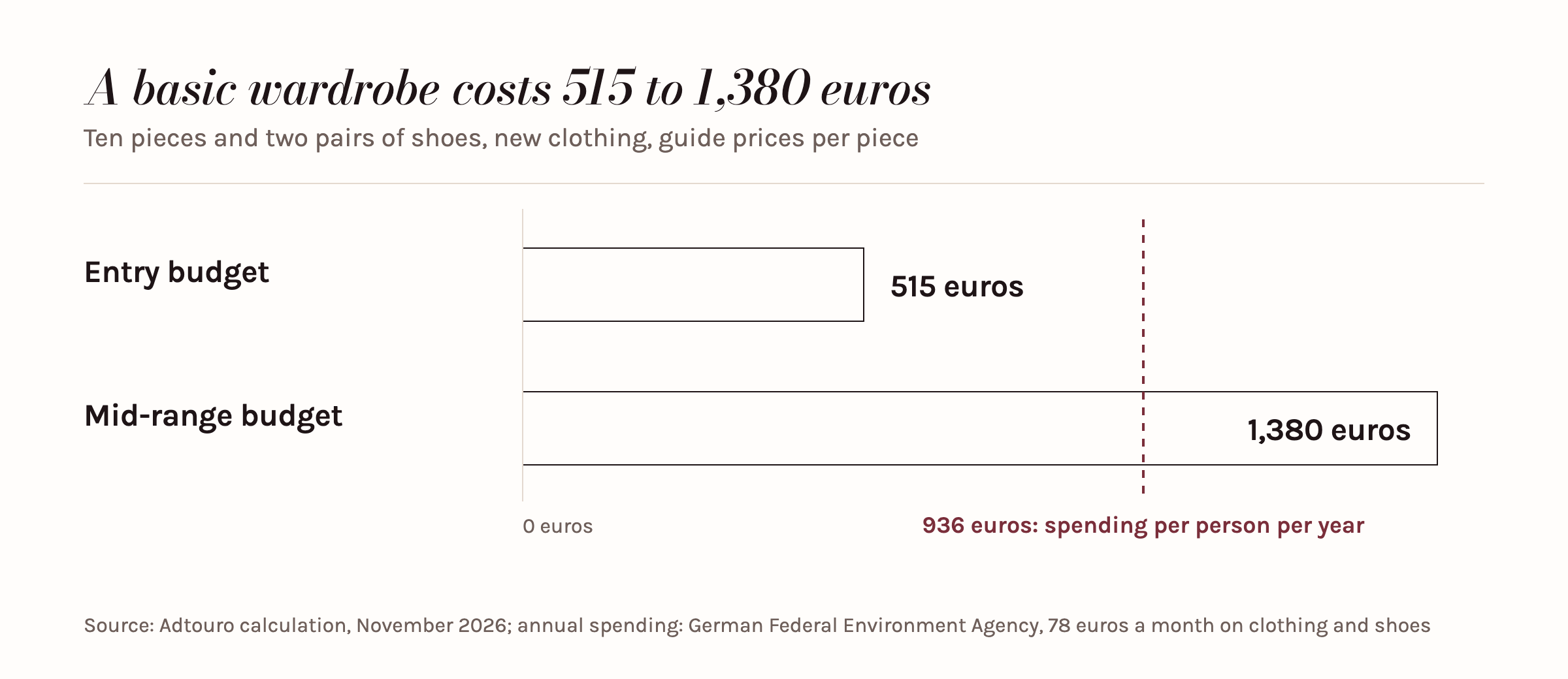
A good basic wardrobe of ten garments and two pairs of shoes costs, on the assumptions of this calculation, about 515 euros on an entry budget and about 1,380 euros on a mid-range budget. The prices are guide values per piece, not surveyed market prices, and apply to new clothing. If you buy some pieces second-hand or already own them, you will spend considerably less.
| Piece | Entry budget | Mid-range budget |
|---|---|---|
| T-shirt | 10 euros | 30 euros |
| Long-sleeved top or fine jumper | 25 euros | 70 euros |
| Blouse | 25 euros | 60 euros |
| Knit jumper or cardigan | 35 euros | 100 euros |
| Dark jeans | 40 euros | 100 euros |
| Tailored trousers | 35 euros | 90 euros |
| Dress or skirt | 35 euros | 90 euros |
| Blazer | 50 euros | 150 euros |
| Transitional jacket | 60 euros | 150 euros |
| Coat | 100 euros | 300 euros |
| Two pairs of shoes | 100 euros | 240 euros |
| Total | 515 euros | 1,380 euros |
Everyday spending helps put these basic wardrobe costs in context. According to the UBA, people in Germany spend an average of 78 euros per person per month on clothing and shoes, which is 936 euros a year.[1] The entry version therefore equals almost seven monthly budgets, the mid-range one almost 18. In practice, a basic wardrobe builds up over one to two years rather than in a single shopping trip.
If you sort out pieces to make room for the basics, clothes in good condition can be sold; fees and buyer protection are compared in Vinted or Kleinanzeigen: fees and protection when selling.
Is quality worth it? Cost per wear in a worked example
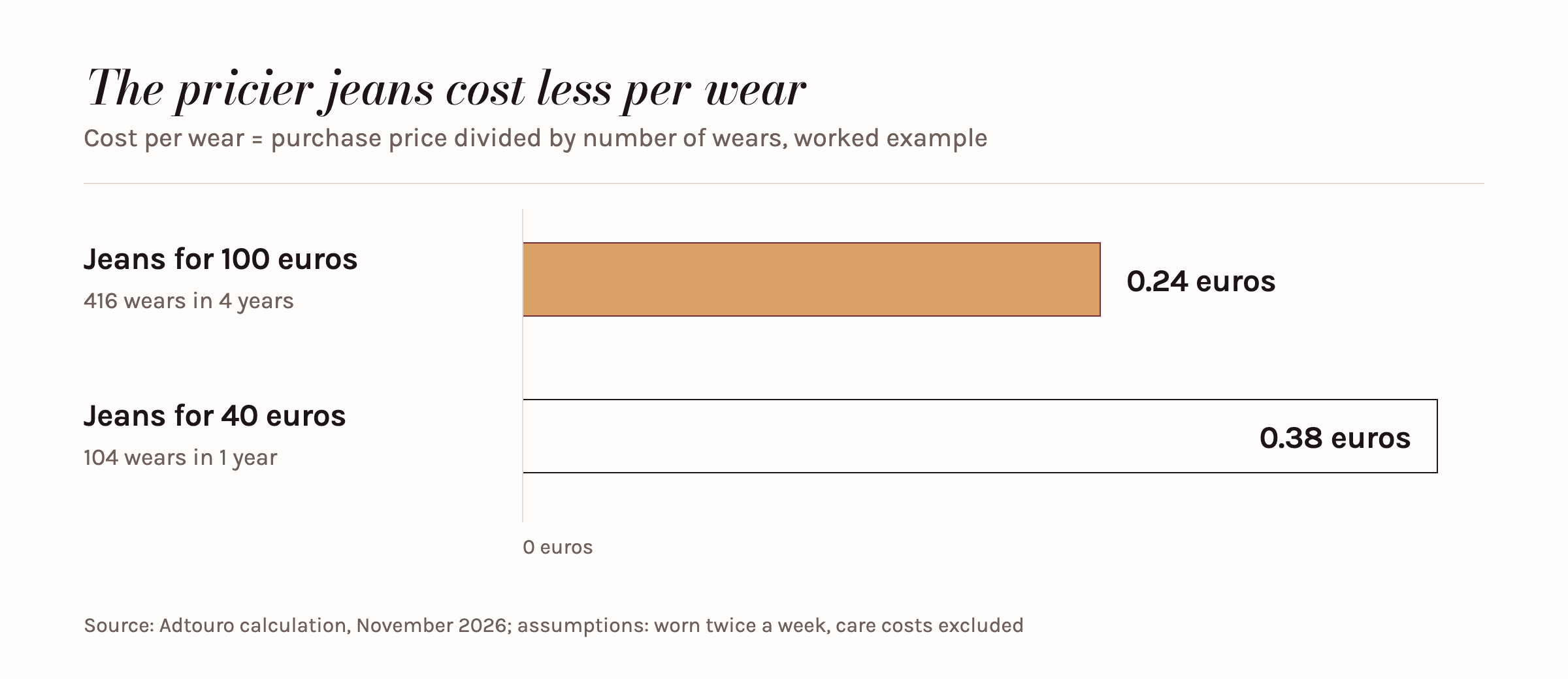
Quality is worth it when a piece lasts longer in proportion than it costs more. You can measure this with the cost per wear: the purchase price divided by the number of days you wear the piece. The example is based on assumptions; with your own figures the result may be quite different.
| Assumption | Jeans for 40 euros | Jeans for 100 euros |
|---|---|---|
| Wears per week | 2 | 2 |
| Lifespan | 1 year | 4 years |
| Total wears | 104 | 416 |
| Cost per wear | about 38 cents | about 24 cents |
The more expensive jeans cost two and a half times as much but, on this assumption, are worn four times as often. That is why they are cheaper per wear. If the cheaper jeans last just as long, the result is reversed.
A high price does not guarantee that longer life, though. The French consumer magazine Que Choisir washed and tested 22 black cotton T-shirts several times; Stiftung Warentest, Germany's consumer testing foundation, summarised the results in November 2025.[2] The two best shirts cost about 50 euros each, but one rated good cost only 4 euros. So check fabric, seams and fit before price decides.
How much clothing does a woman really need?
How much clothing a woman really needs depends on daily routine, job and washing rhythm; there is no fixed number. The ten basics plus shoes cover most days. For a whole season, the capsule wardrobe guide works with 25 to 40 pieces. A selection for the current season is shown in Autumn capsule wardrobe 2026: 30 pieces, colours and costs.
In fact, many wardrobes hold a lot more. In a representative Greenpeace survey from 2015 of 1,011 people in Germany aged 18 to 69, women owned an average of 118 garments and men 73, in each case excluding underwear and socks.[3] One in five garments was hardly ever worn. Including the rarely worn pieces, the share was almost 40 percent.
More pieces do not mean more choice day to day. The UBA recommends getting an overview of your own clothing at least once a year and passing on clothes you no longer use.[1] What can go into a collection bin is explained in Clothing donation bins: what goes in and what doesn't.
Checklist: review your own basic wardrobe
Use this checklist to compare your own wardrobe with the ten basics before you buy anything new:
- Lay out the pieces from the table that you already own and note the gaps.
- Check fit, seams and buttons on every piece you own; anything that does not fit counts as a gap.
- Combine each piece with at least three others; one that cannot manage this is not a basic.
- For each gap, estimate how often you would wear the piece per week and start with the most frequent.
- For more expensive alternatives, work out the cost per wear instead of comparing prices alone.
- Repeat the review once a year and pass on what you no longer wear.
Frequently asked questions
What belongs in a basic wardrobe?
A basic wardrobe holds around ten combinable pieces: T-shirt, long-sleeved top or fine jumper, blouse, knit jumper, dark jeans, tailored trousers, dress or skirt, blazer, transitional jacket and coat, plus two pairs of shoes.
How much does a basic set of clothing cost?
Depending on budget, a basic set of ten pieces and two pairs of shoes comes to about 500 to 1,400 euros, calculated with guide prices for new clothing. Second-hand and pieces you already own lower the total.
Are expensive basics better?
Not automatically. In a T-shirt test by the consumer magazine Que Choisir, the two best shirts cost about 50 euros, but one rated good cost only 4 euros. Fabric, seams and fit are what matter.
Which colours work for basics?
Neutral colours such as white, grey, navy, beige or black, because they go with almost everything. Coloured pieces and patterns add to the base later.
Sources
Related reading
All Style →Autumn capsule wardrobe 2026: 30 pieces, colours and costs
An autumn 2026 capsule wardrobe: a piece list with materials and uses, the season's Pantone colours and a cost-per-wear calculation.
Building a Capsule Wardrobe: which pieces you really need
Building a capsule wardrobe: which garments you really need and how to start with taking stock. With a piece list and cost-per-wear calculation.
Wedding guest outfits: what works without a dress code
Wedding guest outfits without a dress code: which dress length works, which colours are trending in 2026 and how to dress right for an autumn wedding.