Removing pilling: what works on wool and blended fabrics
Removing pilling from wool and blended fabrics: household remedies, wool comb and lint shaver compared, plus prevention via care label and wool cycle.
Contents
What is pilling and why does it form on wool and blended fabrics?
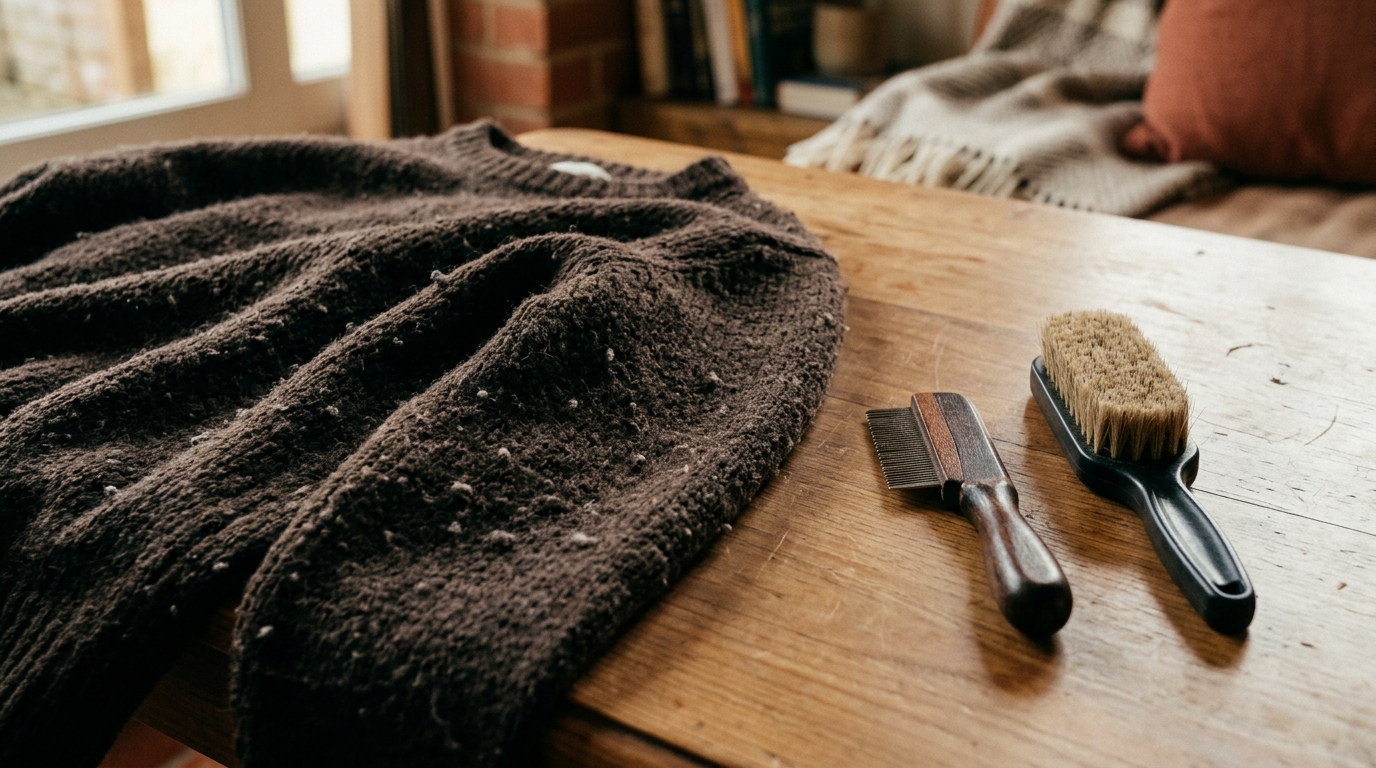
Pilling refers to small fibre bobbles that form on the surface of a fabric. The term comes from English: fibres work loose from the knit or weave, clump together into tiny balls and cling to the textile. The main cause is mechanical friction, for example during wear or in the washing machine, where the fibre ends felt together.[1] How strongly bobbles form depends on fibre type, fibre length and construction — not on price alone.
Why wool and blended fabrics in particular are prone to it
The shorter and finer the fibres, the faster they work loose from the fabric. This affects natural and synthetic fibres alike: merino wool is considered high quality, but because of its high fineness and relatively short fibre length it is especially prone to pilling. With synthetics, the smooth fibre surface also plays a role, because friction within the yarn is lower and fibres come loose more easily. Construction matters too: knitwear is looser than firm woven fabric, which is why bobbles form far faster on a knitted sweater than on woven jeans.
- Elbows, armpits, sleeves, belly and side seams, where the arms and torso constantly rub against each other during wear
- Shoulder and back area when regularly carrying a backpack or bag
- Waistband, shoulders and forearms, where friction during wear is especially high[1]
For travellers, this look at the friction points is especially worthwhile: if you are often out and about with a backpack or shoulder bag, you will find the matching guidance on durable travel clothing in our luggage section.
Which household remedies help remove pilling?
For basic care, your household supplies are enough. Which tool fits depends mainly on whether only loose lint lies on the surface or whether the bobbles have already become firmly attached to the fabric. Loose fibres can be picked off; attached pills must be cut or rubbed away without pulling new fibres out of the fabric.
| Tool | Suitable for | How to use |
|---|---|---|
| Lint roller or adhesive tape | Loose lint, hair, freshly bought clothing | [1]Picks up loose lint without stressing the fabric further |
| Wool comb or lint brush | Natural fibres such as wool and cashmere | Gently comb off knotted fibres with little pressure |
| Pumice stone (sweater stone) | Robust, coarse wool fabrics | Circular motions along the direction of the fibres, then remove the loosened fibres |
| Nail scissors | Individual, isolated bobbles | Snip off protruding fluff one at a time |
For light pilling, a lint roller or brush is usually enough; used regularly, they keep the surface smooth. For more heavily matted areas, reach for a wool comb, a pumice stone (sweater stone) or a lint shaver. What you should avoid: picking the fibre bobbles off with your fingers. Pulling them off releases further fibres, which in turn form new bobbles — the problem gets worse. An ordinary pair of household scissors is also unsuitable, because they are often too blunt and cut imprecisely.
What helps against pilling on wool
Wool pills for a reason rooted in the material itself: the fibre mats especially easily under friction, and every wash exposes the garment to additional mechanical stress. The most effective protection therefore starts not with removal but with washing less often. Wool clothing often does not need to go straight into the machine — frequent airing out is enough in many cases.
- Turn the garment inside out before washing, so the visible surface is protected from friction in the drum[1]
- Use a neutral, mild wool detergent, which extends the life of the wool garment
- Skip all-purpose detergent: wool detergent is usually pH-neutral and enzyme-free, because enzymes attack the protein fibre wool; lanolin in wool detergent reconditions the fibre[2]
- Avoid fabric softener: it lays a smoothing film over the fibres, which then come loose from the fabric more easily[3]
A word on choosing within wool: merino scores with comfort and insulation, but pills faster because of its fine, short fibres. Alpaca wool, by contrast, is considered less prone to pilling. How natural fibres, synthetic fibres and membranes differ in detail is something we compare in our Materials section; our care guide collects in-depth washing and care tips.
Removing pilling from wool sweaters without damage
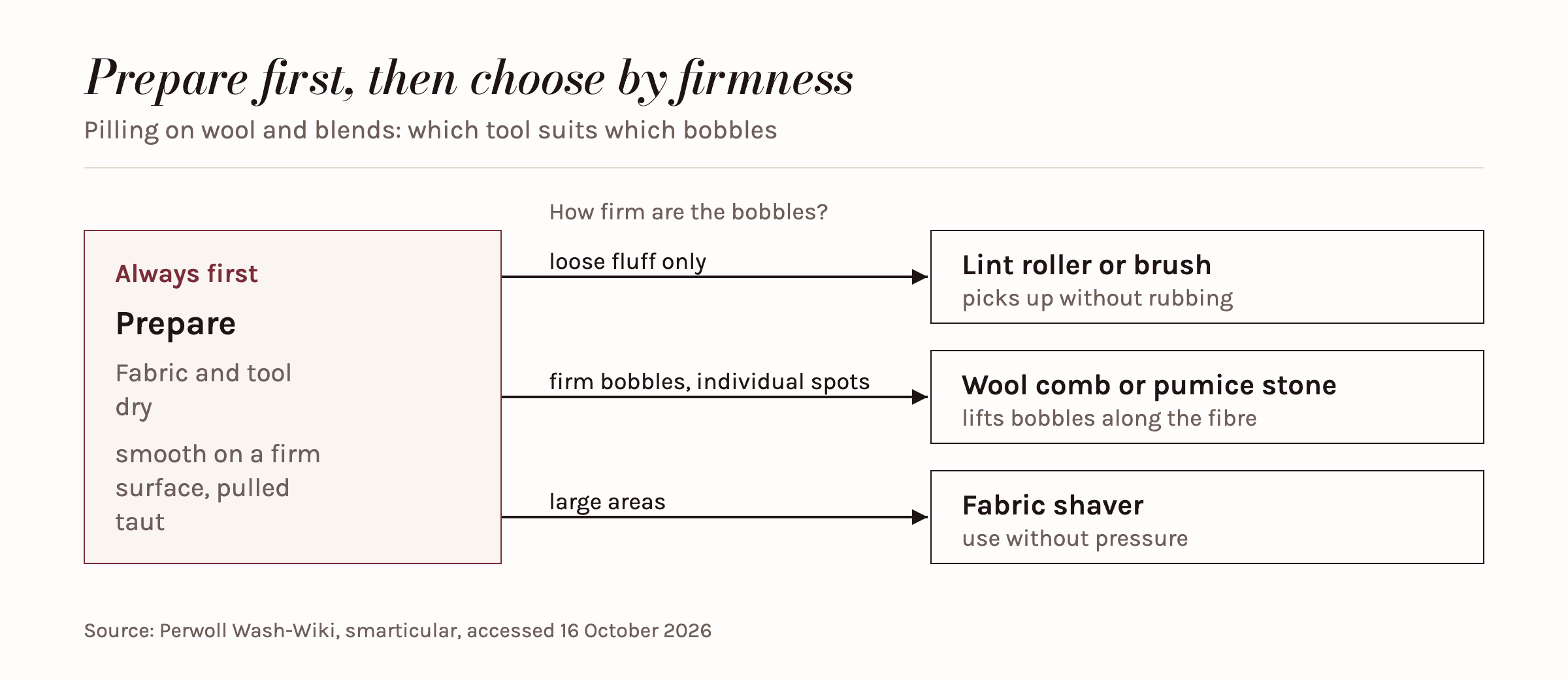
Whether it is a comb, a stone or a shaver: preparation decides between damage and success. The garment and the tool must be dry, and the fabric should lie wrinkle-free on a firm surface.[3] A damp or creased sweater is the most common starting point for cuts and holes, so it is worth not skipping the following steps.
- Let the sweater dry completely and lay it flat on a firm, smooth surface, such as a table or an ironing board
- Pull the area to be treated taut and smooth it out, so no crease gets under the tool[1]
- Test the tool first on a hidden spot, such as the inside
- Work in small movements in one direction and without much pressure[1]
- Tap out or empty the tool or collection container in between, so the blades work cleanly
- Afterwards, dry the sweater flat so it does not lose its shape
The typical sources of error come down to three points: too much pressure, the wrong tool and missing protection. Excessive pressure can cut holes, and blunt household scissors cut imprecisely. And because shaving off the bobbles also cuts intact fibres, the same area should not be treated again and again — otherwise the fabric becomes thinner over time.
Lint shaver for wool: useful or risky?
The electric lint shaver works with rotating blades behind a protective grille. This grille keeps a safety distance between the blade and the fabric, and the cut-off bobbles collect in a container. These devices make the surface of the textile look like new again. That is why they are particularly suitable for widespread pilling on sweaters, cardigans or jackets.[1]
- Guide it entirely without pressure: the weight of the shaver is enough for the protective grille to feed the bobbles cleanly to the blades
- Empty the collection container regularly, so cut fibres do not fall back onto the fabric and the blades work freely
- The general preparation — fabric pulled smooth, a test on a hidden spot and even strokes in one direction — follows the step-by-step guide in the previous section
The risk lies not in the device itself but in how it is handled: as described above, too much pressure can cut holes. For delicate, fine knits such as merino or cashmere, the lint shaver is therefore better suited to occasional, larger-area touch-ups, while a lint brush or wool comb is the gentler long-term solution for regular care. Anyone removing only a few fibre bobbles can get by with scissors or a comb anyway.
Preventing pilling: care label, wash cycle and laundry bag
The most effective prevention is written on the label. GINETEX, the international association for textile care labelling, developed the globally used symbol system, and the symbols are standardised under ISO 3758.[4] Anyone who reads them chooses temperature and cycle the way the garment tolerates it, reducing the friction that causes pilling in the first place.
- The number in the wash tub gives the maximum temperature in degrees Celsius that must not be exceeded[4]
- A single bar under the tub stands for mild treatment with a reduced load and a lower spin speed[4]
- A double bar indicates very mild treatment with reduced mechanical action, for example for wool washes[4]
- A square with horizontal lines means natural drying; the 'dry flat' variant applies, for instance, to delicate wool jumpers[4]
- Put delicate pieces in a laundry bag so they rub less against other laundry
- Fill the drum to at most one third for very mild wool cycles[5]
- Wash wool on the wool or delicate cycle at around 30 degrees and spin only briefly at low speed; dry heavy knitwear flat in the air instead of in the tumble dryer
Putting pilling in perspective: material choice at purchase and realistic expectations
Whether a garment pills is largely decided before you buy it: fibre length, twist and ply of the yarn as well as the knit or weave structure are the decisive factors, not price alone. Expensive merino and cashmere pieces pill too — fine natural fibres in particular tend to pill quickly. Pilling is therefore not a clear-cut quality defect and usually not grounds for a complaint, but a normal sign of wear.
- Choose tightly twisted yarns and longer fibres; they work loose from the fabric less often
- Choose denser woven fabric over loose knitwear when a piece takes a lot of wear, for example under backpack straps
- With wool, opt for resilient types such as alpaca if pilling is a major concern
- Check the care label at the point of purchase, because the care instructions determine the everyday effort[5]
Anyone who wants to build a wardrobe that pills less and lasts longer will find further fundamentals in the Style section. The practical core remains: read the care label before washing and choose the wash cycle accordingly. This one habit protects fibre and colour, reduces friction in the machine and keeps pilling in check for longer than any tool that removes fibre bobbles afterwards.
Frequently asked questions
What is pilling and how does it form?
Pilling refers to small fibre bobbles that form when fibres work loose from the fabric through friction during wear or washing and snag on the surface. Short-fibred and fine materials such as merino wool, cashmere and loose knitwear are particularly prone to it. Pilling does not affect the garment's function.
Which household remedies help against pilling?
For light lint, a lint roller or adhesive tape works well; for individual bobbles, nail scissors. A pumice stone (sweater stone) rubs bobbles off along the direction of the fibres, and a wool comb gently loosens tangled fibres on natural materials. Important: do not pick bobbles off with your fingers, as this creates new loose fibres.
Can you remove pilling from wool with a lint shaver?
Yes, an electric lint shaver is the most reliable method for larger areas. Its protective grille keeps a distance between the blade and the fabric. Work on the dry, flat-laid jumper with gentle pressure along the direction of the fibres; too much pressure or a disposable razor without a guard can cut holes, and frequent use thins the material.
How do I remove pilling from a wool jumper without damaging it?
Lay the jumper out dry and flat on a firm surface, smooth it down, then work with a wool comb, lint brush or lint shaver in the direction of the fibres and with little pressure. Do not rub or pull, and do not use a blunt household scissors. Wash wool as rarely as possible and air it instead — this makes use of the fibre's self-cleaning effect.
Why does merino wool pill even though it is considered high quality?
Merino wool is very fine and relatively short-fibred, so fibres come loose from the knitted structure more easily and snag on the scaly fibre surface. Even expensive merino and cashmere pieces can pill. Alpaca wool is the exception: it barely sheds lint and is hard-wearing.
How do I wash wool correctly to avoid pilling?
The key rules: around 30 degrees on the wool or delicate cycle, turned inside out and in a laundry bag, drum at most one third full, spin only briefly at low speed, and never in the tumble dryer. Details on wool detergent, liquid detergent and fabric softener can be found in the section 'What helps against pilling in wool'.
What do the care symbols on the label mean?
The GINETEX symbols are standardised worldwide under ISO 3758: the wash tub stands for washing, the number inside it for the maximum temperature, a single bar underneath for a milder cycle and a double bar for an especially gentle cycle such as the wool cycle. Added to these are the triangle (bleaching), square (drying), iron (ironing) and circle (professional cleaning). Read the care label before washing and choose the programme accordingly.