Washing a down jacket without the filling clumping
Washing a down jacket without clumping: cycle, temperature, down detergent and drying with or without a tumble dryer explained step by step.
Contents
Can I wash a down jacket without a tumble dryer?
Yes, the washing itself is unproblematic. The real challenge is the drying, as Mountain Equipment also emphasises in its care instructions: for all down products, it is not the washing that is the challenge but the drying.[1] In the machine, the jacket is washed like any other garment, but afterwards it must not simply be left hanging. Anyone who skips the drying part invites clumping exactly where it hurts most: in the filling. As a general rule, it is worth treating care instructions for materials and cleaning as part of wardrobe planning, as we do in our guide to caring for clothes and shoes.
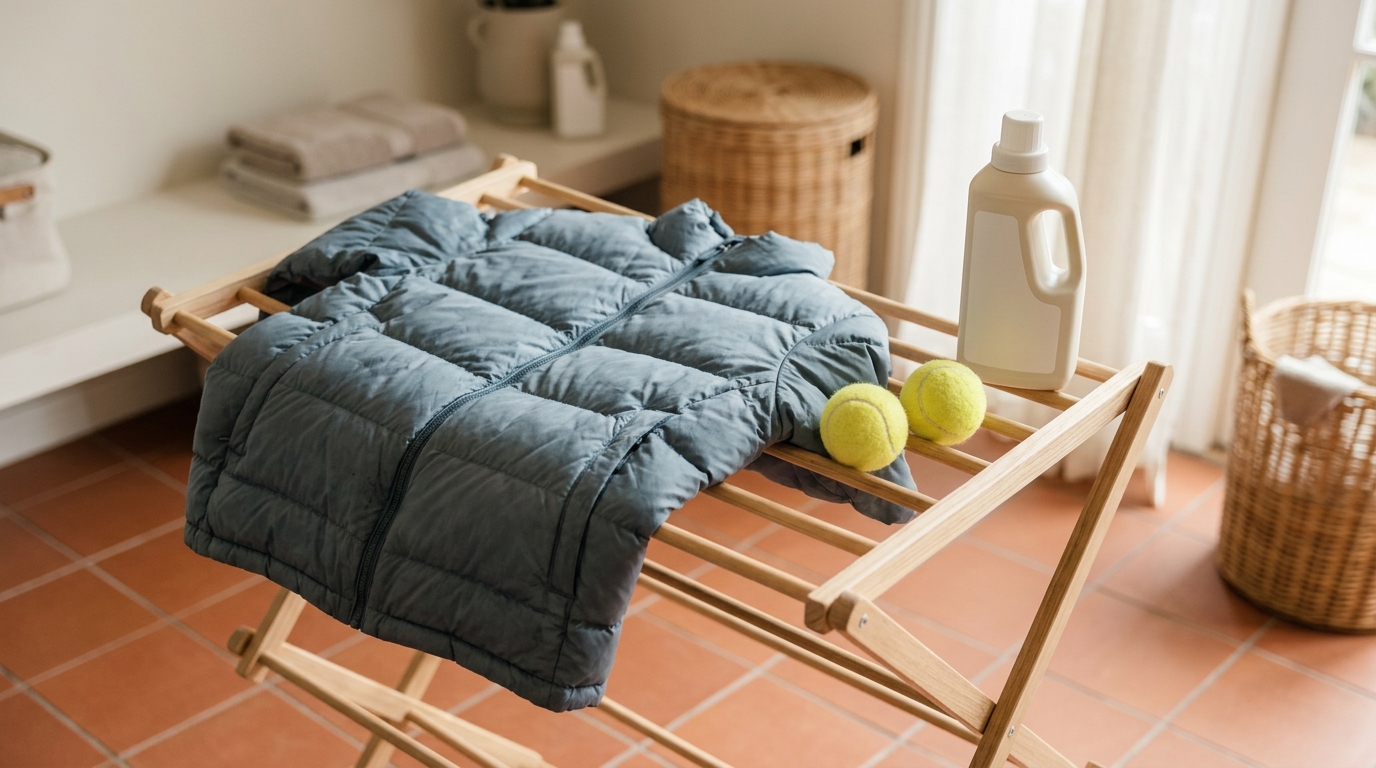
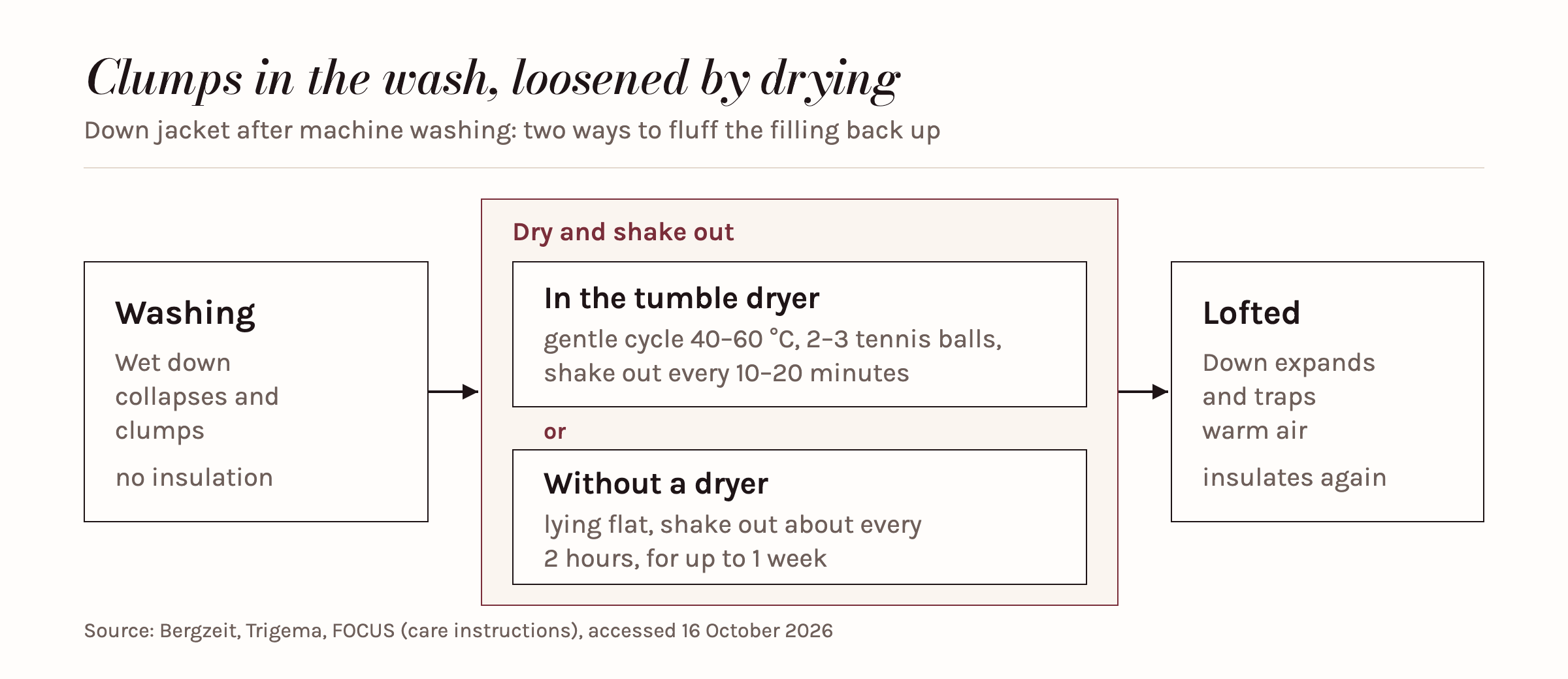
Without a tumble dryer, drying works on a drying rack if you spread the jacket out flat and shake it out regularly.[2] FOCUS recommends rolling a clean tennis ball gently over the spread-out jacket roughly every two hours at first, and later shaking and turning it continuously by hand.[3] One thing matters above all: the jacket belongs lying flat on the drying rack, never on a hanger, because otherwise the wet filling slides down and collects at the bottom.
- Spread out flat on the drying rack and shake out regularly, roughly every two hours (Bergzeit).
- Keep shaking until the jacket is really completely dry. Depending on the jacket and room conditions, this can take several days; FOCUS mentions up to a week for air drying.
- An alternative if your own drum is too small: a launderette's tumble dryer. Its large drums move bulky jackets around better, as Bergzeit explains, and are often the only practical option for down coats and sleeping bags.
Plan this drying time in from the start rather than improvising a shortcut.
How do you wash a down jacket properly?
The machine wash itself is straightforward if you follow a few steps. All the sources cited agree: first check the care label, then prepare the jacket, then choose a gentle cycle.[4][2]
- Check the care label and follow the manufacturer's instructions on temperature and cycle.
- Close zips and Velcro fasteners, empty the pockets, loosen the drawcords.
- Turn the jacket inside out to protect the outer fabric and seams.
- Put the jacket in the drum on its own. The washing machine should have a capacity of at least six kilograms so the jacket can move freely.
- Select 30 degrees on a delicate or wool cycle, unless the label specifies otherwise.
- Reduce the spin speed to 400 to a maximum of 600 rpm.
- Run an extra rinse cycle so no detergent residue remains in the filling.
A practical note from Mountain Equipment's instructions: even if the label only recommends hand washing, the jacket may go into the machine on a suitable cycle, provided the care label does not rule out machine washing altogether.[1] And some patience is required too: a wet jacket is heavy. Bergzeit and Trigema warn that seams and baffle dividers can tear when you yank the soaked garment roughly out of the drum.[4][2] Take it out with both hands and lay it flat immediately afterwards.
How can I rescue a clumped down jacket without a tumble dryer?
If you can feel hard lumps in the filling after washing, you do not need to replace the jacket right away. If the down has dried in clumps, it can often be broken up again by soaking and rinsing it a second time.[4] So the jacket is soaked and thoroughly rinsed once more so that the matted down comes apart in the water before a new drying round begins.
- Soak and rinse the clumped jacket again so the lumps break up while wet.
- Then dry it flat on the drying rack, gently shaking it out and kneading it softly about every two hours.
- Carefully push any lumps you can feel out of the corners of the collar, baffles and hem towards the middle of the baffle. There they come apart more easily, as Bergzeit recommends.
- Allow several days of patience and only put the jacket away once it is really completely dry.
The last point is not a cosmetic detail. A jacket that looks dry on the outside but is still damp at its core can start to smell in storage and, in the worst case, even go mouldy. Drying without a tumble dryer accordingly takes time: FOCUS estimates it can take up to a week until the jacket is truly dry.[3] Before storing it, feel into several baffles with your hand, not just the middle one.
Reading the care label: the symbols and what they mean
Before choosing a cycle and temperature, it is worth taking a close look at the care label. It is the basis for your decision, not the general down rule. The symbols come from GINETEX, the International Association for Textile Care Labelling, and are defined in standard ISO 3758.[5] On its overview, GINETEX Germany explains what the individual symbols mean.
| Symbol on the label | Meaning |
|---|---|
| Wash tub with a number (e.g. 30) | Maximum washing temperature in degrees Celsius that must not be exceeded |
| Wash tub with one bar underneath | Mild treatment with a reduced load and lower spin speed |
| Wash tub with a double bar underneath | Very mild treatment, such as wool washing. Fill the drum to no more than a third |
| Hand in the wash tub | Hand wash only, water temperature depending on the item at most 40 degrees |
| Circle in a square (dryer symbol) | Tumble drying. Two dots mean normal, one dot gentle drying |
| Wash tub crossed out | Do not wash. The item must not be washed |
For a typical down jacket this means in concrete terms: look for the tub symbol with the number 30 or 40 and check whether one or two bars appear underneath. A double bar calls for the wool or delicate cycle with a greatly reduced drum load, which fits well with the recommended single-item wash. If the square with the circle shows two dots, the tumble dryer is allowed at normal temperature; with one dot, only on a gentle setting. If the cycle you have found matches the recommendations from the previous sections, you are ready to go.
Drying a down jacket with tennis balls
The tennis ball method is often misunderstood, so let us clarify first: the balls belong in the dryer, not in the washing machine. Bergzeit explicitly warns against putting tennis balls into the machine, as they can endanger seams and baffles there.[4] In the drum of the dryer, however, they have a useful job: they loosely shake up the jacket as it dries, so the down fluffs up again instead of staying flat.
- Choose the dryer's gentle programme at a low temperature; 40 to 60 degrees are usually recommended (Bergzeit, Trigema).
- Put two or three clean tennis balls into the dryer together with the jacket.
- After the first drying cycle, take the jacket out, shake it out gently and softly push any lumps you can feel towards the middle of the baffle.
- Shake it out every 10 to 20 minutes and repeat the process until only very little residual moisture can be felt.
If you don't have tennis balls at home, there's no need to improvise. Mountain Equipment names special dryer balls as an equivalent alternative that serves the same purpose.[1] What matters is less the exact object than the movement: something has to keep tumbling the jacket in the drum so that the filling distributes itself instead of sticking together in one place.
Preventing clumped filling
First, understand why down clumps in the first place. Down has a delicate, three-dimensional structure. During washing it collapses and clumps together, losing its insulating properties.[2] The filling can only insulate again once it fluffs up during drying and its fine filaments unfold to trap warm air.[4] Clumping is therefore no accident but the filling's natural reaction to water and pressure. Knowing this, you can work against it deliberately. You can read more about the logic behind fill materials and fabrics in our guide to fabrics.
- Strictly avoid fabric softener. It glues together the fine structure of the down and thereby damages its insulating ability (Bergzeit, Trigema).
- Use the extra rinse cycle so that no detergent residue remains in the filling and makes the down stick together.
- Repeat the alternation of drying and shaking out until the jacket is bone dry.
- Let any residual moisture dry out completely overnight or in the air before putting the jacket away.
These four points act at exactly the spot where clumping arises: between the wet collapse and the returning loft. If you follow them, you prevent the clumps not by luck but through the drying itself. Mountain Equipment adds that there is no point in being alarmed by clumped down after the first wash. The jacket looks flat and empty, but the filling recovers if it dries properly.[1]
Detergent for down jackets
Which detergent goes into the machine is not a matter of taste but follows from the material. Down consists of keratin, a fibrous protein, as Bergzeit explains. Conventional detergents often contain proteases, enzymes that dissolve protein-based dirt. Because down itself is made of protein, it can be damaged by exactly these enzymes.[4] A heavy-duty detergent that reliably attacks stains is thus also working on your jacket's filling.
- Choose an enzyme-free down detergent. It is usually slightly re-fatting, conditions the down and helps it regain its natural resilience after washing (Bergzeit).
- Alternatively, use an enzyme-free delicate detergent, but with a critical eye on the ingredients to check that it really contains no proteases (Bergzeit). Schöffel adds that enzymes must be listed in the ingredients if they are included.[6]
- For treated down, use special care products. Bergzeit recommends renewing the water-repellent treatment roughly every four to five washes, because like other functional clothing it wears off over time.[4]
One final thought for context: a down jacket that is washed and dried properly stays functional for years instead of being replaced early. This attitude of keeping clothing in service for a long time through care is also the approach behind our guide to sustainability in fashion. And because down jackets are indispensable for many people when travelling too, it is worth a look at our section on travel clothing. The most important step, however, remains the same and takes only a few minutes: read your jacket's care label and choose the wash programme and drying method accordingly, not according to general rules.
Frequently asked questions
Can I wash and dry a down jacket without a tumble dryer?
Yes. Washing in the machine is the unproblematic part; the challenge is drying. Without a dryer, lay the jacket flat on a drying rack and shake it out regularly, roughly every two hours. Air drying can take several days depending on the jacket, and occasionally up to a week.
At how many degrees can you wash a down jacket?
Unless the care label says otherwise, 30 degrees on a delicate or wool cycle is the standard. The number in the washtub symbol according to GINETEX indicates the maximum washing temperature in degrees Celsius, which must not be exceeded. A bar underneath the symbol calls for milder treatment.
How many tennis balls go in the dryer?
Two to three clean tennis balls on the gentle cycle at 40 to 60 degrees. They loosen the filling while drying and prevent clumping. Important: the balls do not belong in the washing machine, where they can damage the seams and baffles of the wet, heavy jacket.
Which detergent is suitable for down jackets?
A special, enzyme-free down detergent. Down consists of keratin, a protein, and the proteases in conventional detergents break down exactly such proteins. Down detergents are also usually slightly re-fatting. Fabric softener is off limits because it sticks the down together and reduces its insulating ability.
What can I do if the down filling is clumped after washing?
Dried clumps can often be dissolved by soaking and rinsing again. Then dry the jacket carefully: in the dryer with tennis balls and shaking out between cycles, or in the air with regular shaking out and gentle kneading. Carefully push palpable clumps from the corners towards the middle of the baffles.
How often should you wash a down jacket?
As often as necessary, as rarely as possible. Thorough airing is often enough, and collars or sleeve cuffs can be treated with a damp sponge. With normal use, one or two washes per year are usually sufficient.
Is it okay to put a down jacket in the washing machine?
Yes, if the care label allows machine washing. The jacket should go into the drum alone, which should have a capacity of at least 6 kg so it can move freely. Reduce the spin speed, add an extra rinse cycle, and remove the heavy wet jacket carefully.