Everyday sneakers 2026: what matters in fit and materials
Everyday sneakers 2026: what matters in fit, cushioning, upper material and care, with a checklist for the fitting and choosing materials.
Contents
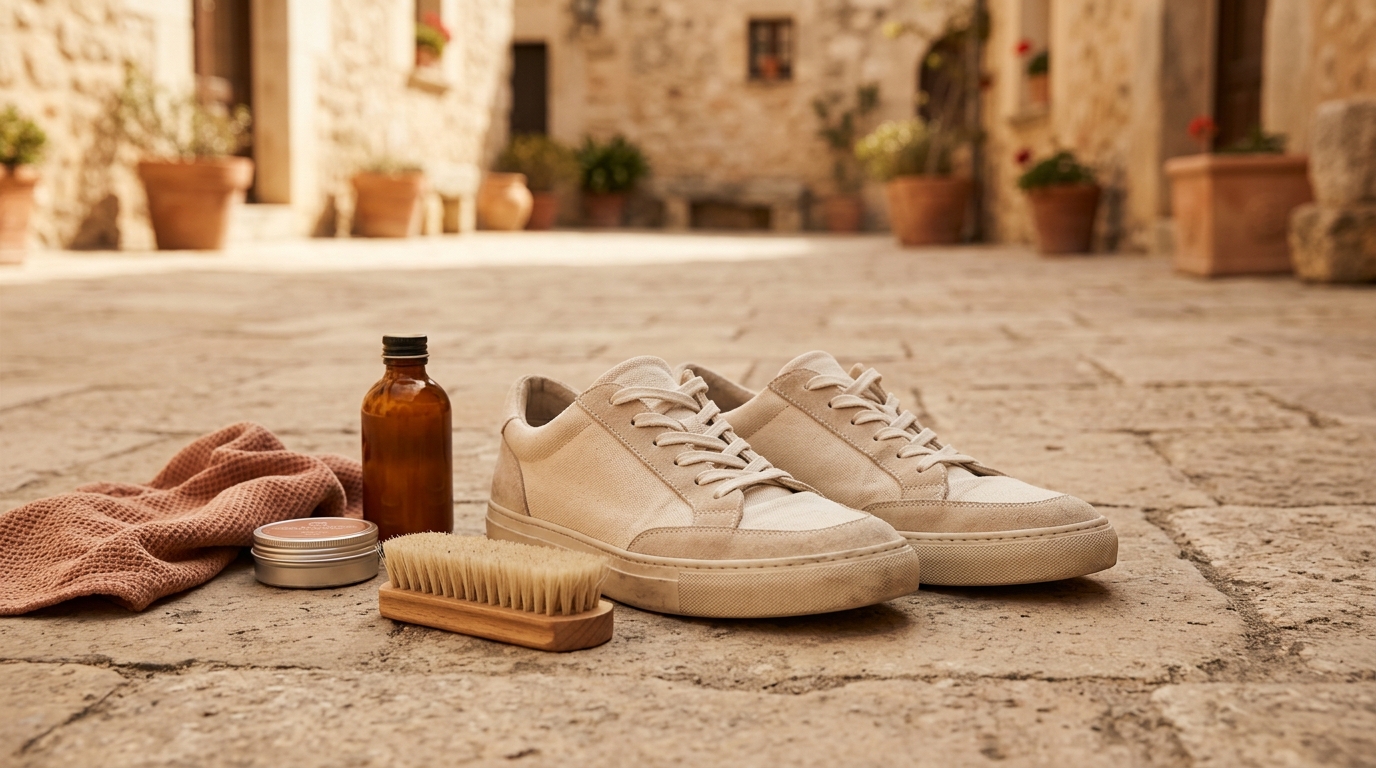
What sneakers to wear in 2026?
For everyday wear in 2026, the sneakers that work are the ones that fit comfortably, suit your usual routes and need little effort to care for. Which silhouette happens to be trending is secondary to this decision: a flat retro sneaker, a tennis-style leather model or a cushioned lifestyle runner can each be the right choice if it matches your foot, your day and your wardrobe.
Instead of a ranking without testing, this guide organizes the choice around four criteria. You can check all of them in any store and with any online order.
| Criterion | What to look for | How to tell |
|---|---|---|
| Fit | Length, width, hold at the heel | No pressure after a few steps, heel does not slip |
| Cushioning and sole | Height and firmness of the midsole, tread of the outsole | Comfortable on your usual surfaces, no rolling at the edges |
| Upper material | Leather, suede, textile or mesh, membrane | Suits the season and the wet conditions on your routes |
| Care | Cleaning and waterproofing depending on material | Effort you are willing to put in regularly |
Fit: check length and width separately
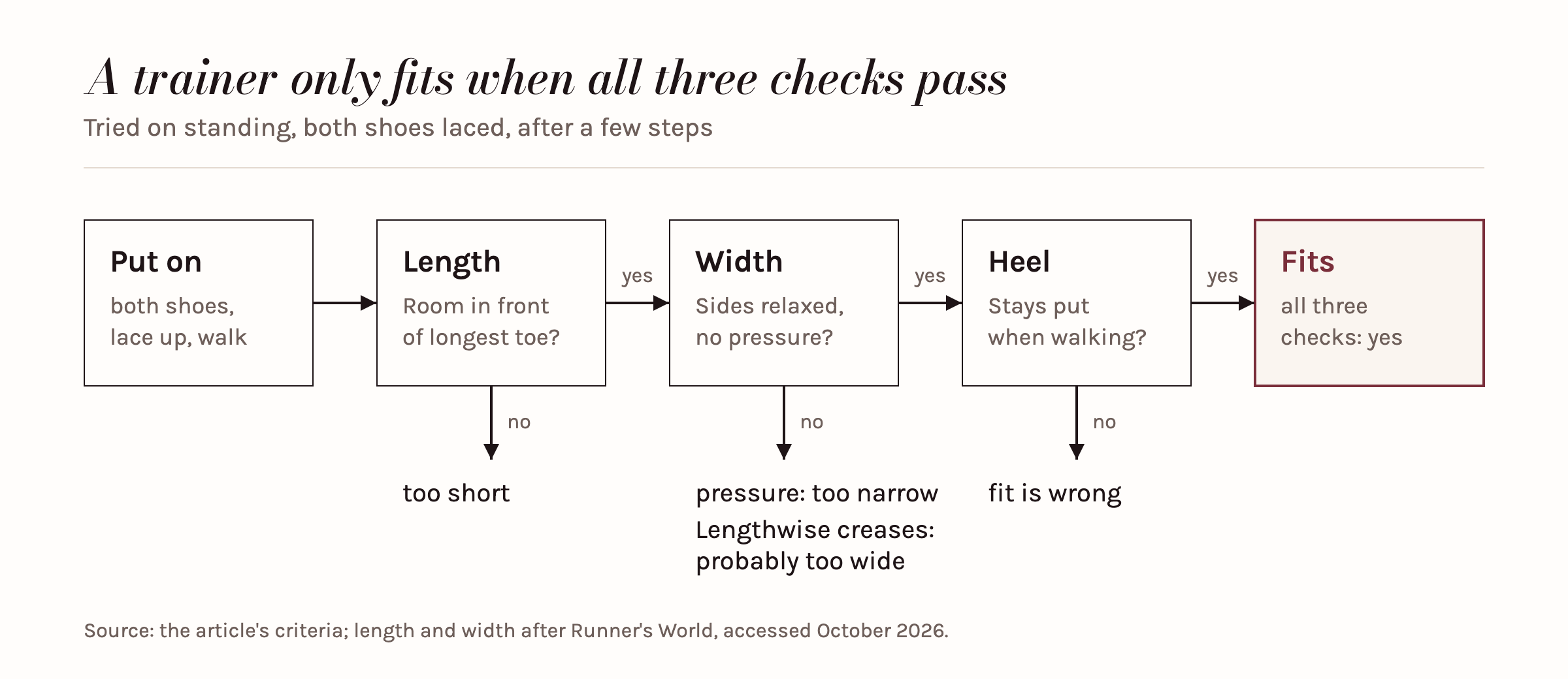
The length is right when there is still some room in front of your longest toe. For running shoes, the Runner's World guide gives a rule of thumb of a thumb's width of space, checked while standing after a few steps, because the foot swells slightly under load.[1] An everyday sneaker usually needs less allowance than a running shoe, but you should still do the same standing test.
For width, the same guide says: the sides of the foot rest against the upper, but only loosely. If you feel pressure or the foot rolls over the edge of the sole, the shoe is too narrow; if lacing produces lengthwise creases over the forefoot, it is rather too wide.[1] Because size charts vary from brand to brand, your usual size is only a starting point.[1] If you switch between EU, UK and US sizes, our size charts will help you find your way.
Cushioning and sole: choose according to your routes
How much cushioning makes sense depends on how long you walk each day and on what surface. For long stretches on cobblestone and in train stations, a higher, softer midsole usually feels more comfortable; for short distances and the office, a flat, firm sole that gives more ground contact is often enough. So judge the sole while walking, not by the product description.
What to wear in autumn 2026?
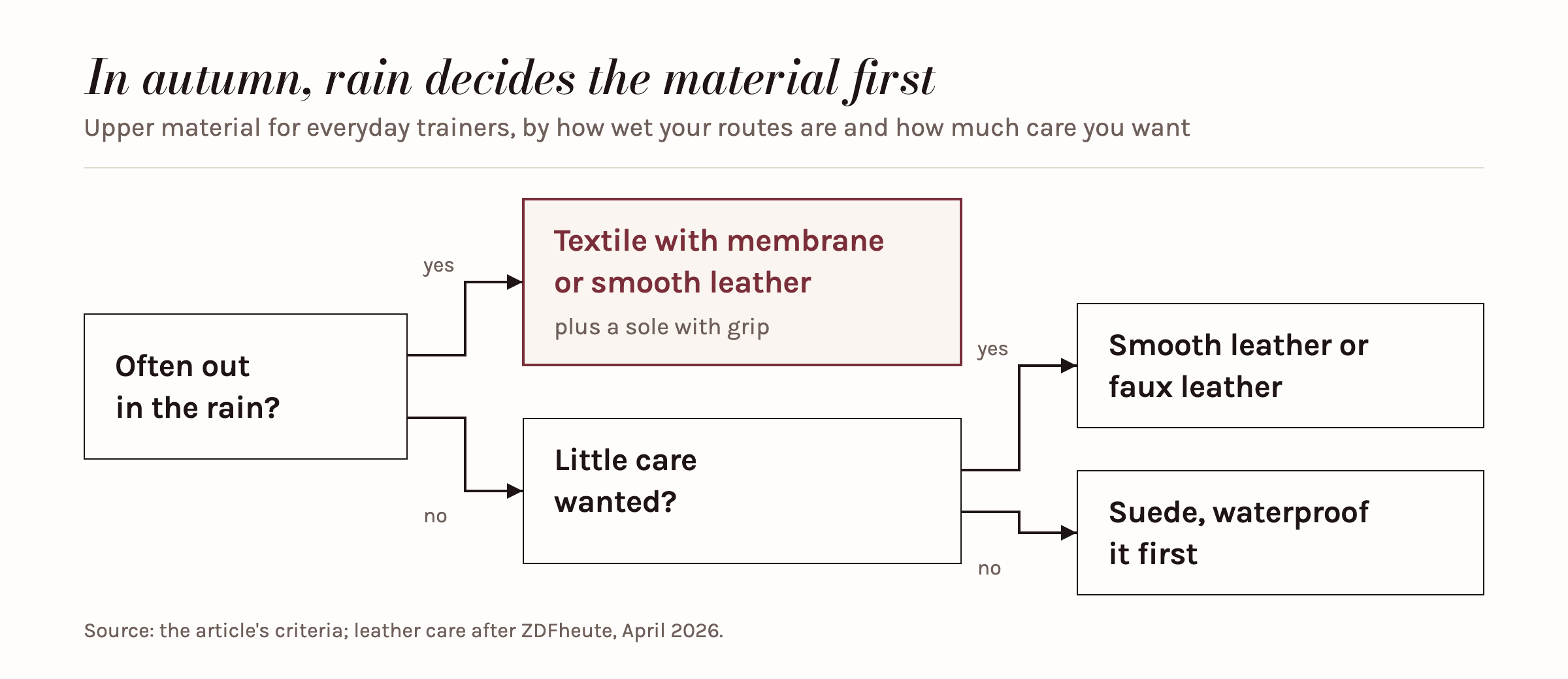
In autumn 2026, sneakers with a closed upper material and a grippy sole are the more practical choice, because wet conditions, fallen leaves and cooler temperatures quickly push open mesh to its limits. Whether smooth leather, suede or a textile model with a membrane is the right fit depends on how often you are out in the rain and how much care you are willing to put in.
| Upper material | In autumn | Care |
|---|---|---|
| Smooth leather | [2]Robust and naturally somewhat water-repellent | [2]Treat regularly with leather care cream so it does not dry out |
| Suede (velour) | [2]Soft, but considerably more prone to dirt | [2]Waterproof right after purchase and then regularly; do not clean with water |
| Faux leather | [2]Easy to care for, usually with a plastic coating such as PVC | [2]Damp cloth with mild washing-up liquid; no fats or oils |
| Textile or mesh | Airy, soaks through quickly in the rain | Clean with a damp cloth, following the manufacturer's instructions |
| Textile with membrane | Waterproof according to the manufacturer, depending on the construction | Follow the manufacturer's cleaning instructions |
We explain how membranes work and where their limits lie in our Membranes section. For textile and mesh, one simple rule applies: the most delicate material on the shoe determines how you clean it.
Best sneakers for autumn
The best sneakers for autumn are the ones whose upper material can cope with moisture and whose sole grips on wet surfaces. For most everyday routes, a leather sneaker with a treaded rubber outsole is a solid foundation, while a textile model with a membrane is an alternative for frequent rainy days. Suede remains an option if you waterproof it before the first wear.
For an autumn pair to last a long time, care after wet days is what matters. According to the leather guide from ZDFheute, leather that has got wet should always dry in the air; heaters and direct sunlight are off limits, because they can dry the material out and make it brittle.[2] For dry dirt on suede, special brushes or a suede eraser help.[2] Our leather care guide collects detailed advice.
Which autumn pair suits whom
- Lots of walking, often in the rain: textile with a membrane or smooth leather, plus a sole with tread.
- Office and short distances: smooth leather in a neutral colour that also works with trousers or a skirt.
- Minimal care effort: faux leather or smooth leather, rather than suede.
- Travelling: a pair you have already broken in that matches most of your outfits; more on this in our Sneakers section.
Highly rated daily wear sneakers 2026
You recognise highly rated everyday sneakers in 2026 less by a star rating than by reviews that match your foot and your intended use. A good average score says nothing about whether a model suits a wide forefoot or long distances. Adtouro has not tested the models on this market itself and therefore does not publish a ranking.
How to read reviews and product information to your advantage:
- Look specifically for comments on sizing: according to many reviews, does the model run small or large?
- Pay attention to statements about width and the heel, not just "comfortable".
- Read reviews from people who have worn the shoe for weeks, and check whether the sole and upper material have held up.
- Separate manufacturer claims from experience: "waterproof" or "especially cushioned" appears in the product description; whether it holds up in everyday use only practice reports can show.
- Check the return policy before ordering online, so you can try the shoe on at home in peace.
Your checklist for the fitting
Take this list with you to the store or keep it next to your online order:
- Put on both shoes, lace them up carefully, and walk a few steps.
- Check while standing: is there still some room in front of your longest toe?
- Sides: does the foot sit comfortably, without pressure and without lengthwise creases over the forefoot?
- Heel: does it stay in place when you walk, without slipping?
- Outsole: does it feel comfortable on hard ground, and does it have tread for wet days?
- Material: does it suit the season, and are you willing to put in the required care?
If a model passes all six points, it is a good everyday sneaker for you, regardless of its position on any best-of list. If you need to convert between sizing systems, our overview converting clothing sizes helps you find your way.
Frequently asked questions
Should I buy sneakers one size larger?
Not as a general rule. Sizes vary from brand to brand, so the standing test decides: there should still be some room in front of your longest toe, without your foot sliding around inside the shoe.
Are suede sneakers suitable for autumn?
Yes, if you waterproof them right after purchase and then regularly. Suede must not be cleaned with water; dry dirt is brushed off.
How can I tell if a sneaker is too narrow?
If you feel pressure on the sides or your foot overhangs the outsole, the shoe is too narrow. Lengthwise creases over the forefoot when lacing, on the other hand, suggest the shoe is too wide.
How much cushioning does an everyday sneaker need?
It depends on your daily routes. If you walk long distances on pavement every day, you will usually feel more comfortable with a higher, softer midsole; for short distances, a flat, firm sole is often enough.
What is the right way to dry wet leather sneakers?
In the open air and away from heaters and direct sunlight, because heat can dry out leather and make it brittle.