Wedding guest outfits: what works without a dress code
Wedding guest outfits without a dress code: which dress length works, which colours are trending in 2026 and how to dress right for an autumn wedding.
Contents
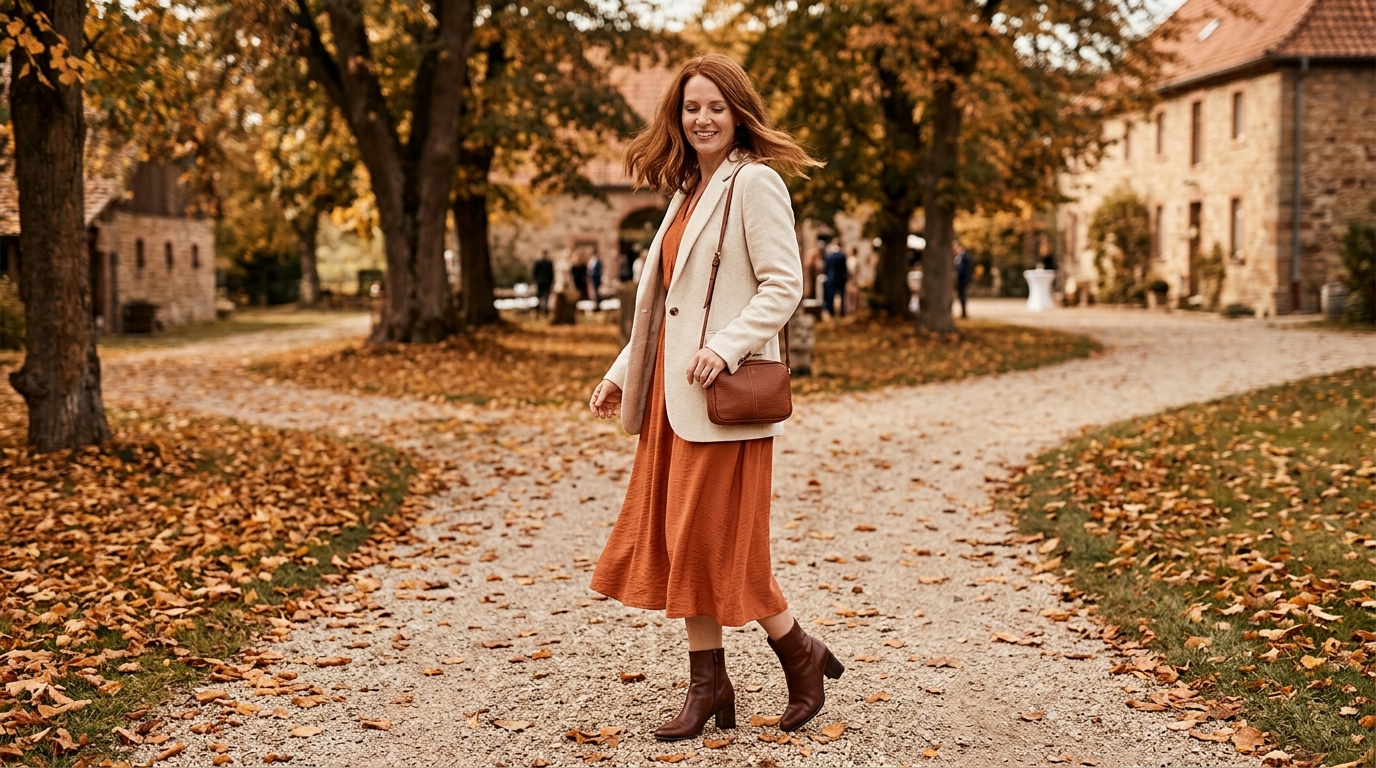
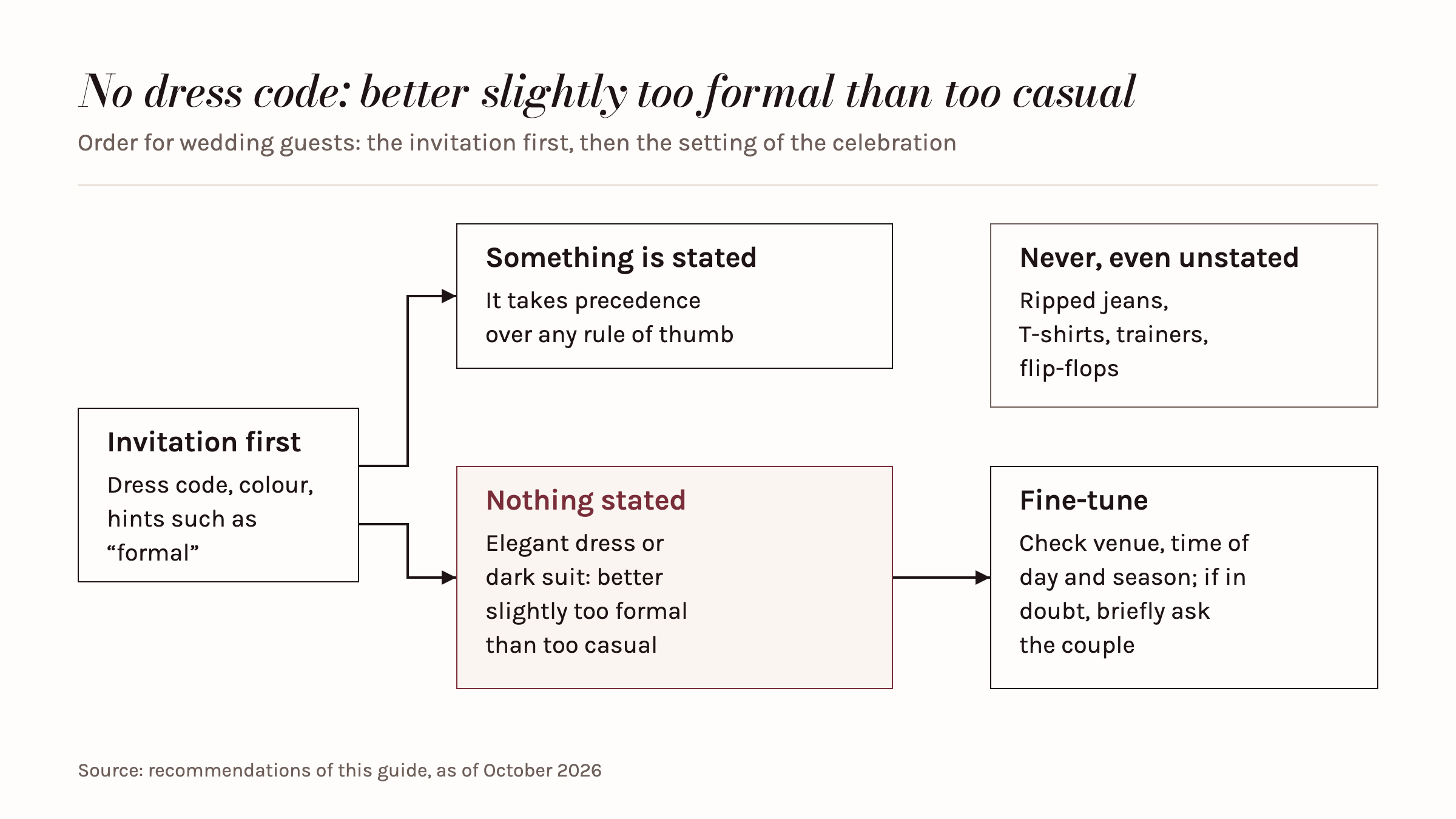
Without a stated dress code, you can read the right level of formality from four things: the invitation, the venue, the time of day and the season. If the invitation states a dress code, a colour request or a note such as "formal" or "casual", that instruction takes precedence over any rule of thumb. If there is no hint at all, a quick question to the couple is the fastest route to the right outfit. The question comes up often: according to the Federal Statistical Office, 348,800 marriages were registered in Germany in 2025 — the fewest since the time series began in 1950.[1]
Which dress length for a wedding guest?
For wedding guests, a midi dress is the safest length: long enough for the ceremony, easy enough to move in for hours standing and on the dance floor. Floor-length dresses are reserved for a formal evening setting, while knee-length versions and simple two-piece outfits are often sufficient during the day. What matters is that the cut suits the occasion and that you can move comfortably in it all day.
| Setting | Length that works well | What to look for |
|---|---|---|
| Registry office, daytime ceremony | Midi dress, jumpsuit or simple two-piece outfit | [2]quality fabrics and colour depth suited to the occasion; floor-length evening gowns look over the top here |
| Cocktail setting, evening reception | Cocktail dress, knee-length to midi | [3]festive fabrics such as satin, silk or lace |
| Formal evening, black tie | Floor-length evening gown | [2]a very elegant cocktail dress also remains acceptable |
The same logic applies to men. For a cocktail setting, a navy or anthracite suit works better than a black one; black tie calls for a tuxedo, and for black tie optional a formal black suit is enough.[2] In a more casual setting, chinos or suit trousers with a shirt and blazer do the job. If you attend the ceremony in the morning and the party in the evening, plan for the day's changing temperatures.
What do wedding guests wear in 2026?
In 2026, wedding guests are wearing warmer tones, statement patterns and two-piece outfits instead of pure pastels. In June 2026, InStyle presented five outfit trends for wedding guests in summer 2026 that replace mint green, lavender and powder pink.[4] Satin trousers, two-piece outfits and patterns carry into autumn too, while orange tones belong more to summer celebrations. The five trends:
- Warm orange tones such as coral and mandarin instead of pink shades, paired with gold jewellery that underscores the warmth of the colour
- Retro floral patterns in vintage design on long dresses, combined with simple shoes and a slim clutch
- Elegant satin trousers that sit loosely, look festive thanks to the fabric and need an elegant top
- Colourful gingham dresses with Vichy or gingham checks, with the rest of the outfit kept calm
- Two-piece outfits in a 70s look of blazer and pencil skirt as an elegant alternative to the dress
Colour rules: what applies today and what remains off-limits
White as well as cream, beige and champagne tones remain reserved for the wedding dress.[3] Black, on the other hand, is no longer taboo: according to the Deutscher Knigge-Gesellschaft, it is permitted as long as it does not look like mourning attire, and colourful accessories can lift the look.[5] Red is also possible, though rather in muted shades such as burgundy, plum or rust than in bright red.[3] If in doubt, briefly check the colour with the couple. Neon colours and extreme animal prints are best avoided, because they seek attention that on this day belongs to the couple. Patterns work best in moderation: a striking check or a floral print carries the look, while the rest stays simple.
What should I wear to an autumn wedding as a guest?
For an autumn wedding, the best choice as a guest is autumn tones such as red, orange, brown and gold, or deep blue and dark green, paired with fabrics that suit the weather. If the couple specifies a wedding colour, follow it. More important than the exact shade is the choice of fabric, because in autumn warm and cool hours often alternate within the same day.
| Weather situation | Fabric and garment choice | Why it works |
|---|---|---|
| Mild autumn days | Midi dress in a light, flowing fabric such as chiffon or satin | light and festive at the same time |
| Cool days | heavier fabrics such as velvet or brocade, ideally with long sleeves | keeps you warm and brings autumnal elegance |
| Moving between indoors and outdoors | blazer or turtleneck over the dress, stole or scarf over the shoulders | can be adapted to the temperature without breaking the look |
Warmth for cool hours
In its guide to wedding guest outfits (2022, updated 2025), Vogue Deutschland recommends for the cooler months a long dress with a turtleneck and blazer, plus ankle boots with a block heel; a satin dress works just as well, its glossy fabric looking festive on its own.[6] Alternatively, wear a loose wrap blouse with a long skirt, as long-sleeved pieces suit increasingly cool temperatures.[6] A scarf or stole over the shoulders is practical and festive at once, and pumps or ankle boots in neutral colours remain a safe choice.
Autumn wedding guest outfit without a dress code
For an autumn wedding guest outfit without a dress code, the rule is: slightly too festive beats too casual. Ripped jeans, T-shirts, sneakers or rubber flip-flops have no place at a wedding, even if the invitation specifies nothing or notes "casual". A slightly too festive outfit, by contrast, hardly ever registers negatively. Four outfit bases cover most autumn celebrations:
| Outfit base | Particularly well suited to | Less suitable for |
|---|---|---|
| Elegant dress with blazer or jacket | the safest choice without a dress code, for ceremony and celebration in one look | very warm rooms where the blazer gets in the way |
| Festive jumpsuit in a high-quality, glossy fabric | [6]anyone who does not want to dance in a dress; with a blazer or jacket also for cool hours | very formal evenings when floor-length is expected |
| Trouser suit | [6]cool autumn days and anyone who prefers a two-piece outfit | celebrations with lots of dancing in heated indoor air |
| Blazer dress | [6]the transition from day to evening, can also be worn after the celebration | settings that call for a floor-length gown |
How to read the level of formality without a dress code
Without a dress code, the time, the venue and the wording of the invitation replace the missing information:
- A morning ceremony calls for different attire than a reception in the early evening
- Castle, church, garden, barn or restaurant each set their own standards for fabric and formality
- Wishes such as "festive", "casual" or a colour motif in the invitation are binding instructions, not suggestions
For guests' attire, the terms used on invitations mean the following:
| Dress code | Typical guest attire | One example |
|---|---|---|
| White Tie | [2]floor-length evening gown; for men a tailcoat with a white bow tie | a grand celebration in a castle or a 5-star hotel |
| Black Tie | [2]floor-length evening gown or a very elegant cocktail dress; for men a tuxedo in black or midnight blue | a formal evening in a festive setting |
| Cocktail or Semi-Formal | [2]cocktail dress or a chic jumpsuit; for men a navy or anthracite suit | the most common setting: festive but not stiff |
| Smart Casual | [2]a dress, jumpsuit or skirt with a blouse; for men chinos or suit trousers with a blazer | a relaxed celebration with standards |
| Casual | [2]a high-quality summer dress, a flowing jumpsuit or a blouse with a skirt, no jeans | garden, beach or barn weddings |
The venue as a yardstick
The venue is a reliable yardstick: a celebration in a castle calls for more formality than a ceremony in a garden. Garden, barn or beach usually means a relaxed setting, but not an arbitrary one. Even there, the occasion deserves festive fabrics, well-kept shoes and a bag that does not look like everyday wear. If you know the venue in advance, you can match fabric weight and footwear accordingly.
Shoes, bag and accessories: getting through the day comfortably
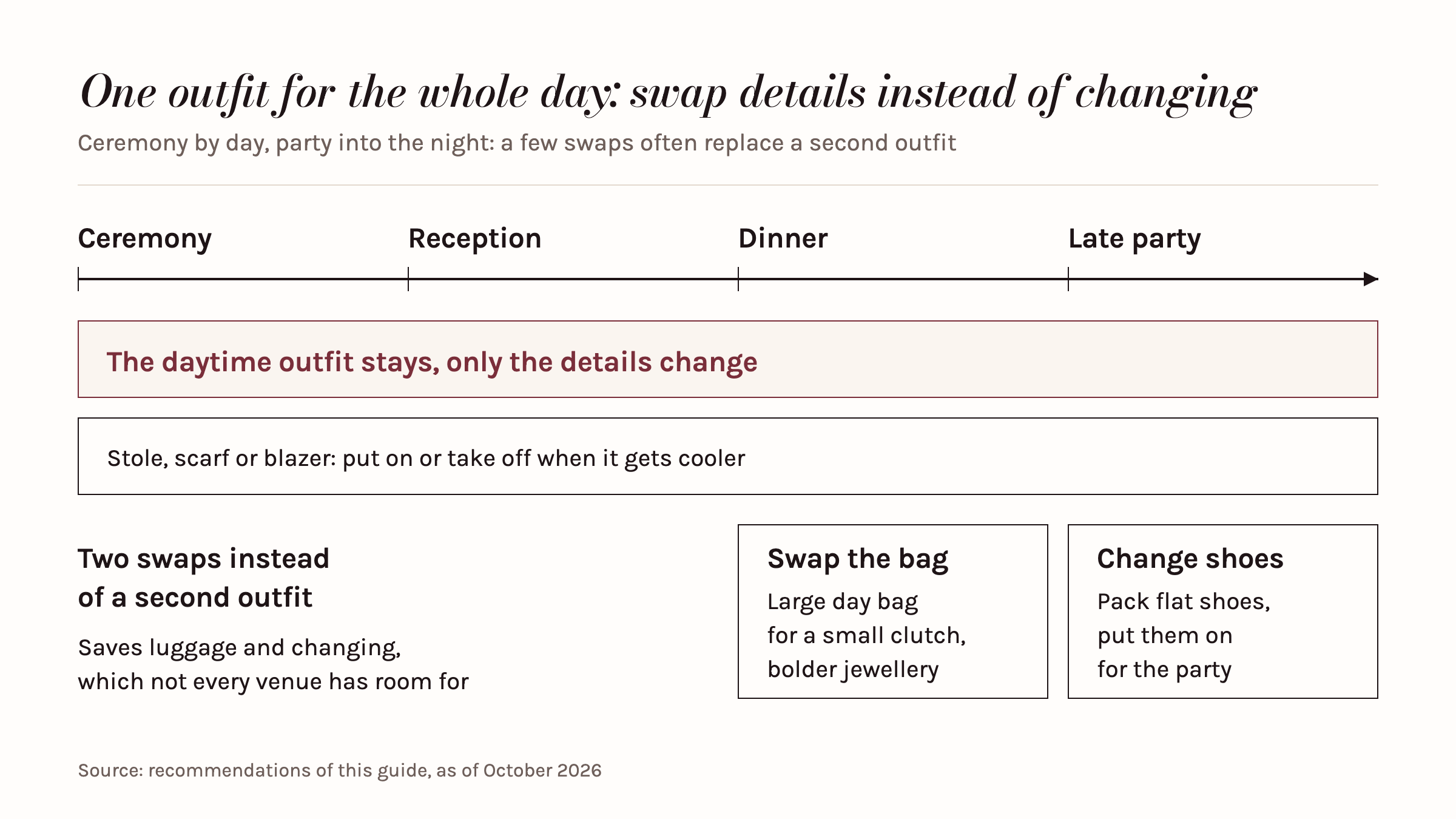
The ground decides which shoes work. On a lawn, high stiletto heels quickly sink into the soil; platform or block heels are the more stable choice there. In autumn, ankle boots with a block heel carry festive looks and keep you warm at the same time.[6] Check in advance where the ceremony and the celebration take place: a garden calls for different shoes than a hotel ballroom. For the late party, it is worth packing flat shoes — the swap makes your daytime outfit evening-ready without a full change of clothes.
- Block heels or platforms on grass and soft ground; slim heels only on solid flooring
- Flat spare shoes for the late party — they noticeably extend your evening
- A small handbag or clutch instead of a large bag; it looks more festive
- Use jewellery sparingly: one or two accents from necklaces, rings or bracelets are enough[6]
- In autumn, a neck scarf and tights as functional accents that complement the look rather than clash with it[6]
If you still have dinner or the party ahead of you after the registry office and the reception, a few simple tricks can make your daytime outfit evening-ready: swap the large day bag for a small clutch and add a bolder piece of jewellery. This saves luggage and a change of clothes that not every venue has space for. Looking at the day's schedule before packing shows whether you need two outfits or whether a good swap is enough.
Checklist: choosing an outfit without a dress code
The most important rule: look up the dress code on the invitation and choose your outfit accordingly. If it says nothing, the venue, time of day and season set the direction, and a short message to the couple settles the rest. The steps at a glance:
- Read the invitation: note the dress code, colour requests and time — the couple's specifications take precedence over any rule of thumb
- Assess venue and time of day: a castle and an evening celebration call for more formality than a garden and an afternoon
- Check season and weather: in autumn, plan for fabric weight, long sleeves and a stole or scarf
- Decide on shoes and a change option: choose the heel shape for the ground, and pack flat shoes for the late party
- Ask if in doubt: a short message to the couple clarifies colour, formality and expectations
On budget: a well-fitting piece from your own wardrobe, combined with new accessories, is usually the better choice than a new purchase that hangs unworn in the closet after this one day. Festivity comes from fabric, fit and details, not from the price.
Frequently asked questions
Which dress length is the safest choice for a wedding guest?
The midi dress is considered the middle ground that suits almost any wedding, from the registry office to the evening celebration. Floor-length gowns look the most formal and fit an upscale setting, while knee-length dresses or simple two-piece outfits are enough for a daytime ceremony. What matters is the venue and the time of day, not a fixed rule.
Can I wear black or red as a wedding guest?
The old rule that black signals mourning and red draws too much attention is considered outdated. Both colours can look elegant today, for example at an evening wedding or with the right cut. If you are unsure, briefly ask the couple before choosing an unusual colour.
Which colours should wedding guests avoid?
White, cream, beige and champagne are reserved for the wedding dress unless the bride explicitly agrees. Loud neon colours and extreme animal prints are also unwelcome, because the couple should be the centre of attention. Pastel shades, floral prints and medium colour depths are hard to get wrong.
What should I wear to an outdoor autumn wedding?
Earthy tones such as red, orange, brown or gold, or alternatively deep blue or dark green, suit the season. In mild temperatures, wear flowing fabrics like chiffon or satin; in colder weather, heavier ones like velvet or brocade. A stole, a blazer or a long-sleeved dress covers the transition between day and evening.
Which shoes work when the celebration takes place on a meadow?
High, narrow heels quickly sink into grass and uneven ground. Shoes with a block heel or a platform are more stable, and in autumn ankle boots with a block heel also work. For the late-night party, it is worth packing a pair of flat, comfortable shoes.
What do you wear as a guest at a registry office ceremony?
At the registry office, the look can be elegant but simpler than at the big celebration: midi dresses, jumpsuits or smart two-piece outfits in muted colours and quality fabrics work well. Floor-length evening gowns and opulent evening wear look oversized here. For a celebration afterwards, you can upgrade the look with more striking jewellery or different shoes.
Do I have to wear a suit as a man when there is no dress code?
A dark or navy suit with a shirt is the safe choice when no dress code is given. A slightly more relaxed option is a blazer with tailored trousers or chinos combined with a shirt, depending on the venue and the style of the celebration. Sportswear, jeans, T-shirts and sneakers do not belong in the look even at casual weddings.