Clothing donation bins: what goes in and what doesn't
What belongs in a clothing donation bin: clean, wearable clothes only. What must stay out, why bins are disappearing, and where to find collection points.
Contents
Why are there hardly any clothing bins left?
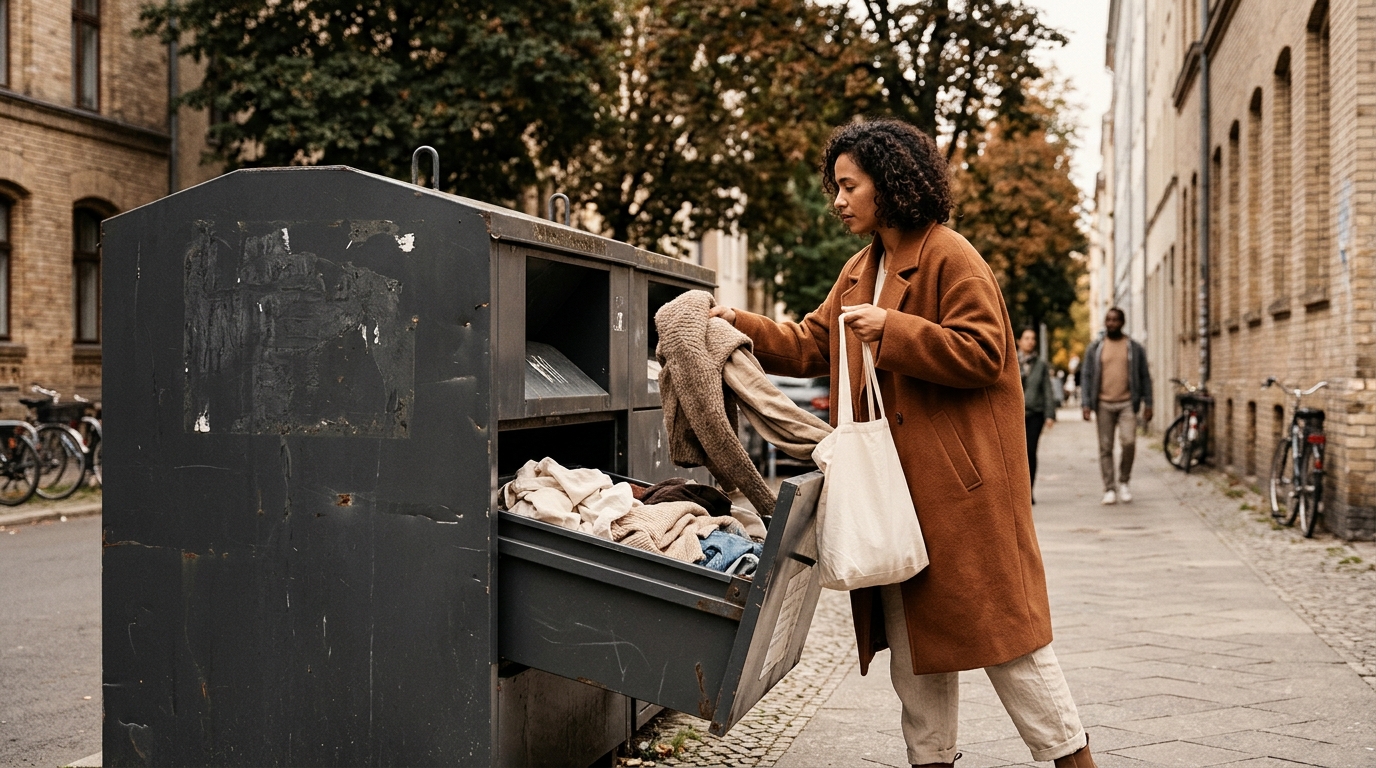
Clothing bins are becoming rarer because collecting no longer pays off for many operators. The umbrella association FairWertung spoke in October 2026 of the third crisis year on the used-textile market. Staff, vehicles, collection containers, parking spaces, emptying and transport have all become more expensive, while revenues from the collected goods remain persistently low.[1]
The consequences are visible on the streets. Collection routes and areas are being scaled back or discontinued altogether, and according to industry estimates cited by FairWertung, more than 30 percent of collection containers in public spaces have been given up. In September 2026, according to FairWertung, another sorting company had to file for insolvency.[1]
One reason for the weak revenues lies in what ends up in the bins. The bags usually go unsorted to commercial textile processors, who sort every item by hand. According to FairWertung, on average only about 50 to 55 percent of textiles are still suitable for second-hand use, and sorting low-quality goods does not cover its costs.[2] The Federal Environment Agency cites a similar figure: around 54 percent of recorded clothing textiles are prepared for reuse.[3]
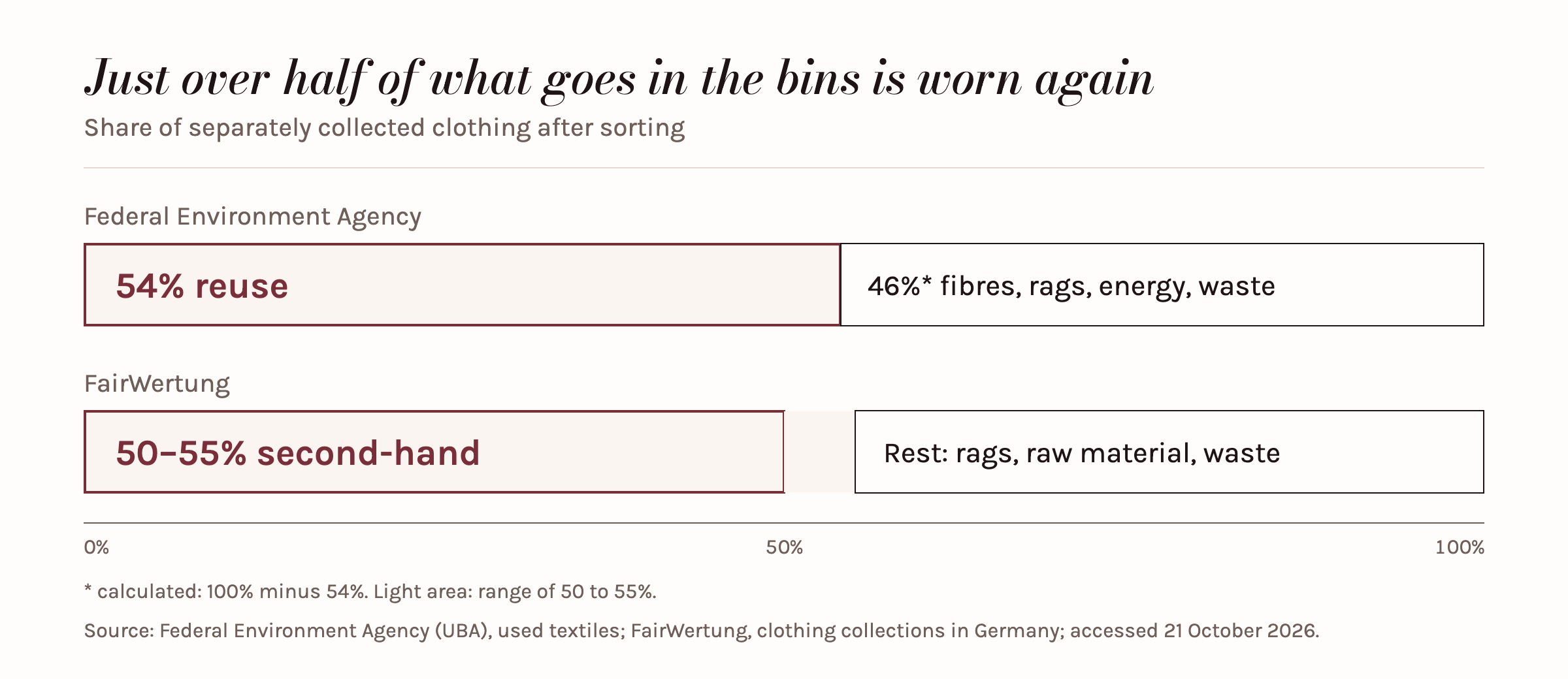
The more damaged and soiled items end up in the bin, the less a tonne of collected goods earns. That is an inference from these figures, not a measurement taken by the collectors.
Why are clothing donation bins being removed everywhere?
Clothing donation bins are not being removed everywhere, but in more and more cities and municipalities. FairWertung reported in July 2026 that municipalities are terminating existing permits for special use of public land, no longer issuing new permits, or banning bins from public spaces altogether. In some cases, entire collection schemes are being discontinued.[4]
The trigger is overflowing bins and illegal drop-offs — bags and boxes left next to the container. These lead to complaints, and municipalities come under pressure to act. Residents are then referred to recycling yards or drop-off points run by non-profit organisations.[4]
At the same time, since 1 January 2025 textiles must be collected separately from other waste. FairWertung therefore considers a mere reference to the few recycling yards in a district insufficient: many people can only reach them by car, and opening hours are limited. The association warns that fewer locations can lead to bins filling up faster, more special collections, and in the worst case to more textiles ending up in the general waste bin.[4]
The separate collection requirement does not, however, turn the clothing donation bin into a textile bin. On altkleiderspenden.de, FairWertung explicitly asks people to distinguish between textile waste and clothing donations.[5]
Why are there no more clothing donation bins
If there is no longer a clothing donation bin at your usual location, the operator has usually given up the collection or the municipality has not renewed the permit. Which drop-off points exist instead is decided by your municipality. The waste advisory service, the waste management company's website or the waste calendar can tell you.
Here is how to find an alternative:
- Check with your municipality: it will tell you whether there are still bins, a recycling yard that accepts textiles, or fixed collection dates.
- Search the FairWertung directory al[5]tkleiderspenden.de for bins and drop-off points run by charitable members.
- Take well-preserved items directly to a clothing bank or a charity shop. According to FairWertung, these organisations need textiles they can pass on directly, with autumn and winter items best dropped off from late summer.[6]
A bin that suddenly appears on a verge or car park is not automatically a replacement. According to the Federal Environment Agency, charitable and commercial collections must notify the responsible authority of their activity before placing bins. They can be identified, for example, by the full address of the waste management company. According to the Federal Environment Agency, bins without an identifiable operator are usually illegal.[7] The consumer advice centre advises donating only to collections with a German address and landline number, and names the FairWertung label and the BVSE quality seal as points of orientation.[8]
Whether the bins will return remains open. According to FairWertung, Federal Environment Minister Carsten Schneider presented key points for extended producer responsibility for textiles in March 2026, which are intended to build on the existing collection structures. Until it takes effect, FairWertung is calling on states and municipalities to provide interim solutions; a motion in the Bavarian state parliament, among other things, provides for emergency financial aid for municipal collections until the end of 2027.[1]
Clothing donation bins: what can go in
Anything that another person can still wear or use may go into the clothing donation bin. FairWertung names fashionable and well-preserved garments, as well as shoes, caps and hats, accessories and scarves, plus bed linen and tablecloths. Everything should be clean and ideally washed, with shoes tied together in pairs.[6]
| What | Bin? | Where else |
|---|---|---|
| Well-preserved, clean clothing | Yes | Alternatively clothing bank, charity shop or sale |
| Shoes, wearable and tied in pairs | Yes | Alternatively clothing bank |
| Caps, hats, scarves, accessories | Yes | – |
| Bed linen and tablecloths | Yes | – |
| Wet or heavily soiled clothing | No | [8]General waste bin |
| Heavily damaged or very old clothing and linen | No | [8]General waste bin, unless repair is possible |
| Worn-out or single shoes | No | [8]Defective shoes in household waste |
| Skis and ice skates | No | Ask your municipality |
The columns "What" and "Bin?"[6] follow the FairWertung FAQ.[5] On the general waste bin, FairWertung and the consumer advice centre agree: according to altkleiderspenden.de, broken or heavily soiled clothing belongs there even after the separate collection requirement was introduced.[8] According to the consumer advice centre, there is currently no recycling option for shoes, because they are not yet manufactured to be recyclable.
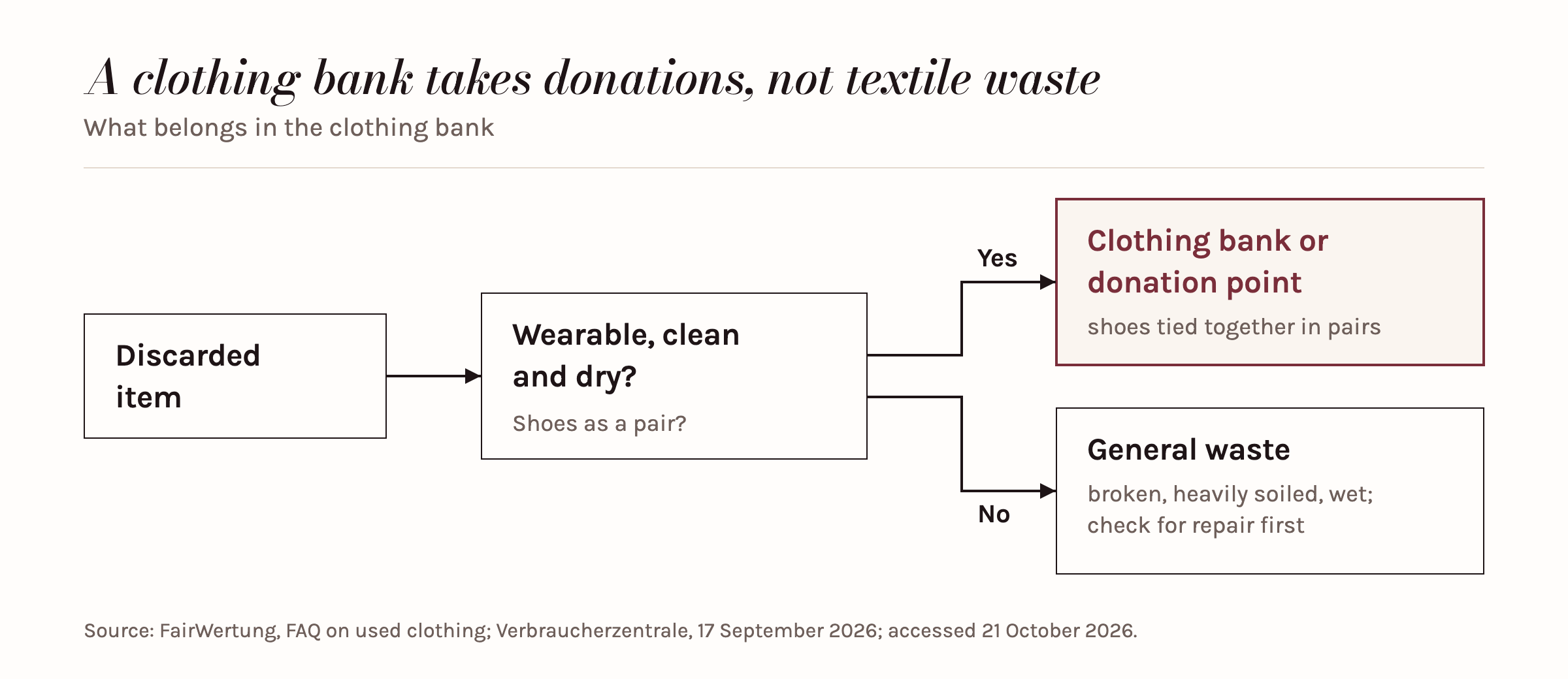
Four questions help before you drop anything in:
- Would you give this item to someone you know? If not, it is not a donation.
- Is it clean and dry? FairWertung explicitly puts wet and heavily soiled items on its no-list.
- Are shoes tied together as a pair?
- Does the bin show the collector's name, address and telephone number?
A loose seam or a missing button is often quickly fixed; our Repairs section gathers ideas. Items with market value can also be sold, as our comparison Vinted or classified ads shows. Where damaged textiles and larger quantities should otherwise go is collected in the Used clothing section. Before you drive off with a full sack, check with your local municipality or on altkleiderspenden.de to find the nearest collection point.
Frequently asked questions
What can go into the clothing donation bin?
Clean, wearable clothing, shoes tied together in pairs, hats, caps, scarves, accessories, as well as bed linen and tablecloths. What matters is that another person can still use the items.
Can broken clothing go into the clothing donation bin?
No. Heavily damaged or heavily soiled clothing belongs in the general waste bin, according to FairWertung and the consumer advice centre — even since the separate collection requirement for textiles came into force.
Why has my clothing donation bin disappeared?
Usually the collector has given up the location because costs have risen and proceeds have fallen, or the municipality has not renewed the permit for special use of public land because the bins were overflowing.
How do I recognise a reputable clothing donation bin?
Reputable bins state the collector's name, a German address and a landline number. The FairWertung label or the BVSE quality seal help you assess them.
May I leave bags next to a full bin?
Better not: bags left beside bins are among the reasons municipalities close collection points. Look for another collection point instead, or come back after the bin has been emptied.