Building a Capsule Wardrobe: which pieces you really need
Building a capsule wardrobe: which garments you really need and how to start with taking stock. With a piece list and cost-per-wear calculation.
Contents
What belongs in a capsule wardrobe?
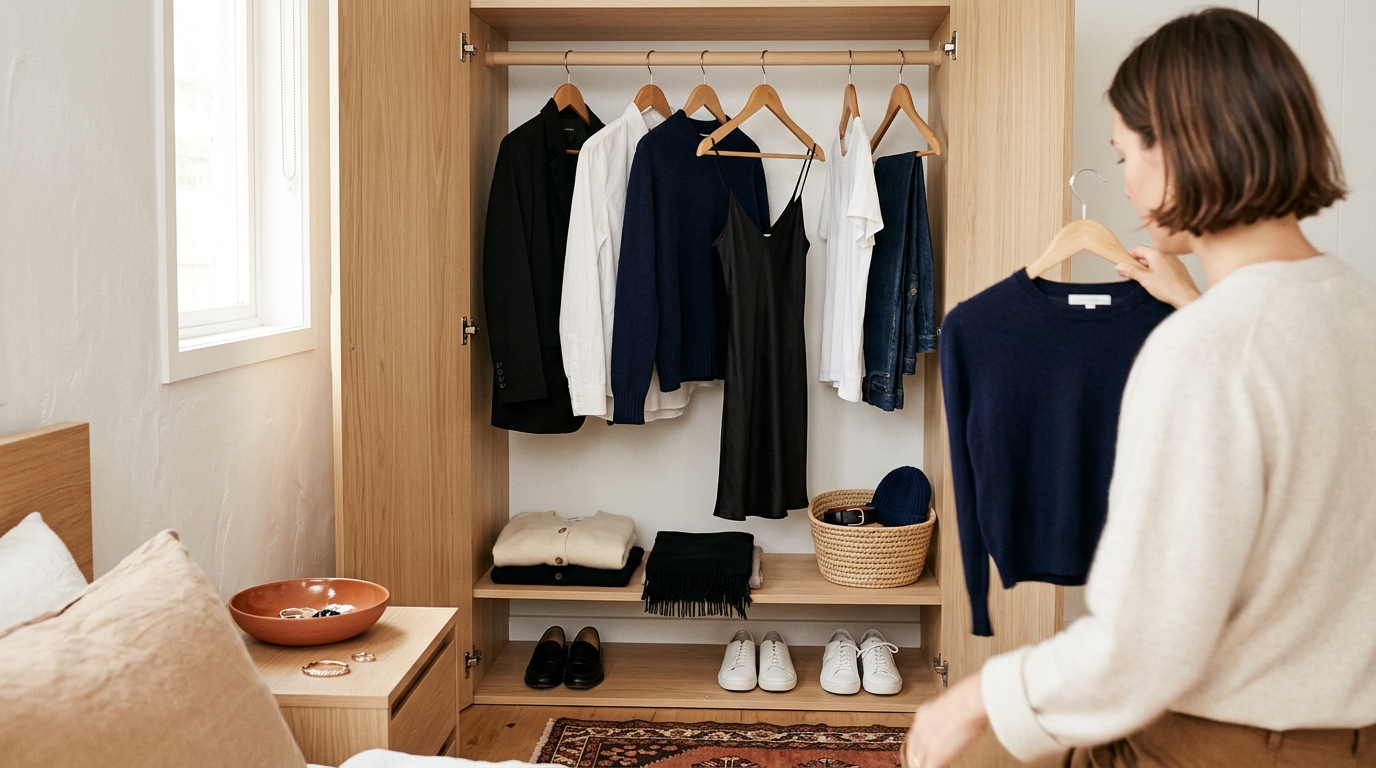
A capsule wardrobe is a deliberately small, coordinated selection of garments for one season, in which every piece can be combined with every other. As a rule of thumb, a range of 25 to 40 pieces per season has become established.[1] The US blogger Caroline Rector, whose concept is frequently cited, draws the line more tightly: a maximum of 37 pieces per quarter, including tops, bottoms, dresses, a jacket, a coat and shoes. The term was coined by London boutique owner Susie Faux in the 1970s.
- What usually counts are tops, bottoms, dresses, jackets and shoes. Bags and accessories are included depending on the concept: in Project 333, for example, clothing, accessories, jewellery, coats and shoes all count.[2]
- Not counted are underwear, sleepwear and loungewear as well as sportswear.[2]
- The number is a guideline, not a law: Courtney Carver chose 33 for her Project 333 because it is easy to remember, and considers any number between 25 and 50 a workable framework as long as it fits your everyday life.[2]
| Average wardrobe | Capsule wardrobe | |
|---|---|---|
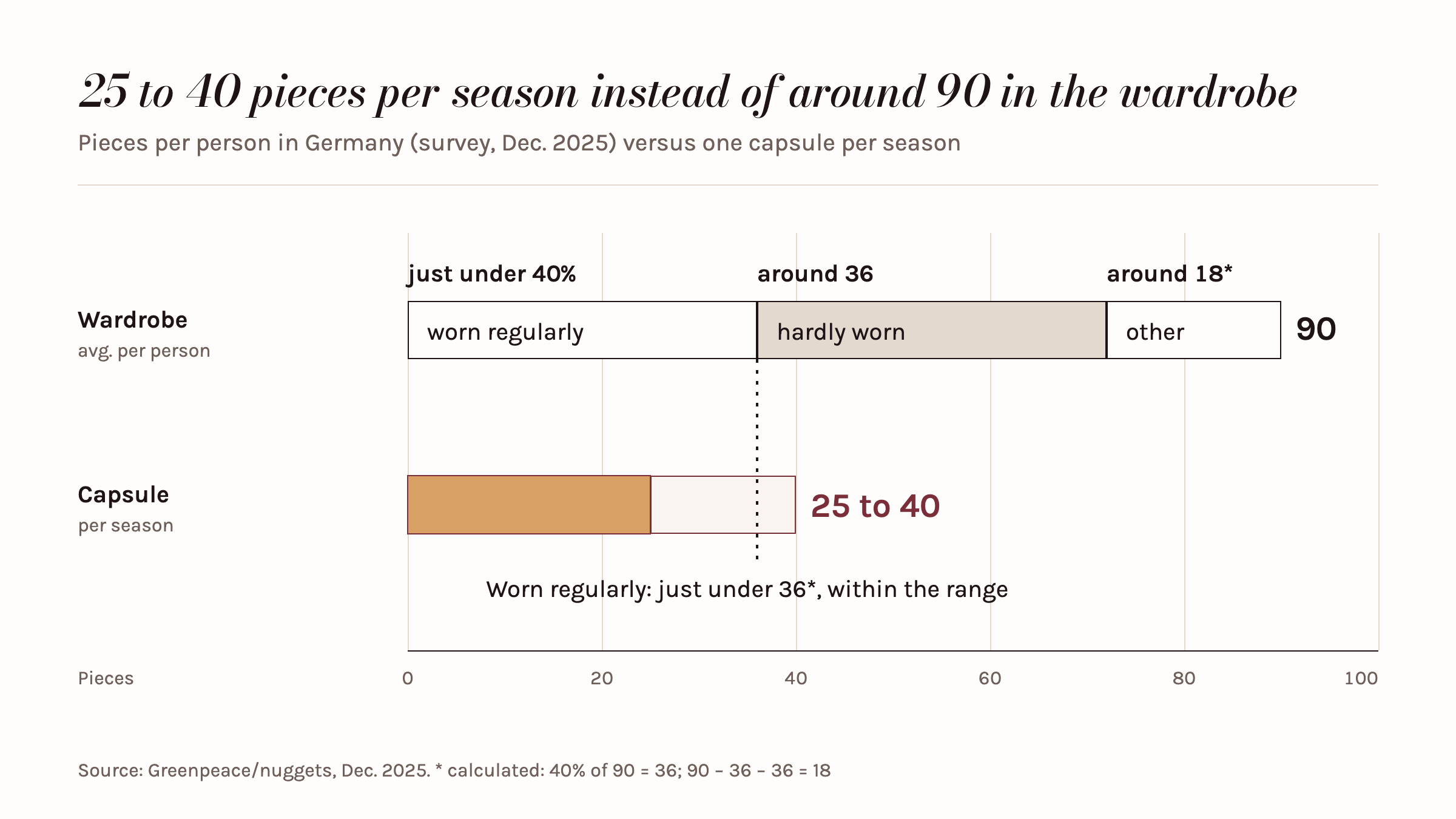
| Size | [3]around 90 pieces per person | [1]25 to 40 pieces per season |
| Worn regularly | [3]just under 40 percent of clothing | all pieces in regular rotation |
| Barely used pieces | [3]around 36 per person | none, every piece has a purpose |
The comparison shows why the concept appeals. According to a representative online survey commissioned by Greenpeace from the market research institute nuggets and published in December 2025, each person in Germany statistically owns about 90 garments, of which around 36 are worn less than once every three months or no more than twice in total; only just under 40 percent of clothing sees regular use.[3] A capsule wardrobe turns this ratio around because it only admits pieces that are actually worn. Anyone who needs more for a formal profession or special occasions should plan at the upper end of the range.
How do I start a capsule wardrobe?
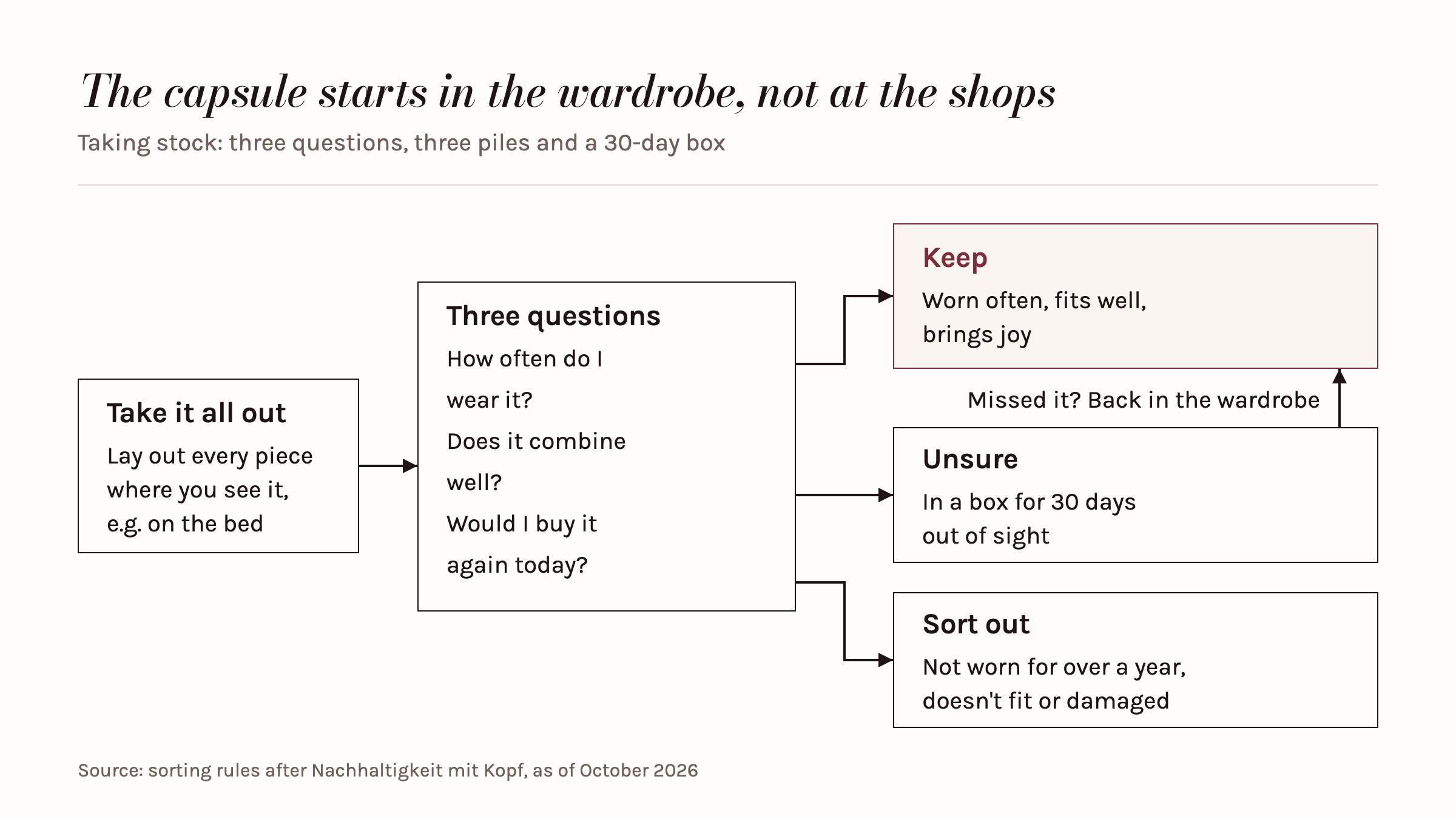
A capsule wardrobe starts with taking stock, not with buying new. Take every garment out of the wardrobe and lay it out visibly, for example on the bed. This immediately shows you how many pieces you own and which colours repeat. Three questions help with sorting: How often do I wear this piece? Does it combine well? Would I buy it again today?
Three piles and one box
- Keep the pieces you wear regularly, that fit well and that you enjoy.
- Sort out clothing that has not been worn for more than a year, no longer fits or is damaged.
- Pieces you are unsure about go into a box out of sight for 30 days. If you miss an item during that time, return it to the wardrobe.[1]
For ongoing checks, the hanger method works well: hang all hangers in the same direction and turn a hanger around once you have worn the piece. After three months, the untouched hangers show which items remain unused.[1]
In parallel, define your style in three words — for example classic, casual and practical — and derive a colour palette from it: 2 to 3 base colours, plus 1 to 2 neutral tones and 1 to 2 accent colours.[1] Do not declutter radically while doing so: anyone who gives away too much at once regrets individual decisions and later buys back what was sorted out. That runs counter to the goal of a capsule.
Which garments belong in a capsule wardrobe?
A capsule wardrobe consists of tops, bottoms, jackets, shoes and a few accessories, in the quantities shown in the table below. The figures are guidelines for one season. What matters more is the rule behind them: every top should match several bottoms. On paper, just 5 tops and 4 bottoms already yield 20 combinations, and 8 tops and 6 bottoms 48 — before jackets, shoes and accessories come into play.
| Category | Quantity | Examples with materials | Typical use |
|---|---|---|---|
| Tops | 5 to 8 | cotton T-shirt, blouse, merino wool jumper | everyday wear, office, cool evenings |
| Bottoms | 4 to 6 | dark jeans, chinos, skirt or dress | from casual to smart, depending on the occasion |
| Jackets and coats | 2 to 3 | blazer, trench coat, winter coat | office, transitional season, winter |
| Shoes | 3 to 4 | sneakers, ankle boots, dress shoes | everyday wear, wet weather, festive occasions |
| Accessories | 3 to 5 | scarf, belt, versatile bag | changing accents to existing outfits |
With materials, the planned use and the care effort count. Cotton usually tolerates a normal machine wash, while fine knitwear needs gentler treatment. Check the care label before a piece makes the selection: an item that only tolerates a delicate or hand wash gets worn less often in everyday life.
The colour palette determines the number of outfits. If base and accent colours work together, 25 to 40 pieces can produce more than 100 outfit combinations.[1] Choose the accent colours to suit your own skin tone.[1]
How do I build a capsule wardrobe for women?
A capsule wardrobe for women can be built with just 12 pieces for spring and summer: this yields more than 50 different outfits.[1] One example:
- Tops: white T-shirt, Breton shirt, blouse, lightweight merino jumper
- One piece for warm days: wrap dress, worn on its own or with a denim jacket over it
- Bottoms: dark jeans, chinos, midi skirt
- Jackets: blazer and denim jacket
- Shoes: sneakers and sandals
With accessories such as a scarf, belt and a versatile bag, the number of combinations rises to over 80.[1] When travelling, the same selection works scaled down in a suitcase, because there too it is mix-and-match potential that decides how many outfits emerge from a few pieces.
The composition depends on your daily life. Anyone who wears a suit to work will not get by with 30 pieces, Berlin personal shopper Andrea Lakeberg told the German Press Agency; in that case, she recommends dividing the wardrobe between work and leisure. The basic principles apply regardless of gender — only the pieces differ.
What belongs in a basic wardrobe?
A basic wardrobe consists of timeless basics worn across several seasons: dark jeans, plain shirts, a blazer or cardigan, a coat and all-round shoes. The basic wardrobe is therefore the foundation, and the capsule wardrobe is the seasonal slice taken from it. A blazer remains part of the foundation for years, appearing in the summer capsule alongside sandals and in the winter capsule alongside the wool coat.
- Dark jeans that work for both dressy and casual outfits
- Plain T-shirts and tops in white, black, beige or grey
- A blazer or cardigan for the office and cool evenings
- A coat for the cold season
- Sneakers as an all-rounder for spring, summer and autumn
Basics make up around 70 percent of a functioning capsule.[1] Their value depends on how often they are worn and how long they withstand that use.
When buying new basics, concrete checks help more than blanket promises: neatly stitched seams, sturdy buttons and a material that survives the planned care routine. Certificates such as GOTS or Fairtrade offer verifiable guidance on origin and production conditions.[1] No label tells you anything about fit, yet fit decides whether a piece gets worn often. Before buying new, it is worth looking at second-hand first.
How does a capsule wardrobe work?
A capsule wardrobe works through rotation: every three months, at the change of season, you swap pieces out and store the rest out of sight, for example in a lidded box.[2] During the season nothing new is added; purchases are made deliberately at the changeover. With Courtney Carver's Project 333, 33 pieces stay in use for a quarter, and everything else is packed away.[2]
For spring and autumn, which are the hardest to plan, layering helps: well-matched layers that can be shed as the day goes on. The same principle works in a suitcase when a trip covers several temperatures and occasions. Whether a piece is worth it is shown by the formula cost per wear = purchase price ÷ number of wears, which the magazine of the fashion label Salzwasser (2022), among others, has worked through. The figures in the table are assumptions for illustration, not market data:
| Piece | Purchase price (assumption) | Use (assumption) | Cost per wear |
|---|---|---|---|
| Simple shirt | €5 | worn ten times | [4]€0.50 |
| Higher-quality shirt | €40 | once a week over five years, around 250 wears | [4]around €0.16 |
The calculation shows why quality matters in the foundation: a more expensive piece that is worn regularly costs less per use than a cheap one hanging in the wardrobe.[4] The prerequisite is that it matches at least three other pieces and that its care fits into everyday life.[1] Anyone who keeps a capsule going over several seasons also knows exactly what they own and what is missing.[5]
Building a capsule wardrobe: the checklist
You can build a capsule wardrobe in six steps, from taking stock to targeted additions:
- Taking stock: take every garment out of the wardrobe and sort into keep, discard and undecided.
- Define your style: settle on three words that describe your personal style.
- Set your colour palette: 2 to 3 base colours, 1 to 2 neutral tones and 1 to 2 accent colours.
- Choose pieces: check each piece for purpose and mix-and-match potential — it must match at least three others.
- Test outfits: put together at least 30 different outfits.[1]
- Fill the gaps: write missing pieces on a wish list and add them deliberately.
Two rules accompany every step. Wait 30 days before each purchase and check whether you still want the item; look at second-hand first before buying new.[1] If a piece breaks and cannot be repaired, replace it with a matching one rather than buying more than you need.
Use this checklist to review your own wardrobe and note which occasions are still uncovered. This list usually turns out shorter than the full closet suggests.
Frequently asked questions
How many items belong in a capsule wardrobe?
25 to 40 items per season is common; some concepts cap it at a maximum of 37 items per quarter. Underwear, sportswear and sleepwear are not counted, while shoes and jackets are. The exact number depends on your daily life: if you wear a suit or tailored outfit to the office, you need more items.
Do underwear and shoes count toward a capsule wardrobe?
In the common concepts, underwear, socks, sleepwear and sportswear are not counted. Shoes, jackets and coats, however, do belong to the capsule wardrobe. Bags, jewellery and accessories count depending on the concept — in Project 333, for example, they are explicitly included.
What is the difference between a basic wardrobe and a capsule wardrobe?
The basic wardrobe is the season-spanning foundation of timeless basics such as dark jeans, a plain T-shirt, a blazer and a coat. The capsule wardrobe is the seasonal slice of it, which can be swapped every three months. Basics make up roughly 70 percent of a functioning capsule.
Do I have to buy everything new for a capsule wardrobe?
No, the process starts with taking stock of your existing closet, not with new purchases. The foundation is your existing favourite pieces; missing items can be added deliberately, and secondhand is an obvious option here. Before any purchase, the 30-day rule helps against impulse buys.
How many outfits are possible with a capsule wardrobe?
With a coherent colour palette of 2 to 3 base colours, 1 to 2 neutral tones and 1 to 2 accent colours, 25 to 40 items can be combined into more than 100 different outfits. Even around 12 well-matched items yield over 50 combinations.
How often do you switch a capsule wardrobe?
A change every three months is common, in other words at the start of each season. The previous season's items are stored away out of sight; new items are only added at the changeover.
Is a capsule wardrobe financially worthwhile?
The cost per wear calculation shows this: purchase price divided by the number of wears. A shirt costing 5 euros that is worn ten times costs 50 cents per wear; a shirt costing 40 euros, worn weekly for five years, only around 16 cents. What matters is mix-and-match potential and durability, not the price alone.