Converting clothing sizes: EU, UK, US, IT and FR
Convert clothing sizes between EU, UK, US, IT and FR: rules of thumb and charts for women's and men's sizes, plus why the manufacturer's chart is what counts.
Contents
How can I convert clothing sizes?
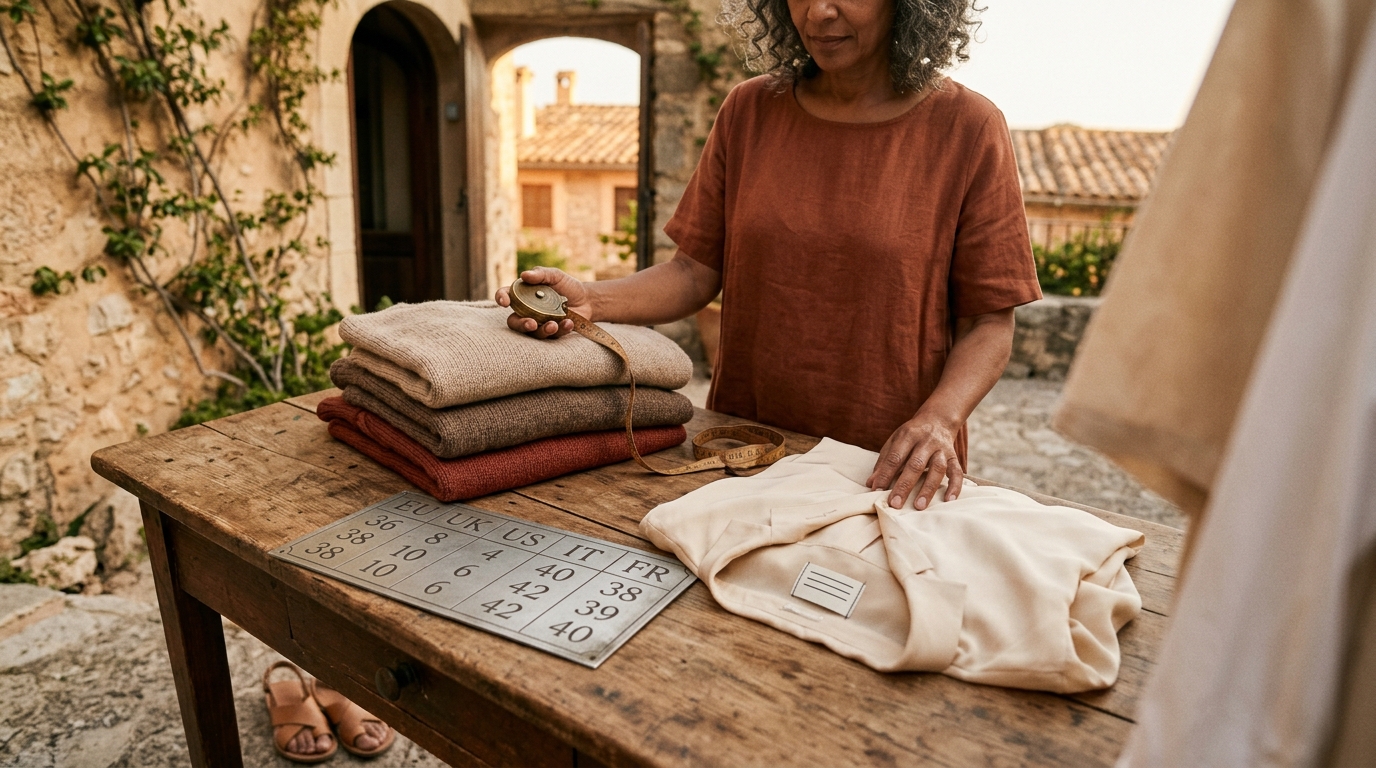
Converting clothing sizes works most reliably in three steps: first take your own body measurements, then compare these measurements against a conversion chart, and finally cross-check the chosen size in the manufacturer's size chart. The starting point is always your own measurements in centimetres, not the number you last wore.[1] That is because the same garment size fits differently depending on the brand and the cut.
- Chest: hold the tape measure horizontally around the widest part of the ribcage, standing relaxed with arms hanging loosely.
- Waist: place the tape measure around the narrowest part of your midsection, usually slightly above the navel.
- Hips: run the tape measure horizontally around the fullest part of the hips and bottom.
- Tip without a tape measure: wrap a non-elastic piece of string around the relevant spot, mark where it meets, and then read off the length with a folding rule.
The theoretical garment size can even be calculated from the chest measurement. For men, divide the chest measurement by two; for women, also divide by two and then subtract six. A chest measurement of 88 cm therefore works out to men's size 44 and women's size 38. This formula gives you a usable starting size — but nothing more.
Worth knowing: there is no internationally valid, binding standard for clothing sizes. General conversion charts like the one below are therefore at best a rough guide, because every manufacturer designs its cuts on the basis of its own measurements and allowances.[1]
What does the EU size correspond to?
The EU size corresponds to the German garment size and is based on the chest measurement. The European standard EN 13402 for clothing size labelling works with body measurements in centimetres and classifies chest circumference mostly in 4-cm steps, for example 88, 92, 96 cm and so on.[2] In theory, then, the number on the label stands for a real body measurement, not an arbitrary catalogue number.
Alongside numeric sizes, international letter sizes have become established, with the X standing for "extra". According to the chart from Bergzeit, the mapping looks like this:[1]
| International size | Men (EU) | Women (EU) |
|---|---|---|
| XS | 44 | 34 |
| S | 46 | 36 |
| M | 48 | 38 |
| L | 50 | 40 |
| XL | 52 | 42 |
| XXL | 54 | 44 |
On this basis, a men's size 48 corresponds to size M, and a women's size 38 likewise. Other charts place women's sizes one step lower: size.ly lists 38 as S and 40 as M.[3] It is also worth noting that different measurements are decisive depending on the garment: for men's outerwear it is usually the chest measurement, for women's fashion, depending on the piece, bust, waist and hips, and for trousers additionally the waistband. That is why the same person may fit a given size differently well in tops and trousers.
Is the EU size the same as the German size?
The short answer: yes. The German garment size and the EU size use the same numbering — a German 38 is also a European 38. The German standard sizes also apply in Austria, Switzerland, the Czech Republic, Denmark, the Netherlands and Poland. Anyone buying in these countries can stick with their usual number.
One important caveat concerns the Romance neighbouring countries: for women, France and Italy use higher numbers. A German 38 corresponds to a French 40 and an Italian 44. Anyone shopping in Paris or Milan is therefore better off converting their size in advance.
And even with the same number, not every 38 is a 38: the actual measurements can vary by manufacturer, because brands from different countries draw on different national body surveys and cut logic.
What size is 2XL?
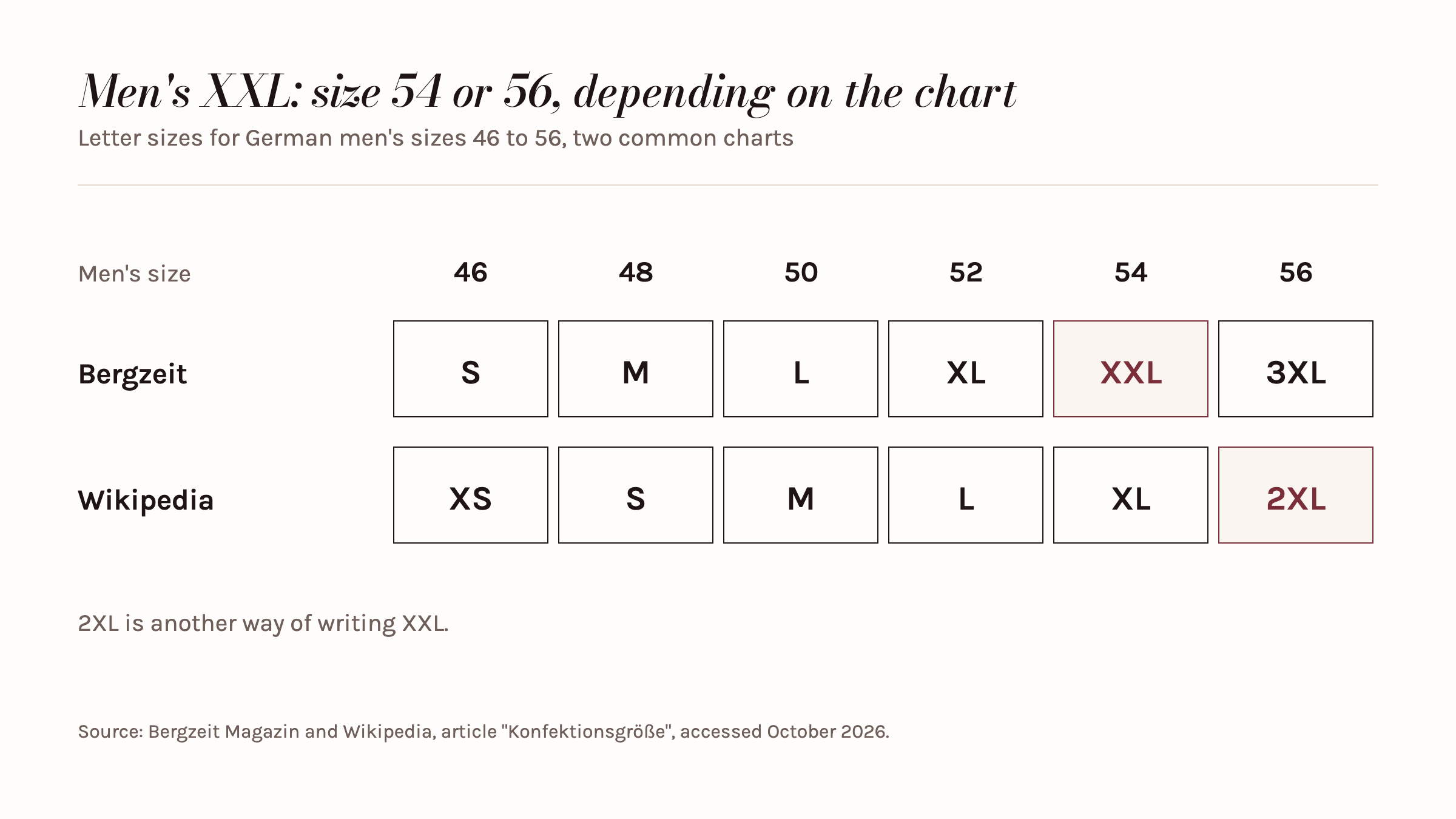
2XL is not a size of its own, just another way of writing XXL. Both abbreviations stand for "extra extra large" and denote the same step after XL. Which garment size lies behind them depends on whether it is women's or men's clothing.
| Area | 2XL corresponds to | Chest measurement |
|---|---|---|
| Men | Garment size 54 | 106 to 109 cm |
| Women | Garment size 44 | 98 to 102 cm |
A note on accuracy: letter sizes are not standardised, and especially with men's sizes some manufacturers place XXL one step higher, at size 56 with a chest measurement of 110 to 113 cm. Both figures circulate because the mapping of letters to numeric sizes varies by brand. For women, the range that many assortments carry as plus sizes begins at around size 46; where exactly this transition lies, however, is not defined and remains fluid.
Which size corresponds to XXL?
XXL corresponds to EU size 44 for women and EU size 54 for men. The international equivalents at a glance:
| Area | EU | UK | US | FR | IT |
|---|---|---|---|---|---|
| Women XXL | 44 | 16 | 12 | 46 | 50 |
| Men XXL | 54 | 44 | 44 | 52 | 54 according to size.ly, 56 according to Portanapoli |
To distinguish the next step: 3XL corresponds to EU size 46 for women and EU size 56 for men. Anyone who regularly buys letter sizes knows this: with one brand XL fits, with the next you already need XXL.
Converting clothing sizes internationally
The following overall table brings together the common systems for women's and men's clothing, as of October 2026. The UK and US values for women follow the conversion from size.ly, the French men's sizes follow the table from Bergzeit.[3][1]
| EU | UK | US | FR | IT |
|---|---|---|---|---|
| 34 | 6 | 2 | 36 | 40 |
| 36 | 8 | 4 | 38 | 42 |
| 38 | 10 | 6 | 40 | 44 |
| 40 | 12 | 8 | 42 | 46 |
| 42 | 14 | 10 | 44 | 48 |
| 44 | 16 | 12 | 46 | 50 |
| 46 | 18 | 14 | 48 | 52 |
| EU (men) | UK and US | FR |
|---|---|---|
| 46 | 36 | 44 |
| 48 | 38 | 46 |
| 50 | 40 | 48 |
| 52 | 42 | 50 |
| 54 | 44 | 52 |
| 56 | 46 | 54 |
Simple rules lie behind this. For women, the Italian numbers sit six above the German ones, i.e. three two-step increments higher, and the French two above.[1] For men there is no difference between UK and US; the rule is: German size minus ten, so 50 - 10 = 40.[4][5] size.ly equates Italian men's sizes with the German ones, while Portanapoli observes in practice roughly one size more — a German 54 corresponds there to an Italian 56. A rule of thumb like the one for women does not work reliably here.
One limitation concerns the US and UK markets in particular: vanity sizing is widespread there — the practice of labelling the same body with smaller numbers. The former US sizing standard was withdrawn in 1983, and since then US sizes have run more generously than decades ago. The numbers shift as a result, one more reason to rely on the size chart rather than the familiar number when buying abroad.[3]
Converting women's sizes: EU, UK and US
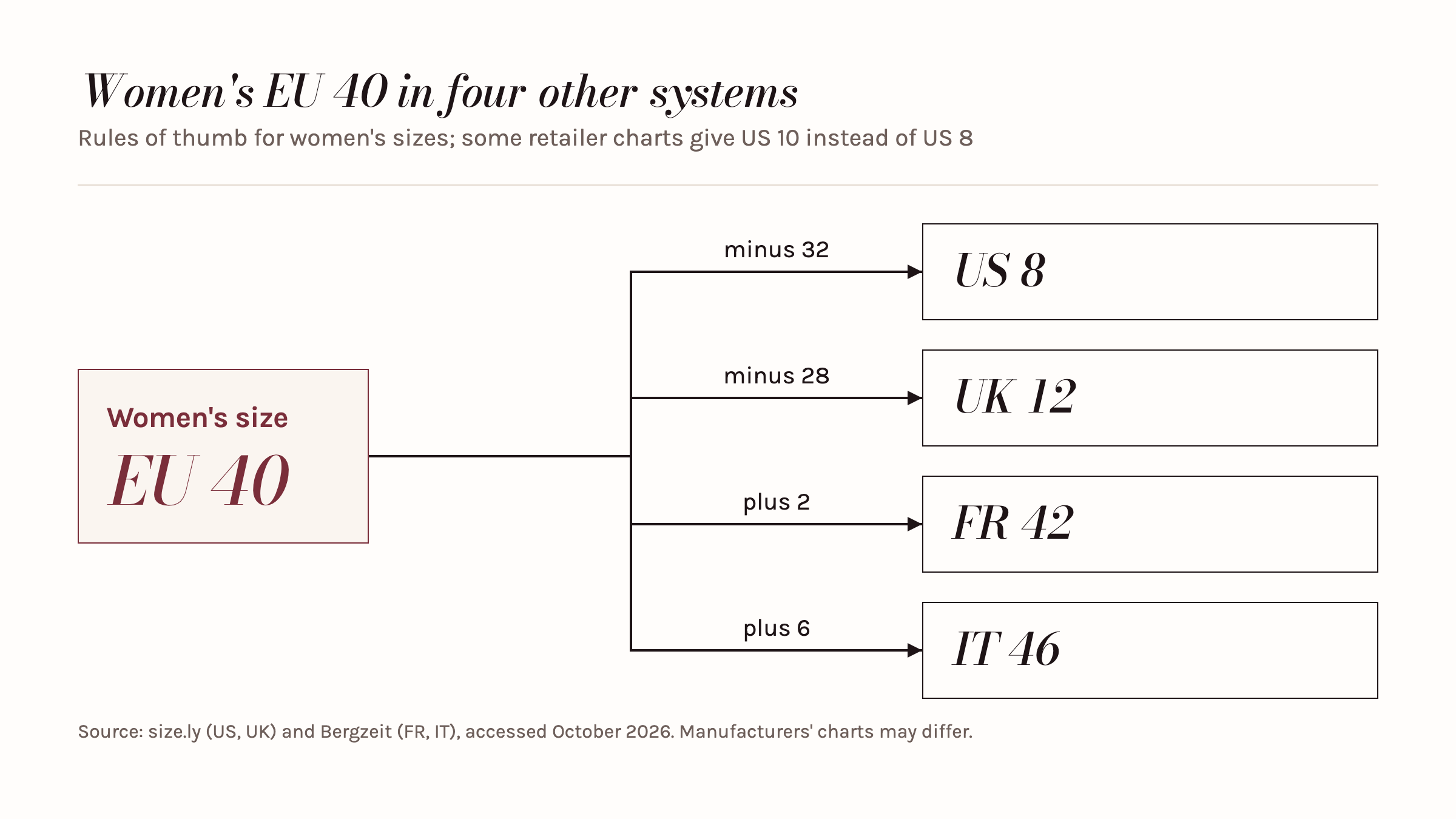
For women's sizes, two rules of thumb are enough to switch between the three most important systems. Subtract 32 from the EU size to get the US size; add 4 to the US size to get the UK size. An example: EU 42 = US 10 = UK 14.[3] In reverse, US plus 32 leads back to the European number.
- Jeans and trousers often follow their own system: the inch size states waistband and inseam in inches, for example 32/34.
- To convert, divide your centimetre value by 2.54, because one inch equals 2.54 cm.
- A waistband of 32 inches therefore corresponds to roughly 81 cm, and an inseam of 34 inches to roughly 86 cm.
- For trousers, some manufacturers also mark the leg length with R (regular), S (short) or L (long).
In practical terms, this means for buying: if you are torn between two sizes, go by the chest measurement, because it is the leading measurement for most tops. And before you order the chosen size, check it against the manufacturer's size chart, because only that tells you anything about the specific cut.[1] That is how you get a good fit even when the label carries an unfamiliar number.
Frequently asked questions
Is XXL the same as 2XL?
Yes, 2XL is simply another way of writing XXL (double extra large). For women, XXL usually corresponds to EU size 44; for men, to garment size 54. The actual measurements can vary by brand.
Which US size corresponds to the German 38 for women?
A German or EU size 38 for women usually corresponds to US size 6 and UK size 10, and internationally to S or M depending on the chart. As a rule of thumb: EU size minus 32 gives the US size, plus 4 on top of that gives the UK size.
Do Italian sizes run small?
Italian sizes are numbered higher, not cut larger: a German 38 corresponds to IT 44. Italian brands also tend to cut slim.
Does the German garment size also apply in Austria and Switzerland?
Yes, the German standard sizes such as 38, 40 or 42 are also used in Austria, Switzerland, the Czech Republic, Denmark, the Netherlands and Poland. The actual cut measurements can still vary by manufacturer.
How do I measure chest and waist correctly?
Use a flexible tape measure that sits close to the body without digging in. The chest measurement is taken horizontally at the widest point of the ribcage, the waist at the narrowest point of the torso, and the hips at the widest point. Write the values down, then you can look them up in any size chart.
Can I rely on general conversion charts?
Only to a limited extent. There is no internationally binding standard for clothing sizes; in the US and the UK, vanity sizing also shifts the numbers. General charts offer a first orientation, nothing more.
What is the difference between EU size and German size?
There is no difference in numbering: the German garment size and the EU size use the same numbers. Differences appear with women's sizes in neighbouring countries: France counts one step higher, Italy three, so a German 38 is listed there as FR 40 or IT 44.