Hard-Shell or Soft-Shell Suitcase: Pros and Cons
Hard-shell or soft luggage? Protection, weight, wheels, capacity and rain compared, with findings from Stiftung Warentest and a rule for each type of trip.
In this article9
- What size is a 23 kg suitcase?
- What are the pros and cons of plastic recycling?
- What are the disadvantages of polypropylene suitcases?
- What are the disadvantages of a hard-shell suitcase?
- Hard-shell or soft luggage
- Suitcase: hard-shell or soft luggage
- Hard-shell or soft suitcase
- Frequently asked questions
- Sources
What size is a 23 kg suitcase?
There is no fixed size for a 23 kg suitcase, because 23 kg is a weight limit, not a size. Airlines limit size separately. On Lufthansa, a checked bag in Economy may weigh 23 kg, and width, height and depth together may not exceed 158 cm.[1] Anything above that is charged as excess baggage.
A case measuring 75 × 50 × 30 cm adds up to 155 cm and stays below the limit. A model measuring 79 × 52 × 31 cm comes to 162 cm and is already over it. Use the outside dimensions including wheels and handles, because that is how airlines measure.
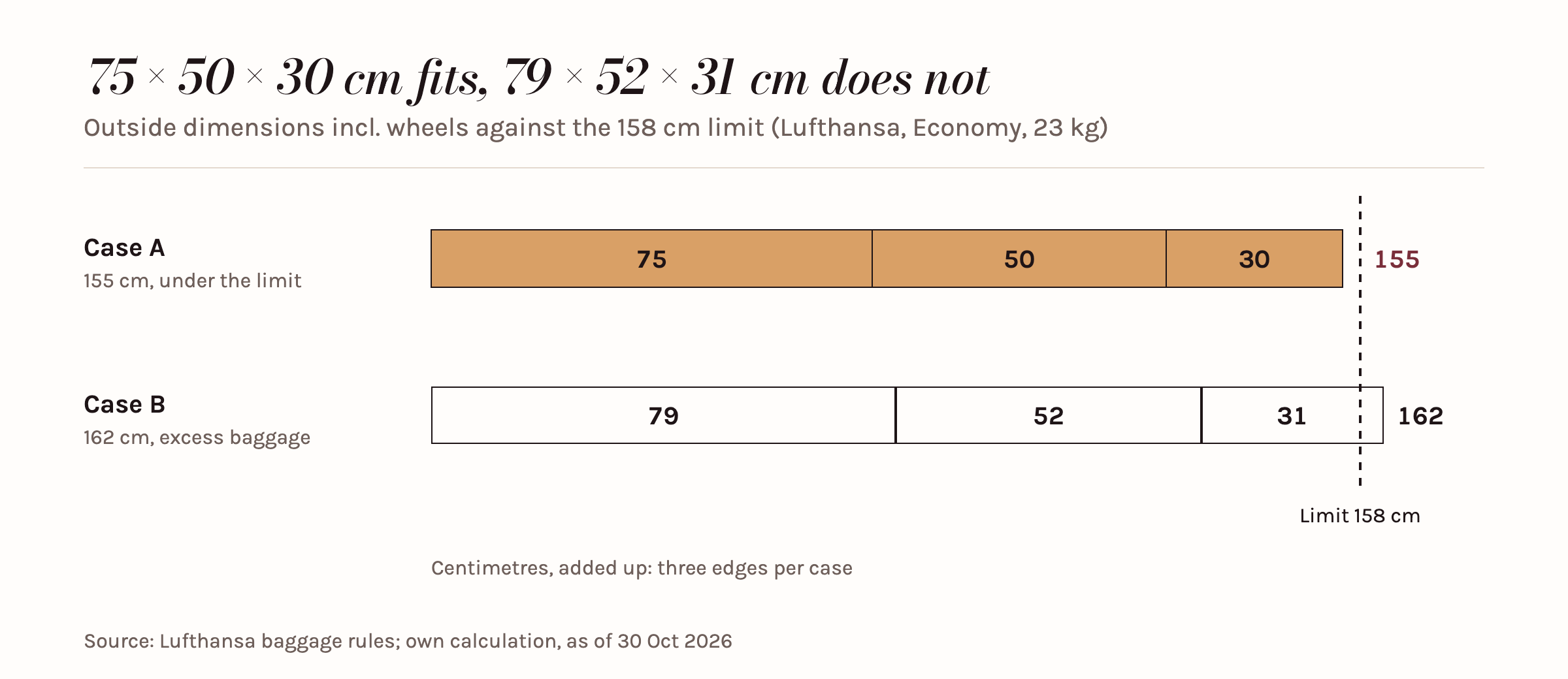
This matters when choosing between hard-shell and soft luggage. A hard shell keeps its outside size however full it is. Soft luggage with an expansion zip can grow past 158 cm when the zip is open. The empty weight counts too: twelve medium-sized soft-shell cases in a test by the Swiss magazine saldo weighed between 2 and 4.5 kg empty.[2] Every kilo of suitcase is a kilo less for what you pack.
What are the pros and cons of plastic recycling?
Recycled plastic has become a selling point for suitcases. In 2021 Samsonite launched its Magnum Eco range, with shells made from recycled polypropylene and a lining made from recycled PET bottles.[3] In soft luggage the recycled material is usually in the fabric, in hard-shell cases in the shell.
The advantage: according to Germany's Federal Environment Agency (UBA), recycled plastics generally have less harmful climate and environmental effects than plastic made from crude oil.[4]
The drawbacks lie in proof and quality:
- Proof: You cannot tell from looking at a plastic whether it is recycled, and even laboratory tests cannot say so reliably. The UBA had ten certification schemes examined and found considerable differences in the scope, depth and transparency of their checks.[4]
- Purity: High-quality recycling needs clean input material. Sorted polypropylene waste, however, also contains missorted items, moisture and residues.[5]
For buyers, this means: with a recycled suitcase, ask what share is recycled and who confirms it. A claim without a certification scheme cannot be checked. Stiftung Warentest rates environmental properties as a separate test criterion for carry-on cases.[6]
What are the disadvantages of polypropylene suitcases?
Polypropylene suitcases are light, but less stiff and more sensitive to cold than polycarbonate shells. Polypropylene is the standard plastic with the lowest density, which keeps the empty weight down. As a pure homopolymer, it becomes brittle below 0 °C.[7] How a particular case behaves in winter depends on the exact blend, which manufacturers rarely disclose.
Polycarbonate, by contrast, is strong, impact-resistant and stiff. Its weak point is UV light: without a protective coating, it can yellow and become brittle over time.[8]
For the basic choice between hard-shell and soft luggage, this overview is enough. A detailed comparison of polycarbonate, ABS, aluminium and nylon is a topic of its own.
What are the disadvantages of a hard-shell suitcase?
The biggest disadvantage of a hard-shell suitcase is that it gives you little flexibility when packing. Stiftung Warentest puts it this way: if you want to put a jacket on top at the last minute, you quickly reach the limits of the rigid shell.[6]
Three more points add to that:
- Weight: Fabric cases are lighter on average than hard-shell suitcases.[2]
- Wheels and drops: Fabric cases are considered better protected against drop damage, and their wheels are considered more robust.
- Access: A hard shell rarely has outside pockets. It opens in two halves and needs twice the space, in a hotel room as much as at the gate.
For carry-on luggage these disadvantages weigh less. The fixed outside size is even an advantage there, because the case still fits the airline's sizer when fully packed. It becomes awkward when you want to reach your laptop or passport on board: then the whole case has to come open.
Hard-shell or soft luggage
Hard-shell wins on protection, rain and care; soft luggage wins on capacity, access and usually weight. The overview below sets the findings of the two tests side by side, as of 30 October 2026.
| Criterion | Hard-shell suitcase | Soft luggage |
|---|---|---|
| Protecting the contents | protects against knocks and pressure | fabric gives way, fragile items need padding |
| Rain | mostly more rain-resistant in the test | water gets in more easily through zips |
| Capacity | rigid, no reserve | takes a little more, often with an expansion zip |
| Outside pockets | rare | common, for example for documents |
| Empty weight | heavier on average | lighter on average |
| Wheels and drops | wheels considered less robust | considered better protected against drop damage, sturdier wheels |
| Care | easy to wipe clean | fabric cannot simply be wiped clean |
| Harmful substances in test 6/2026 | less often affected | mostly soft-shell cases affected |
The findings on protection, rain, capacity, outside pockets, care and harmful substances come from Stiftung Warentest's test of 17 carry-on cases in May 2026.[6] Five models were rated poor because handles and outer materials contained harmful substances such as PAHs and PFAS. Weight and drop damage are based on the saldo test that Stiftung Warentest reported on. There, seven of twelve soft-shell cases had puddles inside.[2]
To put this in context: ten of the 17 cases in test 6/2026 were rated good, and prices of the models tested ranged from 50 to 710 euros. According to Stiftung Warentest, price is no guide, as good and poor cases came at both ends of the price range.
Suitcase: hard-shell or soft luggage
Which suitcase suits you depends on the type of trip. Four situations cover most cases:
- Flight with checked luggage: hard-shell. The case is loaded and stacked, and the shell protects souvenirs, bottles and electronics. Watch the 158 cm rule and an empty weight that leaves you enough of the 23 kg.
- Carry-on for frequent flyers: either works; what matters is outside size and weight. If you want your laptop and documents at your seat, the outside pockets of soft luggage help. If you always pack to the limit, a hard shell gives you a size that does not bulge. The airlines' current limits are in the overview of carry-on luggage sizes 2026.
- Car and train journeys: soft luggage. It adapts to the boot and the luggage rack, and changing loads are no problem.
- Tour with changing luggage: soft luggage with an expansion zip, because something is often added along the way.
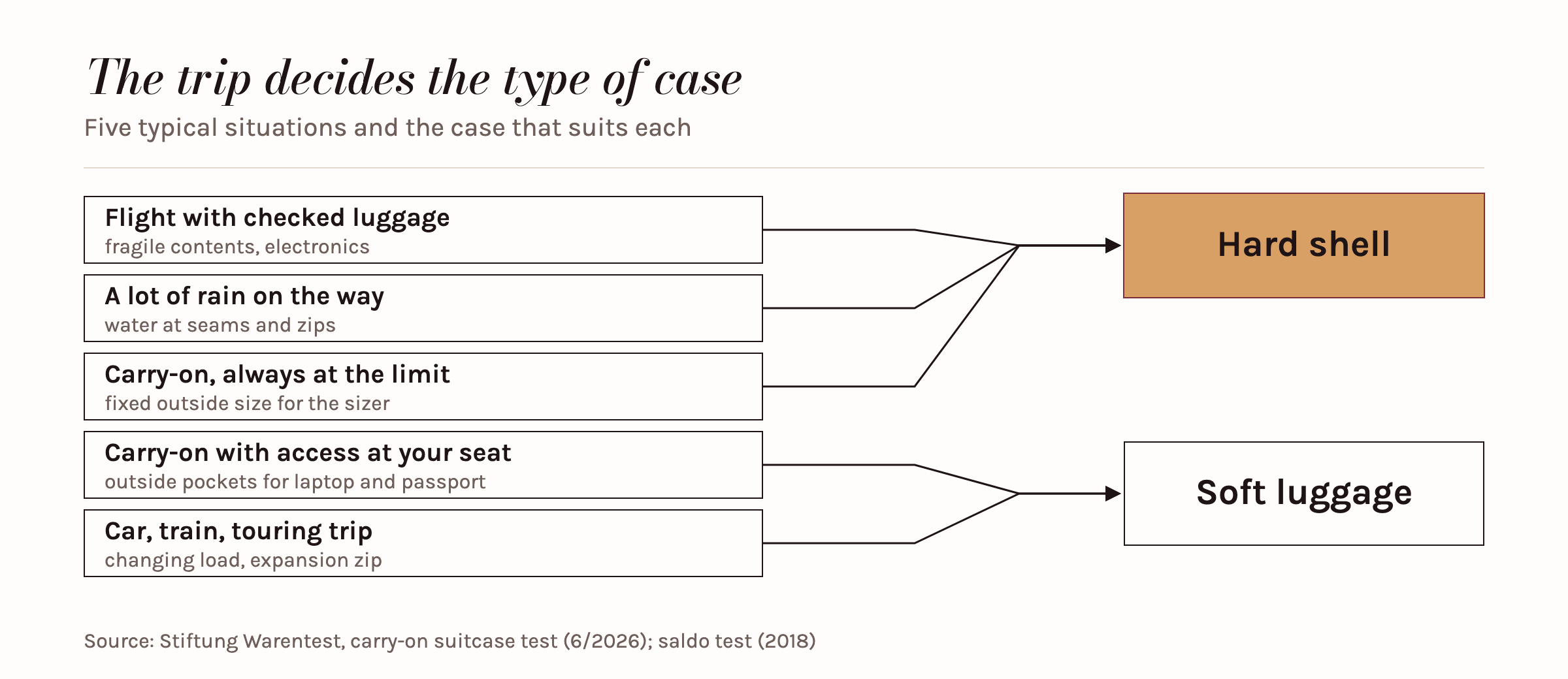
If you expect frequent rain, more speaks for the hard shell. Soft luggage with water-repellent fabric only helps so much when water comes in through seams and zips. How waterproofness is measured for textiles is explained in the piece on hydrostatic head.
Hard-shell or soft suitcase
Choose the case in two steps: first the type according to the trip, then the model according to four criteria. That way you compare models of the same type on facts.
- Material: Hard-shell labels usually say polycarbonate, polypropylene, ABS or aluminium; soft luggage says nylon or polyester. For recycling claims, ask about the certification scheme.
- Empty weight: The lighter the empty case, the more the airline's weight limit leaves for your things.
- Wheels: Four wheels make pushing through the terminal easier. In Stiftung Warentest's endurance test, the cases covered 50 kilometres over bumpy tracks, and the good ones came through without significant damage.[6]
- Capacity: Plan by trip length and weight limit, not by the largest model. A large case that goes over 23 kg when full costs fees at the counter.
Before buying, also check whether wheels and handles can be replaced individually. That extends the life of a case more than any material. How Adtouro selects comparisons and sources is described in its methodology.
Frequently asked questions
Is a hard shell better for carry-on luggage?
Not in principle. A hard shell keeps its outside size and fits the sizer when fully packed. Soft luggage has outside pockets for documents and a laptop instead. If you often need things on board, soft luggage is often the better fit.
What are the disadvantages of soft luggage?
Soft luggage protects fragile contents less well against pressure, the fabric can tear, and water gets in more easily through zips. In the 2026 Stiftung Warentest test, it was also mainly soft-shell cases that contained harmful substances.
Do hard-shell suitcases break more easily?
Not across the board. Fabric cases are considered better protected against drop damage, but in the 2026 test all good models passed the drop test. What matters is build quality, wheels and whether spare parts are available.
How heavy can an empty suitcase be?
There is no limit for the empty weight, but it counts towards the airline's weight limit. Medium-sized soft-shell cases weighed between 2 and 4.5 kg empty in the saldo test.
Sources
Related reading
All Luggage →Carry-On Luggage Sizes 2026: Overview for 13 Major Airlines
Carry-on sizes for 2026 from Lufthansa to Turkish Airlines: dimensions, weight and small bag per airline, and the one size that fits them all.