Hydrostatic head explained: which values are enough for jackets, shoes and tents
Hydrostatic head explained: 10,000 mm for rain jackets, 3,000 mm for the tent fly, 5,000 mm for the tent floor. What ISO 811, EN 343 and the Ret value mean.
Contents

What hydrostatic head does a tent need?
A tent needs two values: around 3,000 mm for the fly and at least 5,000 mm for the floor. The fly is stretched above the inner tent, rain runs off, and the material is barely stressed. The floor, by contrast, carries your entire weight — and point loading at that. A blanket figure for "the tent" is therefore misleading.
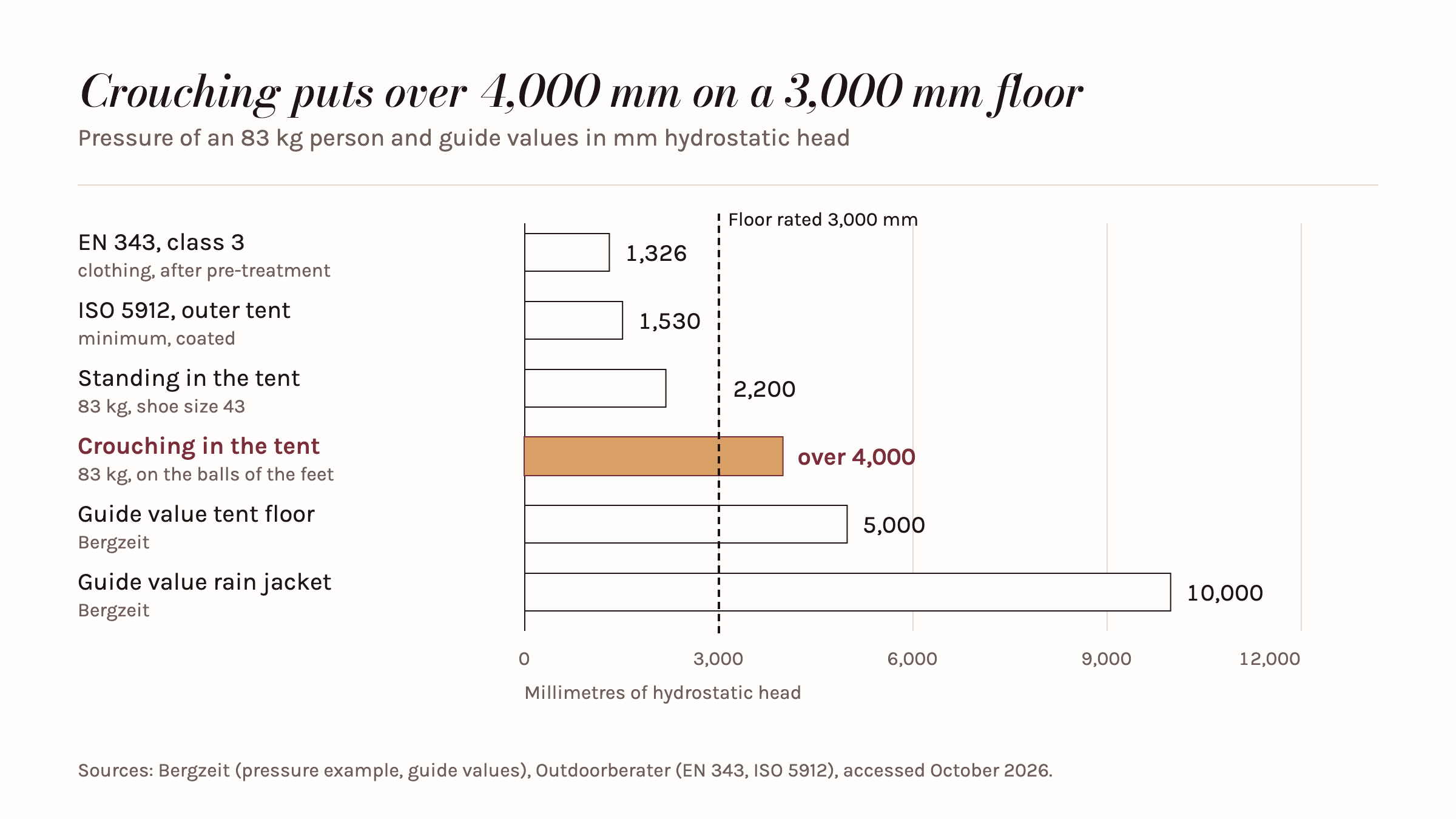
Why the floor has to withstand so much becomes clear with a simple thought: anyone kneeling in the tent or crouching on the balls of their feet while rummaging in their backpack concentrates their body weight on a tiny area. A calculation by the Bergzeit editorial team: a person weighing 83 kilograms with shoe size 43 generates around 0.22 bar when standing, roughly 2,200 millimetres of hydrostatic head.[1] Crouching on the balls of the feet raises the pressure to about 0.4 bar, i.e.[1] over 4,000 millimetres of hydrostatic head. A floor with only 3,000 millimetres would no longer stay watertight under that load.
- Tent fly: from around 3,000 mm hydrostatic head — enough even in wind and sustained rain.[1]
- Tent floor: from 5,000 mm, because kneeling and lying down greatly increase the pressure.[1]
- For comparison, tent standard ISO 5912:2020: it requires at least 15,000 pascals (around 1,530 mm) for coated tent flies and, depending on the level, up to 50,000 pascals (around 5,100 mm) for tent floors.[2]
In addition, a groundsheet, usually sold as a footprint, protects the tent floor from sharp stones, branches and moisture from below. It extends the floor's lifespan and relieves the seams. All the guideline values mentioned are manufacturer or editorial figures: they describe the material in the laboratory, not the watertightness of the pitched tent with its seams and zips.
How long does a 20,000 mm hydrostatic head stay watertight?
A hydrostatic head of 20,000 mm says nothing about time: it is a pressure value describing how much water pressure a material can withstand before it becomes permeable. The test standard ISO 811 itself limits what the figure can tell you: the result is directly relevant to textiles exposed to water pressure over short to medium periods. It says nothing about hours of sustained rain.[2]
- 20,000 mm is headroom for mechanical pressure: heavy backpacks, straps pressing against your back, ski touring packs with bulky contents.
- It does not automatically mean longer protection in sustained rain, but a bigger buffer against point pressure.
- The value refers to the material, not the finished garment.
Actual watertightness therefore depends above all on the places the hydrostatic head never measures: seams, zips and seam tape. In the end, the workmanship of the whole garment matters more than the number on the label: a jacket with 20,000 mm and unsealed seams lets water through sooner than a cleanly made one with 10,000 mm.
Is 3,000 mm hydrostatic head good for a tent?
For the tent fly: yes. From around 3,000 millimetres, a tent fly is generally sufficiently watertight, even in wind and sustained rain. The reason lies in the construction: as with an umbrella, the material is under tension, water runs off instead of pooling in one spot and building up pressure. The static water pressure that the hydrostatic head measures hardly occurs on a tensioned tent fly.
For the tent floor, the same value is a compromise. Ultralight tents deliberately save weight here and accept lower watertightness; anyone camping with a light pack and a carefully chosen spot can get by with it. Those sleeping on rough ground or expecting prolonged wet conditions are better served by 5,000 mm and more.
For context: the European standard EN 343 for protective clothing assigns fabrics from around 1,300 millimetres to class 3, and from around 800 millimetres to classes 1 and 2.[2] So the 3,000 mm of a tent fly sits well above these clothing thresholds. The tent standard ISO 5912, by contrast, requires only around 1,530 mm for coated tent flies.[2]
| Tent part | Typical guideline | Why |
|---|---|---|
| Tent fly | from 3,000 mm | Material tension sheds water, low point pressure |
| Tent floor | from 5,000 mm | Body weight acts on a point, crouching generates over 4,000 mm |
| Ultralight floor | around 3,000 mm | A deliberate trade-off between weight and performance |
How watertight is 10,000 mm hydrostatic head?
10,000 millimeters of hydrostatic head is waterproof enough for rain jackets worn while running, cycling and hiking, and it is the established benchmark for that purpose. The value covers wind, movement and sustained wear, and under normal conditions it is sufficient even in sustained rain.[1] A conversion helps put it in perspective: 1,000 mm of hydrostatic head corresponds to a pressure of roughly 0.1 bar.[1] So 10,000 mm equals about 1 bar of water pressure before the material lets water through.
How waterproof is 3,000 mm of hydrostatic head?
3,000 millimeters of hydrostatic head is a solid value for rainwear and sufficient for the tent fly. EN 343 already assigns fabrics to class 3 from around 1,300 millimeters; 3,000 mm is more than twice that.[2] For the tent floor, however, 3,000 mm is only an ultralight compromise.
Measured against the standard's classes, the value even sits above the highest class: EN 343 measures after defined pre-treatment such as washing, abrasion and repeated flexing, not the as-new state.[2] Even the highest class 4 only starts at 20,000 pascals after pre-treatment, which converts to roughly 2,039 millimeters of hydrostatic head.[2] At 3,000 mm, a jacket therefore also sits above this toughest threshold.
| EN 343 class | Resistance to water penetration | Converted hydrostatic head |
|---|---|---|
| Class 1 and 2 | [2]from 8,000 Pa | [2]around 816 mm |
| Class 3 | [2]from 13,000 Pa after pre-treatment | [2]around 1,326 mm |
| Class 4 | [2]from 20,000 Pa after pre-treatment | [2]around 2,039 mm |
| Manufacturer rain jacket | [1]10,000 mm typical | [1]about 1 bar of water pressure |
Is 10,000 mm of hydrostatic head enough?
Yes, 10,000 mm is enough for everyday use, for travel with luggage and for most outdoor activities. The value is five times the highest class of EN 343, which starts at 20,000 pascals after pre-treatment, around 2,039 mm.[2] For alpine tours and trekking with heavy packs, hardshell jackets with 20,000 mm and more are the better choice, because backpack straps and hip belts put pressure on the material and the reserves there are larger.[1]
For shoes, by contrast, the hydrostatic head of the upper material plays a minor role. Shoes become waterproof through the membrane and the construction: a closed tongue that stops water running in through the lacing, sealed seams and a sufficient shaft height. A high-quality upper with a high hydrostatic head is of little use if water can run in over the laces.
- Everyday use, commuting, city trips: 10,000 mm on the jacket is sufficient, plus waterproof shoes with a closed tongue.
- Hiking and cycling in changeable weather: 10,000 mm is usually enough; rain pants may rather have 15,000 mm.
- Alpine tours, trekking with a heavy backpack, ski touring: rather 20,000 mm and more.
- If you stay with 10,000 mm on the jacket, look for sealed seams and waterproof zippers rather than a higher figure.
Hydrostatic head compared across waterproof membranes
Comparing membranes takes two values: the hydrostatic head and the Ret value for breathability. As the hydrostatic head rises, breathability usually falls, but not always. The Ret value describes resistance to water vapour, measured to ISO 11092 on a heated, 'sweating' plate. The lower it is, the more permeable the fabric is to water vapour.[2]
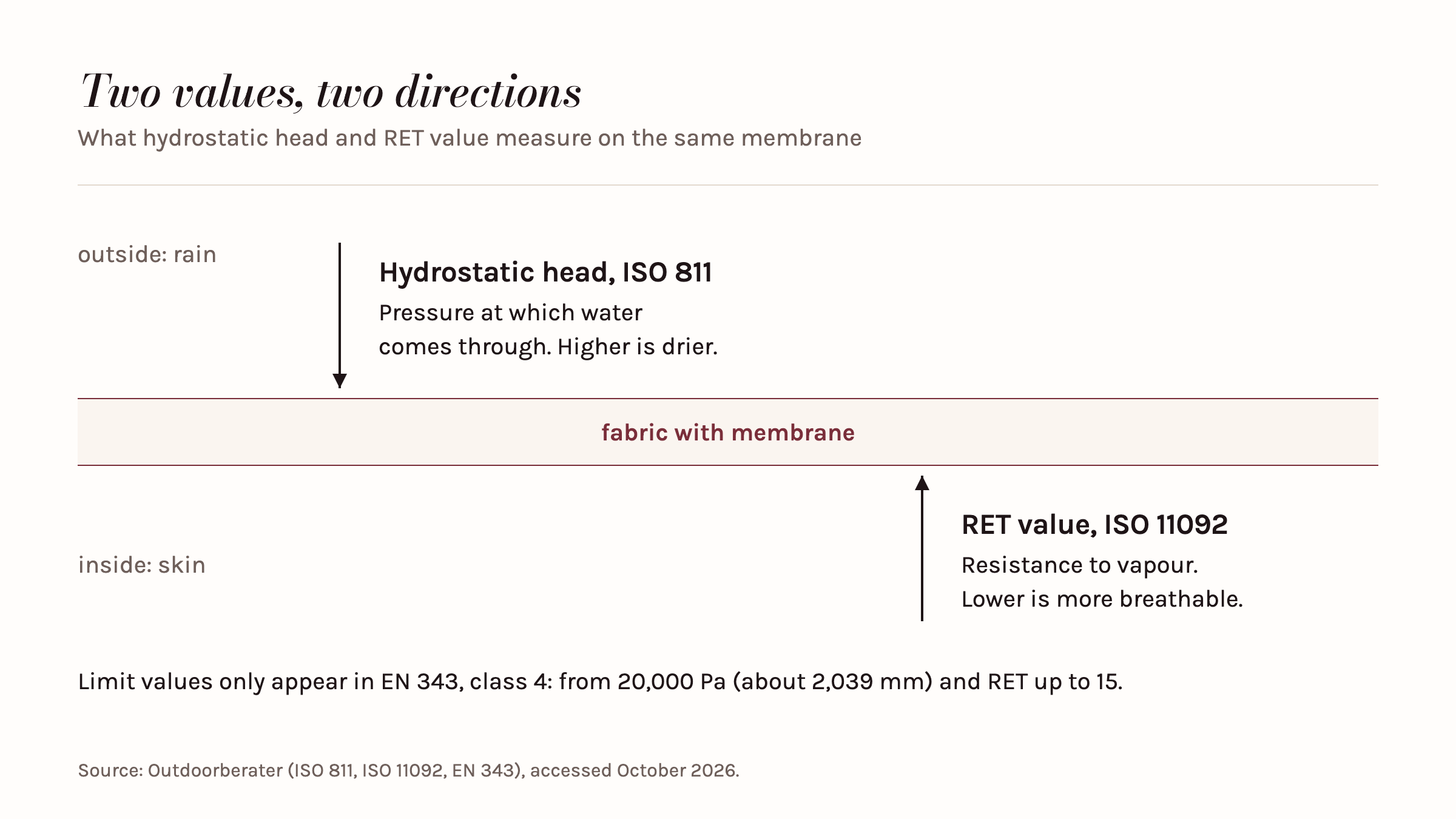
The scale commonly quoted in retail — under 6 "very good" and 6 to 13 "good" — is an industry convention; the measurement standard itself contains no rating scale. Binding figures appear only in requirement standards such as EN 343.[2] Read both values together: at the same hydrostatic head, breathability varies considerably depending on the laminate, and two jackets with identical 20,000 mm ratings can differ markedly in their Ret value.
| EN 343 class | Ret value (m²·Pa/W) | Assessment |
|---|---|---|
| Class 4 | [2]up to 15 | highest class, most breathable |
| Class 3 | [2]over 15 to 25 | a good compromise for activity |
| Class 2 | [2]over 25 to 40 | better suited to gentle movement |
| Class 1 | [2]over 40 | lowest vapour permeability |
Both figures depend on care: a fading DWR finish — the durable water-repellent outer treatment — lets water soak into the face fabric. The fabric becomes saturated, breathability suffers, and the feeling of dampness from inside increases. Regular washing and re-proofing therefore preserve water resistance and breathability alike.
Values from different manufacturers are only partly comparable, and that comes down to the test method. In Europe, the hydrostatic head is determined according to ISO 811 or its successor EN 20811, in the USA according to AATCC Test Method 127. The principle is similar, but the water pressure rises at different rates depending on the procedure. Even ISO 811 allows two rates of rise, 10 or 60 centimetres of water column per minute, and the standard itself notes that results from different rates can deviate from one another.[2]
The test standard itself names no threshold for "waterproof". Neither ISO 811 nor the Ret standard ISO 11092 contains requirement values or a definition of waterproofness. The familiar thresholds come from product standards such as EN 343 for protective clothing; DIN replaced it in 2026 with DIN EN ISO 24232, while the EU list of harmonised standards still lists EN 343:2019.[2] What counts as watertight enough therefore depends on the use, not on the term.
- ISO 811 (Europe): hydrostatic pressure test; the pressure at which water penetrates at the third point is recorded.[2]
- AATCC 127 (USA): hydrostatic pressure test based on a similar principle; values from the two methods are not readily comparable.[1]
- EN 343 or EN ISO 24232: product standard for protective clothing; this is where the classes and thresholds quoted in retail as "waterproof" come from.[2]
For your buying decision this means: always compare hydrostatic head and breathability together in the spec sheet, check which standard the value was measured to, and weight seams, zippers and workmanship at least as highly as the number itself. That way you can choose jacket, shoe and tent sensibly by intended use, rather than by the biggest figure.
Frequently asked questions
From how many mm of hydrostatic head is a fabric considered waterproof?
The test standard ISO 811 itself specifies no limit value. Limit values come from product standards: EN 343 for protective clothing assigns fabrics from around 1,300 mm to class 3, and from 20,000 Pa — around 2,039 mm — to the highest class 4. Manufacturer figures of 10,000 mm and more lie well above that.
Is 10,000 mm of hydrostatic head enough for a rain jacket?
For running, cycling, hiking and travel, 10,000 mm is sufficient in most cases, even in sustained rain. For alpine tours and trekking with heavy luggage, whose straps press water through the fabric, 20,000 mm and more are recommended.
What hydrostatic head should a tent have?
For the tent fly, 3,000 mm is usually enough, because the material tension helps, as with an umbrella. For the tent floor, at least 5,000 mm is advisable, since kneeling and lying down greatly increase the pressure on the surface; a footprint provides additional protection.
Is 3,000 mm of hydrostatic head good for a tent?
For the tent fly, yes — that is the usual rule of thumb. For the tent floor, 3,000 mm is a compromise between weight and waterproofness, the kind ultralight tents make: anyone kneeling inside or crouching on the balls of their feet generates local pressures above 4,000 mm.
How long does a hydrostatic head of 20,000 mm stay watertight?
The hydrostatic head is a pressure value, not a time specification. The standard explicitly assigns its result to short to medium exposure under water pressure. How long a product stays dry in sustained rain depends on seams, sealants, care and the opportunity to dry out.
Are waterproof shoes better the higher the hydrostatic head?
Shoes are hardly ever compared via the hydrostatic head of the face fabric. What matters are the membrane, the seam sealing, a closed tongue and the shaft height: higher-cut, well-made models keep muddy trails and stream crossings dry for longer than low lace-up shoes.
Why is my jacket wet inside even though it has 20,000 mm of hydrostatic head?
Often it is condensing sweat, not rain: when the DWR finish wears off, a water film forms on the fabric that blocks vapour transport. Washing with technical detergent and re-proofing usually restores the repellency.
Are hydrostatic head figures from different manufacturers comparable?
Only to a limited extent. In Europe, measurement follows ISO 811; in the USA, AATCC 127. The test methods are similar, but even ISO 811 allows two rates of rise whose results can differ. So compare values determined to the same standard.