Gore-Tex and Alternatives: Membranes Compared
Gore-Tex vs Sympatex compared: water column to EN 343, breathability, PFAS in ePTFE and ePE, durability and care for jacket and shoe.
Contents
Why are my Gore-Tex shoes no longer waterproof?
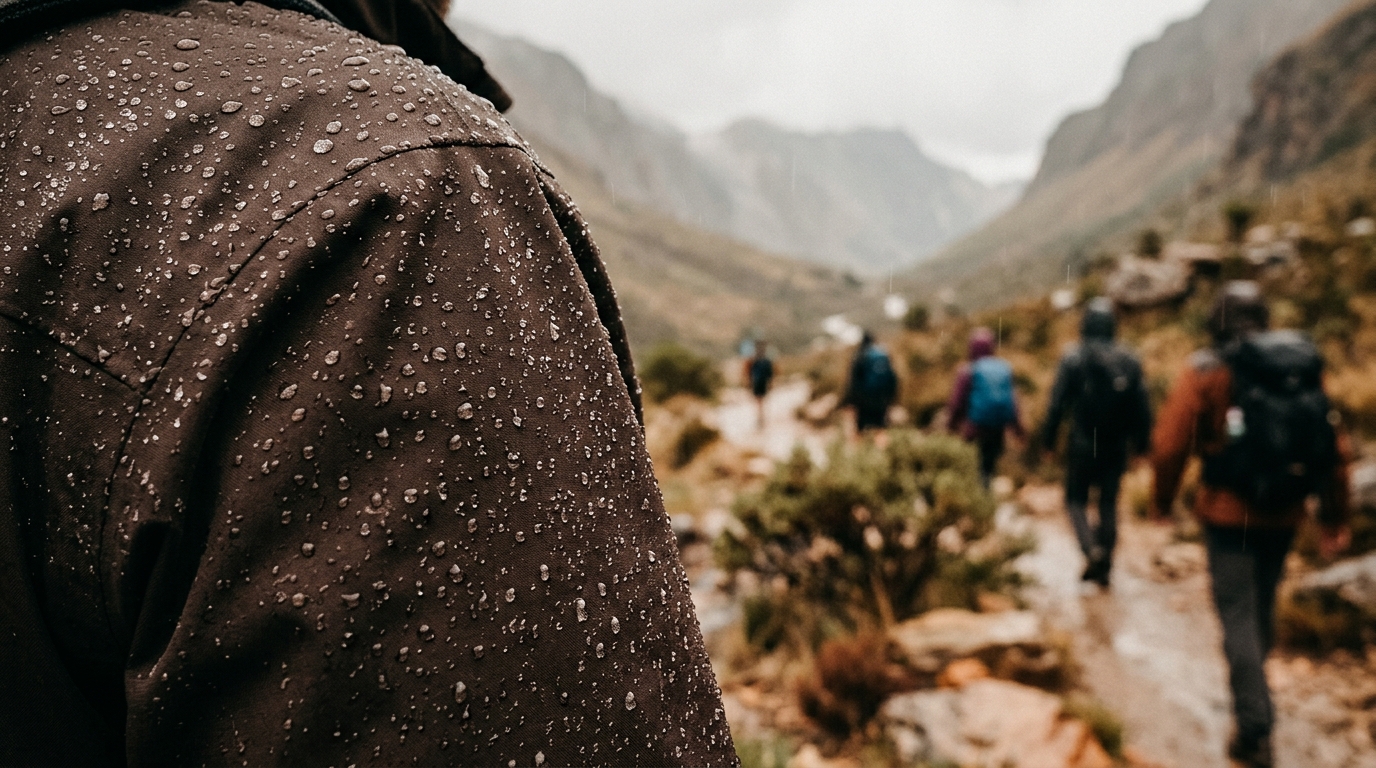
Usually it is not the membrane that leaks, but the water-repellent finish (DWR) on the outer fabric that has worn off. The abbreviation DWR stands for "durable water repellent". This thin protective layer makes water bead up and roll off instead of being absorbed by the fabric, and according to manufacturers it contributes significantly to wearing comfort because it prevents clothing and shoes from feeling clammy.[1] The gear guide from Bergfreunde considers the conclusion "water no longer beads up, so the jacket is no longer waterproof" to be wrong: the membrane keeps the product waterproof, permanently. However, water absorbed in the outer fabric forms an additional barrier and impedes the passage of water vapour.[2]
- Missing beading effect: without an intact DWR finish, the outer fabric loses its water-repellent effect; a soaked outer fabric feels cool and clammy.[1]
- Moisture from the inside: water absorbed in the outer fabric forms an additional barrier and impedes the passage of water vapour, which is why the product feels damp from the inside.[2]
- Seams and bonded joints: seams in waterproof fabrics are potential weak points through which moisture can penetrate.[3]
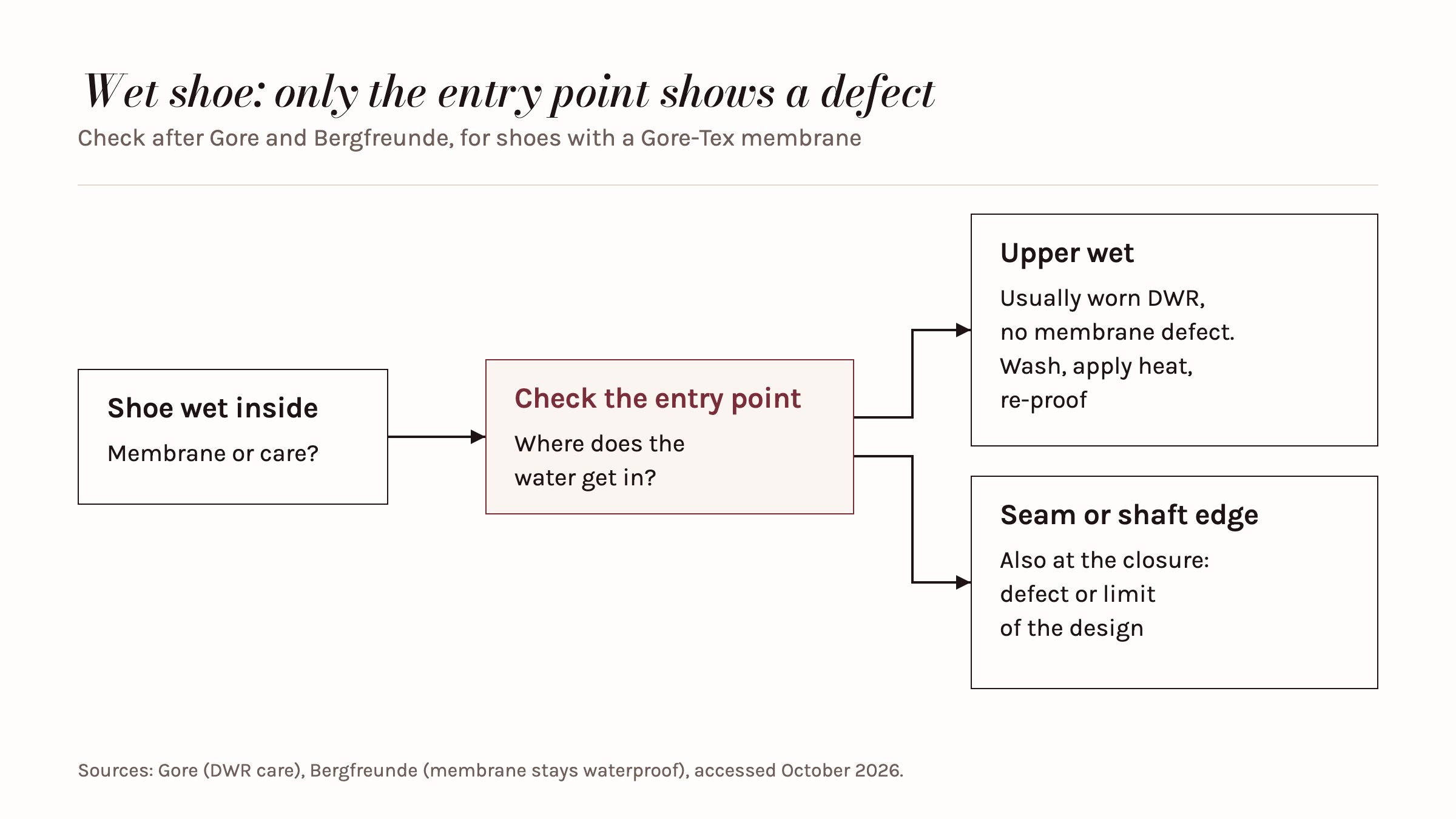
- Areas outside the membrane: with shoes, moisture often gets in where the construction offers no complete protection, such as at the laces and the top edge of the shaft. Here the only help is to check exactly where the moisture is coming in.
According to Gore, a fatigued DWR finish can be revived: wash and dry the product as usual and finish by treating it with heat in the tumble dryer. If washing and heat no longer revive the DWR finish, a new re-proofing treatment must be applied, either as a pump spray or as a wash-in product.[1] The same principle applies to shoes in adapted form: remove dirt, clean gently, and use a care product designed for membrane shoes. If you are unsure about the diagnosis, first check whether water is being drawn through the outer fabric or entering at a seam, a closure or the top edge of the shaft. Only in the second case is a defect the cause.
What are the disadvantages of Gore-Tex?
The disadvantages of Gore-Tex lie in wearing comfort, environmental footprint and the effort required for care. A comparison with the pore-free Sympatex membrane shows where the trade-offs are.[4]
- Wearing comfort: Gore-Tex is considered robust and durable, but not quite as comfortable; Sympatex is less stiff and therefore more pleasant to wear, according to a comparison by the British outdoor portal Advnture (2024).[4]
- Raw materials and disposal: Gore-Tex is based on plastics from petroleum-based sources and degrades biologically very slowly; Sympatex, by contrast, is considered biodegradable and recyclable.[4]
- Care effort: the DWR finish does not last indefinitely and must be revived by washing and heat or renewed with a pump spray or wash-in product. Gore points out that the PFAS-free finish is less oil-resistant and needs to be re-proofed more frequently.[1]
- Breathability without care: frequent wear lets sweat, dirt and sunscreen contaminate functional textiles from the inside, which restricts vapour permeability; regular washing noticeably improves breathability.[2]
How much these points matter depends on the intended use: what counts is the conditions you expect the garment to cope with. The trade-off between Gore-Tex and Sympatex follows in the comparison below.
What does Gore-Tex mean?
Gore-Tex is a waterproof, breathable membrane and a brand of the US company W. L. Gore & Associates, founded in 1958. The classic membrane is made of stretched polytetrafluoroethylene, or ePTFE for short, with the "e" standing for "expanded". Stretching produces a thin film with a mesh-like structure of tiny pores.[2] The membrane is therefore microporous, while pore-free alternatives such as Sympatex transport moisture through chemical processes.[4]
- On one square centimetre of the membrane sit around 1.4 billion microscopic pores.[2]
- According to Bergfreunde, the pores are around 20,000 times smaller than a water droplet, but 700 times larger than a vapour molecule.[2]
- Water in liquid form therefore stays outside, while water vapour from sweat can escape through the pores. It is precisely this combination that makes the material waterproof and breathable at the same time.[2]
In 2021, Gore introduced a second material platform: the ePE membrane made from expanded polyethylene, produced without fluorinated materials. The first products using it came onto the market in autumn 2022, and in 2023 the first three-layer performance products followed, together with brands such as Mammut, Norrøna and Patagonia.[5] So if you buy a Gore-Tex product today, depending on the model you get either the classic ePTFE membrane or the newer ePE membrane. Both carry the manufacturer's promise of being durably waterproof, windproof and breathable, but they differ in material, weight and chemical composition.[6]
Are Gore-Tex shoes waterproof?
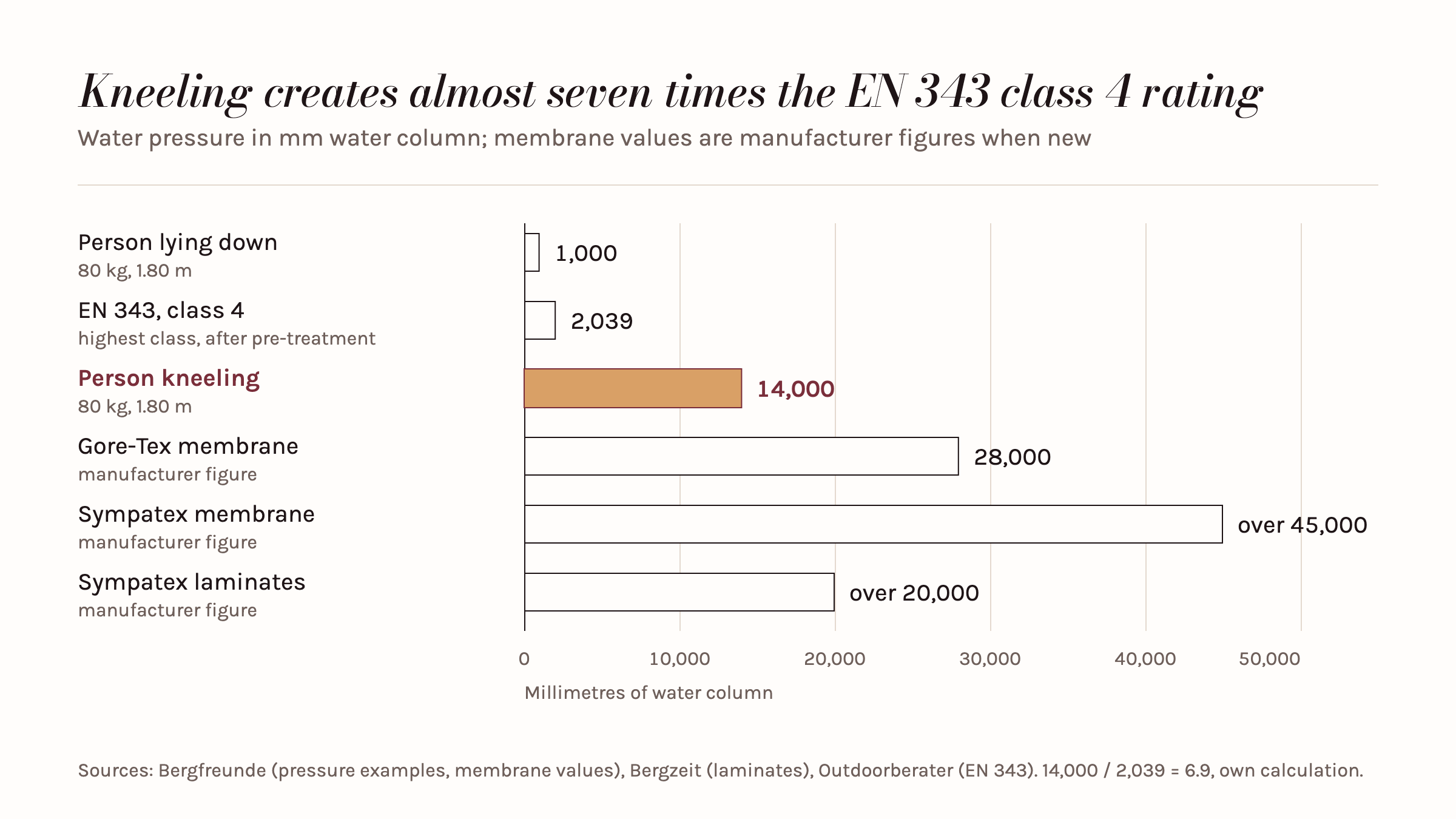
Yes, the membrane in Gore-Tex shoes is waterproof, and by a wide margin beyond the standard values. The European standard EN 343 for protective clothing classifies textiles with a water column of around 1,300 millimetres as class 3, and from around 2,000 millimetres as class 4.[7] Gore-Tex membranes are specified with a water column of around 28,000 millimetres.[7] That is a manufacturer's specification, not an independently measured value, and it refers to the membrane in new condition. For context in comparison:
| Water column | Classification |
|---|---|
| 800 mm | Waterproof class 1 and 2 under EN 343 |
| 1,300 mm | Waterproof class 3 under EN 343 |
| 2,000 mm | [8]Waterproof class 4 under EN 343 |
| around 28,000 mm | [4]Manufacturer's specification for Gore-Tex membranes |
| > 45,000 mm | [8]Manufacturer's specification for the Sympatex membrane; Sympatex laminates are listed at > 20,000 mm |
The water column alone, however, does not tell the whole story. Pressure drives water through the fabric: Bergfreunde cite the example that a person lying down, weighing 80 kilograms and measuring 1.80 metres in height, already generates around 1,000 millimetres of pressure, whereas kneeling produces roughly 14,000 millimetres.[7] Backpack straps or strong headwinds can likewise press water through a jacket.[7] With shoes, seams, bonding, lacing and the top edge of the shaft come into play — points where the construction, not the membrane, decides.[9] A waterproof rating in the data sheet therefore does not guarantee dry feet in every situation; it describes the material under laboratory conditions.
Which is better, Sympatex or Gore-Tex?
Gore-Tex is the better choice when breathability and robustness matter, Sympatex when comfort and recyclability matter. Both membranes are waterproof, windproof and breathable. The table summarises the differences; the figures are manufacturer's specifications or come from published comparisons (retrieved in October 2026):
| Criterion | Gore-Tex | Sympatex |
|---|---|---|
| Structure | [4]Microporous, classically made from stretched PTFE (ePTFE) | [10]Non-porous, made from a polyester-ether copolymer |
| Water column (manufacturer's specification) | [4]around 28,000 mm | [10]> 45,000 mm (membrane), > 20,000 mm (laminates) |
| Breathability | [4]Noticeably more breathable, widely regarded as a clear advantage in comparison | [4]Less breathable than Gore-Tex |
| Comfort | [4]More robust and durable, but less supple | [10]Stretchable by up to 300 percent, more comfortable on the skin |
| Environmental footprint | [4]Petroleum-based, very slow to biodegrade | [10]Fully recyclable, PTFE- and PFC-free according to the manufacturer |
For technical alpine tours, demanding hiking and conditions where robustness and high breathability matter, Gore-Tex is a reliable choice. For everyday wear, travel, easy walks and stretchy clothing such as softshell trousers or close-fitting jackets, Sympatex is often the better fit, because it feels softer and is easier to recycle.[4] Anyone who wants to avoid PFAS will find, according to the manufacturer, a membrane free of PTFE and PFC at Sympatex, and the newer ePE product line at Gore-Tex.[10][6] The two routes set different priorities.
Does Gore-Tex contain PFAS?
Classic Gore-Tex membranes made of ePTFE are manufactured using PFAS; the new ePE membrane is made without intentionally added PFAS. PFAS are per- and polyfluorinated substances which, because of their persistence, are also known as "forever chemicals". The US environmental organisation Toxic-Free Future, citing information from Gore, states that ePTFE is manufactured with PFAS.[11]
- Classic ePTFE membrane: manufactured with PFAS, according to Toxic-Free Future.[11]
- Newer ePE membrane: made without intentionally added PFAS; the first products came onto the market in late 2022.[11] Gore itself notes in a footnote that the laminate may still contain traces.[6]
- DWR finish: Gore offers a PFAS-free finish, again with the caveat that traces may be present.[1]
- Announcement from 2021: Gore announced it would stop using environmentally harmful PFC from 2023 onwards; Greenpeace framed this as a success of its Detox campaign.[12]
Criticism remains nonetheless. Toxic-Free Future criticised the fact that Gore has not publicly committed to eliminating all PFAS from the production of Gore-Tex products and from DWR treatments.[11] Anyone who wants to avoid PFAS as far as possible should look at the product name: ePE-based Gore-Tex products and Sympatex laminates are the clearer choice than classic ePTFE models. This assessment reflects the state of published information, not an independent measurement of individual products.
How long does Gore-Tex stay waterproof?
The Gore-Tex membrane remains permanently waterproof; it does not lose its watertightness on its own. What wears off is the DWR finish on the outside, and according to Gore that does not last indefinitely.[1] Bergfreunde add an important point: the stated water columns apply to new material; used and worn fabrics lose performance.[7] A sponsored guest post on Bergfreunde (2024) states: "With moderate use and good care, a GORE-TEX jacket lasts seven to fifteen years. Often even longer."[5] That is an assessment, not a guaranteed figure.
- Wash regularly: Gore stresses that its products are designed for long-term durability and that regular washing is actually important for optimal performance.[1]
- No fabric softener: fabric softener can permanently clog the fine pores of a microporous membrane like Gore-Tex and reduce breathability.[13]
- Repair damage: small holes can often be patched yourself; larger damage should be repaired professionally.[5]
For your buying decision, this means: compare the water column and breathability in the data sheet of the specific product, not the brand on the label. The water column says something about protection against water pressure, while values such as RET or MVTR indicate vapour permeability — that is, how well sweat vapour escapes to the outside.[7] Both figures together, combined with the intended use and your budget, are a better basis than a single brand seal. And because these values refer to the new condition, care ultimately determines how long a product actually maintains the promised level.
Frequently asked questions
What water column counts as waterproof?
The European standard EN 343 for protective clothing classifies fabrics at around 1,300 mm as class 3 and from around 2,000 mm as the highest class 4, in each case after pre-treatment. Gore-Tex membranes are specified at around 28,000 mm, the Sympatex membrane at over 45,000 mm.
Is Sympatex better than Gore-Tex?
It depends on the use. Sympatex is non-porous, stretchable and fully recyclable, and the membrane is specified at over 45,000 mm water column; however, it is considered less breathable. Gore-Tex is considered more robust and more breathable. For everyday wear and travel, Sympatex may be the more comfortable choice.
Does Gore-Tex contain PFAS?
Classic Gore-Tex membranes made of ePTFE are manufactured using PFAS. Since the end of 2022 there have been products with the ePE membrane, which is made without intentionally added PFAS. Toxic-Free Future criticises that Gore has not committed to removing all PFAS from production.
Why does my Gore-Tex jacket get wet on the inside?
Usually sweat vapour is the cause: no membrane is fully breathable, and the more waterproof the fabric, the less vapour escapes. A soaked outer fabric without an intact DWR finish additionally blocks the transport of water vapour. Washing, heat in the tumble dryer or re-proofing help restore the function.
How often do you need to re-proof Gore-Tex?
The durable water-repellent finish (DWR) does not last indefinitely. As soon as water no longer beads off, it should be refreshed — for example by washing and heat treatment in the tumble dryer, or with a pump spray or a wash-in product. How often this is necessary depends on use, dirt and UV exposure.
Are Gore-Tex shoes really waterproof?
The membrane itself is waterproof, but the shoe is a system: seams, lacing and the top edge of the shaft are potential weak points. In addition, pressure — for example when kneeling or from rucksack straps — drives water through the fabric, which is why the water column alone is only a rough guide. Gore-Tex Infinium products, by contrast, are considered water-repellent, not waterproof.
How long does the waterproofness of Gore-Tex last?
The membrane is designed for lasting performance, but it loses effectiveness without care. Water column figures refer to the new condition; used and worn fabrics lose their properties. Regular washing with a mild detergent, no fabric softener and gentle drying preserve the function for years.