How much does a trip to Japan cost? A two-week budget
How much does a trip to Japan cost? A two-week budget based on data from the Japan Tourism Agency, rail pass prices as of October 2026, food and departure tax.
In this article9
- What do you absolutely need when travelling to Japan?
- How much money for 2 weeks in Japan?
- How much money for 14 days in Japan?
- Is Japan expensive for a holiday?
- What does a 14-day holiday in Japan cost?
- How much does a meal cost in Japan?
- How much does a two-week trip to Japan cost?
- Frequently asked questions
- Sources
A two-week holiday in Japan costs an average of around 306,000 yen per person on the ground — about 1,750 euros — plus flights and insurance. This figure is a guide, not an offer: it is based on the Japan Tourism Agency's preliminary figures for 2025.[1] All euro amounts in this guide are based on the European Central Bank reference rate of 23 October 2026, 1 euro = 175.51 yen.[2] Routes and timing for a first trip to Japan are covered in a separate article.
What do you absolutely need when travelling to Japan?
For Japan you absolutely need a valid passport, travel health insurance for trips abroad, and a payment card that works at Japanese ATMs. The German Federal Foreign Office lists the key points in its travel and safety advice (as of 26 October 2026):[3]
- Entry: German citizens can enter visa-free for short stays of up to 90 days. The passport must be valid for the duration of the stay; an ID card is not sufficient.
- Health: There are no mandatory vaccinations. The Federal Foreign Office recommends travel health and repatriation insurance and points out that many hospitals treat foreign patients only against advance payment.
- Money: The national currency is the yen. According to the Federal Foreign Office, the ATMs of most Japanese banks still do not accept foreign cards; at 7-Eleven, Family Mart and Japan Post machines, some European debit and credit cards work.[3]
For entry formalities, the Japanese tourism organisation JNTO still recommends — though no longer requires — the Visit Japan Web portal, where you can fill in the arrival card and customs declaration in advance.[4] For your budget, this means: travel health insurance belongs in the calculation, and part of your money should be available as cash or on a card that works at the ATMs mentioned.
How much money for 2 weeks in Japan?
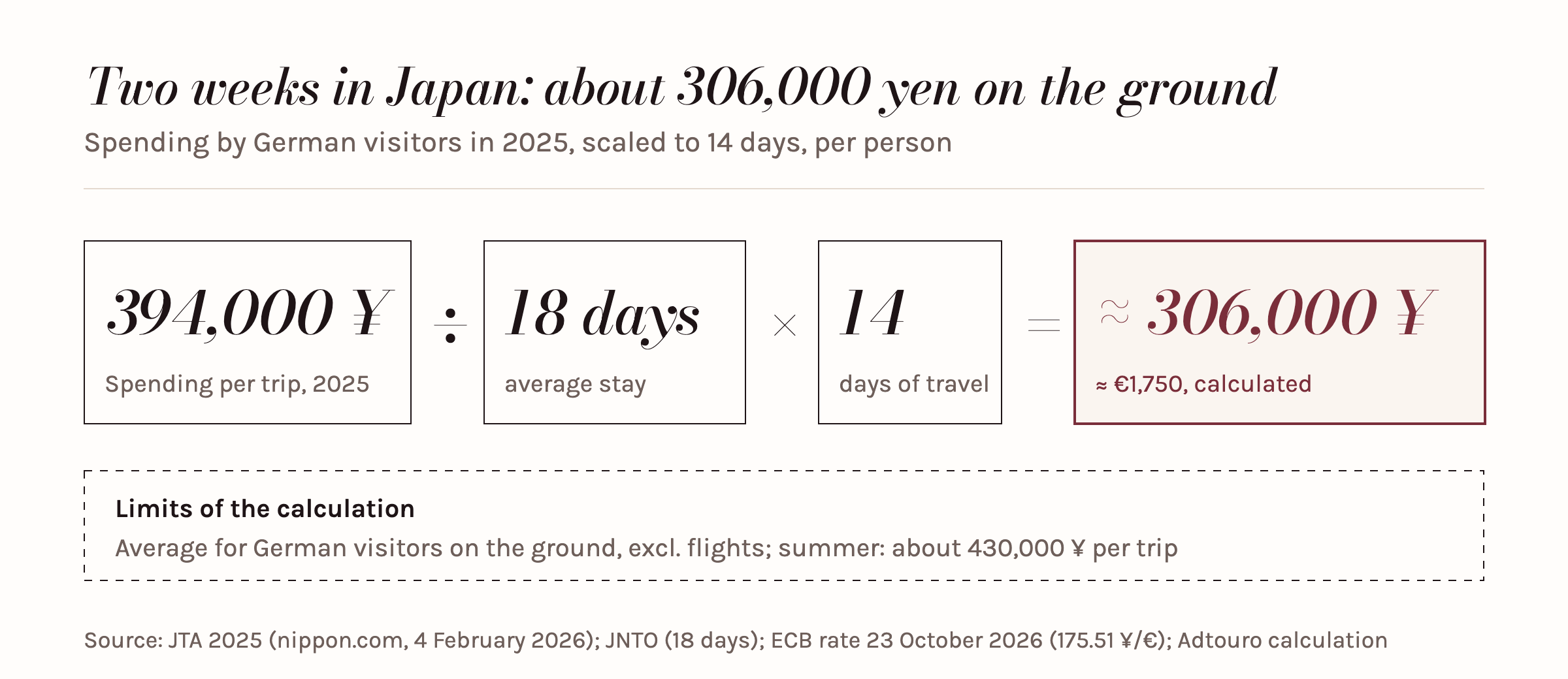
For 2 weeks in Japan, based on the average spending of German visitors, you need around 306,000 yen per person on the ground — about 1,750 euros — excluding flights. The basis: German visitors spent an average of 394,000 yen in 2025, according to the Japan Tourism Agency.[1] According to the JNTO office in Frankfurt, they stayed an average of 18 days in Japan; during the summer holiday season, spending rose to around 430,000 yen.[5] Divided by 18 days, that comes to roughly 21,900 yen per day, times 14 days around 306,000 yen.
| Key figure | Value | Euros (rate 23 Oct 2026) |
|---|---|---|
| Spending per German visitor in 2025, average | 394,000 yen | around €2,245 |
| Average length of stay | 18 days | – |
| Per day (calculated) | around 21,900 yen | around €125 |
| For 14 days (calculated) | around 306,000 yen | around €1,750 |
Two caveats belong to this figure. First, it is an average across all types of travel, from hostels to ryokans. Second, travellers spend more in the high season, as the summer figure shows. If you are planning with a fixed budget, it is better to calculate based on your own accommodation class than on the average.
How much money for 14 days in Japan?
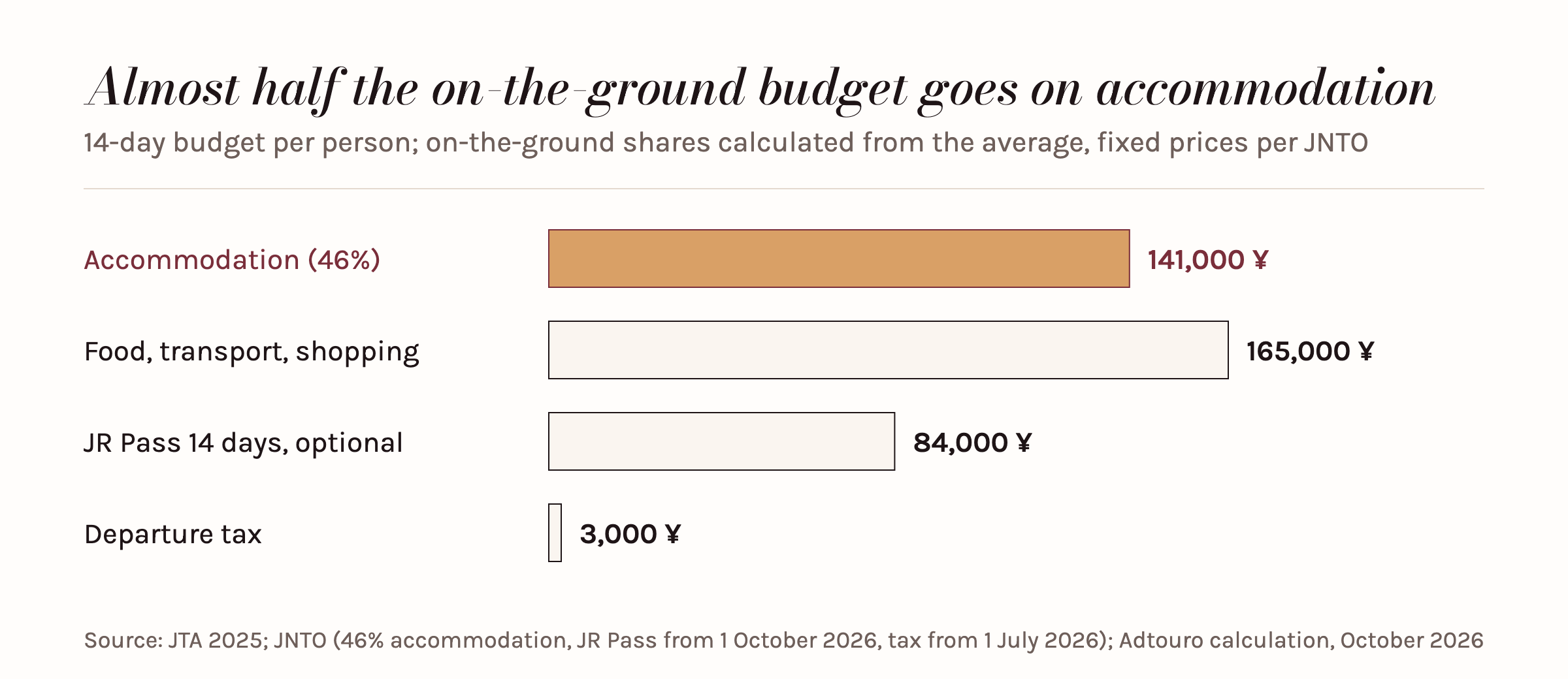
For 14 days in Japan, the money goes mainly on accommodation, food and shopping, and for German travellers accommodation accounts for 46 percent of spending, according to JNTO.[5] Based on the daily value of around 21,900 yen, that is roughly 10,100 yen per day for accommodation; the remaining 11,800 yen or so is spread across food, transport, admission fees and shopping.
Across all international visitors, the Japan Tourism Agency provisionally reports spending of 9.5 trillion yen for 2025, of which 3.5 trillion went on accommodation, 2.5 trillion on shopping and 2.1 trillion on food and drink.[1] The ranking shows where you have the most room to manoeuvre:
- Accommodation: the largest item. A room for two halves the amount per person; a ryokan with dinner increases it.
- Shopping: freely plannable. If you buy little, you can bring your budget well below the average.
- Food and drink: easy to control, because simple dishes are inexpensive, as the section on food shows.
So plan your 14 days in three steps: book accommodation for all nights and note the amount, set a daily budget for food and admission fees, and cap shopping separately from that.
Is Japan expensive for a holiday?
Japan is not a budget destination for German holidaymakers, but the costs on the ground are easy to plan, and simple meals are inexpensive, as the section on food shows. What makes Japan expensive is above all the long journey, accommodation in the high season and long stays.
That Germans spend a lot is also down to the length of their trips. According to the Japan Tourism Agency, German visitors topped all countries of origin in 2025 with an average of 394,000 yen per person, 18.2 percent up on the previous year; the average for all visitors was 229,000 yen.[1] Over an average stay of 18 days, that is less per day than the total suggests.
How expensive Japan feels also depends on the exchange rate. On 23 October 2026, one euro bought 175.51 yen, according to the European Central Bank.[2] Check the rate shortly before your trip, because a shift of a few percent noticeably moves a budget of this size.
What does a 14-day holiday in Japan cost?
A 14-day holiday in Japan costs the on-the-ground expenses of around 1,750 euros plus the fixed costs incurred before the trip: flights, insurance and, where applicable, a rail pass. The verifiable fixed costs at a glance:
| Item | Amount | Euros (rate 23 Oct 2026) | Source, as of |
|---|---|---|---|
| Japan Rail Pass, 7 days, ordinary class | 53,000 yen | around €302 | JNTO, price as of 1 Oct 2026 |
| Japan Rail Pass, 14 days, ordinary class | 84,000 yen | around €479 | as above |
| Japan Rail Pass, 21 days, ordinary class | 105,000 yen | around €598 | as above |
| Departure tax (International Tourist Tax) | 3,000 yen | around €17 | JNTO, since 1 Jul 2026, usually included in the ticket |
| Flight | current prices | – | no independent price comparison |
The nationwide Japan Rail Pass became more expensive on 1 October 2026; before that, the 14-day version cost 80,000 yen. According to JNTO, buyers could still get the old prices on the official website for a limited time.[6] Whether the pass is worth it depends on your route: if you stay mostly in one city, individual tickets work out cheaper than a pass at 84,000 yen.
The departure tax rose from 1,000 to 3,000 yen on 1 July 2026 and is in most cases added automatically to the return flight ticket.[7] This guide does not quote flight prices, because they change daily and this guide has not checked them with its own price comparison. For context on the distance: as the crow flies, the great-circle distance between Frankfurt am Main and Tokyo-Haneda is roughly 9,360 kilometres; the actual flight route is longer.
How much does a meal cost in Japan?
A simple meal in Japan costs little: a bowl of ramen in a restaurant averaged 607 yen in Tokyo's 23 wards in January 2026, according to the retail price survey by Japan's statistics office.[8] That was 1.3 percent more than a year earlier. The figure is an average across all surveyed establishments; in tourist areas and for specialities, you will pay more.
Eating costs more if you dine in the evening in restaurants with table service or in ryokan with set menus. A fixed daily sum cannot be substantiated. A practical split: simple meals such as ramen, udon or konbini ready-made dishes for lunch and breakfast, and a set budget for dinner. In 2025, food and drink accounted for around 2.1 of 9.5 trillion yen of spending across all visitors — just over a fifth.[1]
How much does a two-week trip to Japan cost?
A two-week trip to Japan costs around 1,750 euros per person on the ground, plus flights, insurance and, if needed, a 14-day rail pass for 84,000 yen. The following worked example is illustrative and shows how the budget adds up; the input figures come from the sources above, and the subtotals are calculated from them:
| Component | Example trip, 1 person, 14 days | Note |
|---|---|---|
| On-the-ground spending per average | around 306,000 yen / around €1,750 | includes accommodation, food, transport, shopping |
| of which accommodation (46%) | around 141,000 yen / around €800 | share for German travellers in 2025 |
| Japan Rail Pass, 14 days (optional) | 84,000 yen / around €479 | only worthwhile with many long-distance journeys |
| Departure tax | 3,000 yen / around €17 | usually included in the flight price |
| Flight and travel health insurance for trips abroad | current at time of booking | compare before booking |
Whether a rail pass increases your on-the-ground budget or replaces part of your transport spending depends on how many long-distance journeys you take; the JTA averages do not distinguish this. Travellers on a tight budget can stay below the average, while those travelling in high season or shopping a lot will exceed it.
Plan your budget once your route and accommodation are set, then convert it at the current exchange rate. Before departure, check the German Federal Foreign Office's entry and safety advice, as it can change. More long-haul destinations and travel times can be found under destinations on Adtouro, for example destinations in December; how these guides are produced is described in Adtouro's methodology.
Frequently asked questions
How much cash should you take to Japan?
A fixed sum cannot be substantiated. What matters is a card that works at the ATMs of 7-Eleven, Family Mart or Japan Post, because most bank ATMs do not accept foreign cards.
Do you need a visa for Japan?
German nationals can enter visa-free for short stays of up to 90 days. A passport valid for the entire duration of the stay is required.
How much money do you need for 3 weeks in Japan?
For 21 days, the same daily average works out to around 460,000 yen per person on the ground, excluding flights. A 21-day rail pass has cost 105,000 yen since October 2026.
Sources
Related reading
All Destinations →Baltic Sea or North Sea: which coast suits you better
Baltic Sea or North Sea compared: sunshine, rain and water temperature from DWD and BSH, 2026 spa tax, tides and the rules for dogs in autumn.

December travel destinations: warm, a short flight away, New Year's Eve
Where it is warm in December, how far each destination is from Frankfurt and when all German states have Christmas holidays in 2026, with climate data and sources.

Warm destinations in February: where it's hot
Warm destinations in February: the Canary Islands, Hurghada, Madeira and long-haul options, with DWD climate data, distance from Frankfurt and 2027 school holidays.