Baltic Sea or North Sea: which coast suits you better
Baltic Sea or North Sea compared: sunshine, rain and water temperature from DWD and BSH, 2026 spa tax, tides and the rules for dogs in autumn.
In this article9
- Which is better, the Baltic Sea or the North Sea?
- Why is the Baltic Sea more popular than the North Sea?
- Where is it warmer, the Baltic Sea or the North Sea?
- Which is better for the lungs, the North Sea or the Baltic Sea?
- Which is cheaper, the North Sea or the Baltic Sea?
- Baltic Sea or North Sea with a dog in autumn
- North Sea autumn holiday with a dog: what to expect
- Frequently asked questions
- Sources
Which is better, the Baltic Sea or the North Sea?
The Baltic Sea is better for anyone looking for plenty of sunshine, calm water and short routes to the islands. The North Sea suits anyone who wants to experience mudflats, wind and tides. There is no universal ranking, because the two coasts each lead on different criteria. This guide therefore compares four points: weather, water, costs and the rules for dogs.
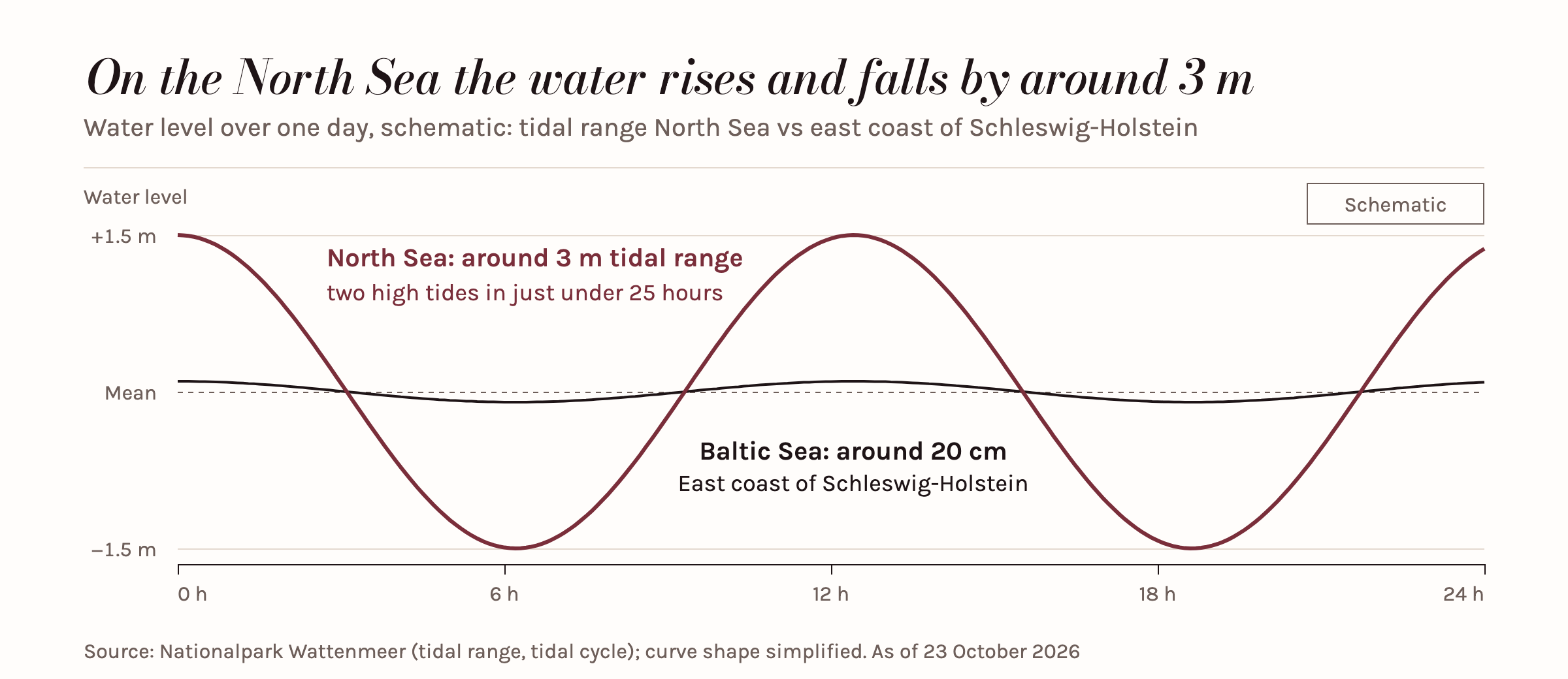
The biggest difference lies in the water itself. According to the Wadden Sea National Park, the tidal range on the German North Sea coast is about three metres, while on the east coast of Schleswig-Holstein it is only about 20 centimetres.[1] On the North Sea, it is the tide that determines when the sea reaches the beach and when the mudflats are exposed. On the Baltic Sea, the waterline stays almost the same throughout the day.
The criteria at a glance
| Criterion | Baltic Sea | North Sea |
|---|---|---|
| Annual hours of sunshine (DWD stations, 1991–2020 average) | 1,735 to 1,949 | 1,699 to 1,745 |
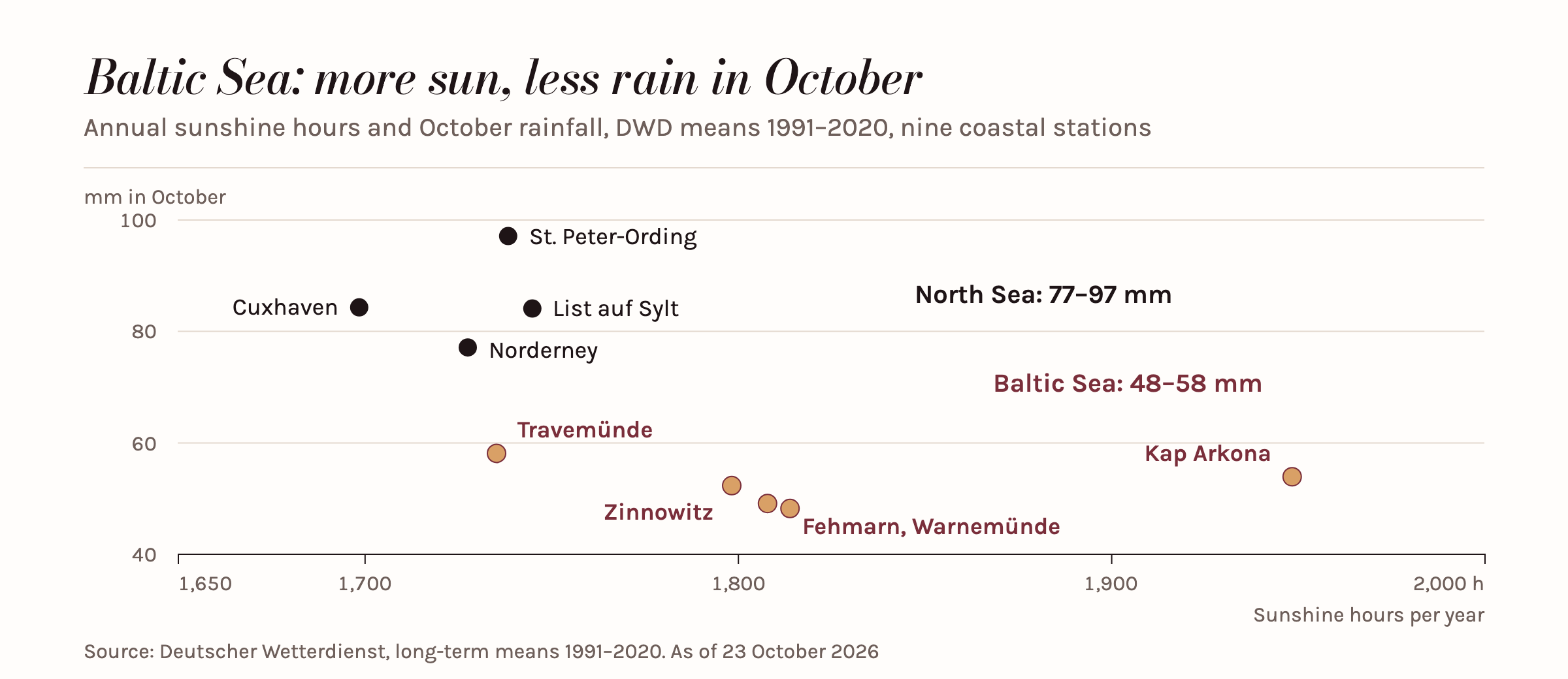
| Precipitation in October | 48 to 58 mm | 77 to 97 mm |
| Tidal range | about 20 cm (east coast of Schleswig-Holstein) | about 3 m |
| Islands | Rügen, Usedom and Fehmarn reachable by bridge | East Frisian Islands by ferry |
| Spa tax, high season (towns compared) | 3.40 to 3.70 euros | 4.00 to 5.50 euros |
The figures come from the sections below, where the sources are also listed. The spa tax is given only for the towns compared here and is not an average for the coast.
How long is the journey?
How long the journey takes depends mainly on where you live. From Hamburg, both coasts are close; from Berlin, the Baltic Sea is clearly nearer, from Cologne the North Sea. The straight-line distances are our own calculation from the city centres to the towns' weather stations, rounded to ten kilometres. The distance by road or rail is longer.
| Destination | from Hamburg | from Berlin | from Cologne | from Munich |
|---|---|---|---|---|
| Westerland (Sylt) | 190 km | 430 km | 450 km | 780 km |
| St. Peter-Ording | 130 km | 370 km | 390 km | 720 km |
| Norderney | 190 km | 440 km | 310 km | 690 km |
| Cuxhaven | 90 km | 350 km | 350 km | 670 km |
| Travemünde | 70 km | 230 km | 430 km | 650 km |
| Warnemünde | 150 km | 200 km | 500 km | 670 km |
| Zinnowitz (Usedom) | 260 km | 180 km | 580 km | 680 km |
| Kap Arkona (Rügen) | 260 km | 240 km | 600 km | 740 km |
Why is the Baltic Sea more popular than the North Sea?
More popular, measured by overnight stays. In Schleswig-Holstein, the number of overnight stays on the Baltic Sea coast rose from 18.8 to 19.5 million per year since 2022. On the North Sea coast it remained at around 12.7 million.[2] The German Press Agency (dpa) reported this in March 2026.
The islands show the same picture. According to the Statistics Office North (Statistikamt Nord), more than 1.2 million guests came to Rügen in 2022 and over one million to Usedom, while Sylt received around 762,000.[3] Relative to their population, however, the small North Sea islands lead the way: Spiekeroog recorded around 483 guest overnight stays per registered resident.
These statistics do not record why guests make this choice. The climate data, however, point to two plausible reasons: the Baltic Sea coast gets more hours of sunshine and less rain. In addition, Rügen, Usedom and Fehmarn are reachable without a ferry, and the sea does not disappear with the tide.
Where is it warmer, the Baltic Sea or the North Sea?
In summer, both coasts are almost equally warm; in autumn, the North Sea is slightly milder. This is shown by the long-term averages for 1991 to 2020 from the German Weather Service (Deutscher Wetterdienst, DWD) for nine coastal stations.[4] The temperature there is the monthly mean of the air, day and night, not the daily maximum.
| Station | July | October | Sunshine hours per year | Precipitation in October |
|---|---|---|---|---|
| List auf Sylt (North Sea) | 17.2 °C | 10.7 °C | 1,745 | 84 mm |
| St. Peter-Ording (North Sea) | 17.7 °C | 10.4 °C | 1,739 | 97 mm |
| Norderney (North Sea) | 17.6 °C | 11.2 °C | 1,728 | 77 mm |
| Cuxhaven (North Sea) | 18.0 °C | 10.9 °C | 1,699 | 84 mm |
| Travemünde (Baltic Sea) | 18.0 °C | 10.0 °C | 1,735 | 58 mm |
| Fehmarn (Baltic Sea) | 17.9 °C | 10.6 °C | 1,808 | 49 mm |
| Warnemünde (Baltic Sea) | 18.3 °C | 10.5 °C | 1,814 | 48 mm |
| Kap Arkona, Rügen (Baltic Sea) | 17.4 °C | 10.2 °C | 1,949 | 54 mm |
| Zinnowitz, Usedom (Baltic Sea) | 18.1 °C | 9.5 °C | 1,798 | 52 mm |
The sunshine hours and precipitation figures were also compiled by the DWD for the same period.[5][6] The stations were selected so that well-known holiday resorts and islands are represented on each coast.
Summer days and water temperature
Hot beach days are rare on both coasts. On average, the DWD counts 20.3 summer days with at least 25 °C per year in Warnemünde, 16.4 in St. Peter-Ording and only 4.9 at Kap Arkona.[7] Anyone looking for reliably warm swimming weather may be equally disappointed on the North Sea and the Baltic Sea.
The sea cools down more slowly than the air in autumn. In autumn 2025, the surface temperature of the Baltic Sea averaged 13.0 °C according to the Federal Maritime and Hydrographic Agency (Bundesamt für Seeschifffahrt und Hydrographie, BSH), and that of the North Sea 13.8 °C.[8] Both values were above the 1997 to 2021 average; for the Baltic Sea it was the warmest autumn since the data series began.
Which is better for the lungs, the North Sea or the Baltic Sea?
Neither coast is simply better for the lungs across the board; the North Sea is considered the rougher stimulus climate, the Baltic Sea the milder one. The DWD counts among the climatic stimulus factors, among other things, cold stimuli, strong daily temperature fluctuations, increased solar radiation and gusty wind. According to the DWD, healing-climate conditions in Germany are found mainly along the coasts and in the low mountain ranges.[9]
Medical climatologist Angela Schuh of Ludwig-Maximilians-Universität München comments on this in an interview published by the Mecklenburg-Vorpommern tourism association. She describes a mild stimulus climate on the Baltic coast that differs from the considerably rougher climate of the North Sea.[10] The slightly salty air is said to help loosen mucus in respiratory conditions. The page is an offering of the tourism association, not an independent comparison of the two coasts.
If you have a chronic respiratory condition, discuss with your doctor how much stimulus is sensible. A stronger stimulus is not automatically the better one. The climate data above only shows that the North Sea coast gets considerably more rain in autumn.
Which is cheaper, the North Sea or the Baltic Sea?
Among the places compared here, the Baltic Sea is cheaper, at least when it comes to the spa tax. This guide does not quote fixed accommodation prices, because they change with the season and demand and no independent price comparison was carried out. What can be documented are the charges each person pays per day or night on site.
| Place | Coast | Spa tax, high season | Off-season | As of |
|---|---|---|---|---|
| Spiekeroog | North Sea | 5.50 euros | 2.20 euros | 2026 |
| Norderney | North Sea | 4.90 euros | – | 2026 |
| Sylt (Westerland) | North Sea | 4.10 euros | 2.05 euros | 2026 |
| St. Peter-Ording | North Sea | 4.00 euros | – | since 2025 |
| Zinnowitz (Usedom) | Baltic Sea | 3.70 euros | – | 2026 |
| Binz (Rügen) | Baltic Sea | 3.40 euros | – | 2025 |
The figures for Spiekeroog, Norderney and Zinnowitz come from an evaluation of 390 towns and municipalities by the travel portal HolidayCheck. The trade publication Tageskarte reported on this in February 2026.[11] For Sylt, the municipality itself quotes 4.10 euros from 1 May to 31 October 2026 and 2.05 euros in the remaining months.[12] St. Peter-Ording has charged four euros in the high season from 15 May to 30 September since 2025, and Binz remained at 3.40 euros for 2025.[13] This guide did not find a figure for Binz in 2026.
What comes on top of the spa tax
You reach the East Frisian Islands by ship, and the crossing adds to the cost of your stay. Rügen, Usedom and Fehmarn are connected to the mainland by bridges. On paper, the spa tax for two people over seven days comes to 77 euros on Spiekeroog in the high season (5.50 × 2 × 7)[11] and 47.60 euros in Binz based on the 2025 figures (3.40 × 2 × 7)[13]. Whether accommodation on the Baltic Sea is cheaper overall only becomes clear when you compare for your actual travel dates.
Baltic Sea or North Sea with a dog in autumn
Choosing between the Baltic Sea and the North Sea with a dog in autumn depends less on the weather than on the rules on site. The Tourism Agency Schleswig-Holstein points out that leash and muzzle requirements can vary locally and seasonally, and recommends checking with the tourist information office in advance. In the Wadden Sea National Park, on dykes and salt marshes, dogs must always be on a leash, and dunes are off-limits to dogs.[14]
North Sea: the national park sets the rules
On the North Sea coast, a large part of the shoreline lies within the Wadden Sea National Park. In Schleswig-Holstein, dogs must be on a leash at all times throughout the entire national park and on the dykes. In Lower Saxony, dogs must be leashed year-round in the quiet and buffer zones, and everywhere in open countryside from 1 April to 15 July. To protect the sheep that graze on them, dogs are generally not allowed on Lower Saxon dykes at all, not even on a leash.[15] Off-leash areas exist at designated dog beaches; the municipalities list them.
Baltic Sea: every municipality regulates its own beach
On the Baltic Sea, each municipality sets out in its beach bylaws when dogs are allowed where, and those periods can extend well into autumn. In Schwedeneck near Kiel, for example, dogs are banned from the fee-charging beach from 1 April to 31 October under the municipality's beach bylaws, and are only permitted on the designated dog beaches.[16] So if you arrive in early October, do not assume the season for dogs is already over.
The autumn weather
In autumn, the main argument for the Baltic Sea is the rain, as the chart below shows for all nine stations. Sunshine hours in October are similar on both coasts, at roughly 104 to 115 hours per month according to the DWD. So plan long walks on the North Sea with a rain jacket; a separate guide explains how much water column a jacket needs for that.
North Sea autumn holiday with a dog: what to expect
What a North Sea autumn holiday with a dog is actually like depends above all on where you can find off-leash space. This guide is based on data and local rules, not on our own travels.
How dense this offering is varies from island to island. According to Tourismus-Agentur Schleswig-Holstein, Föhr named six dog beaches in 2023; in Utersum dogs may run free, and Wyk has a fenced exercise area. Pellworm has four fenced dog beaches.[17] Before booking, ask how far your accommodation is from the nearest dog beach.
A checklist for autumn
- A leash for the national park and the dykes; in Lower Saxony, a route that does not cross the dyke.
- Rain gear and sturdy shoes; for cold days it helps to look at winter boots that really keep you warm.
- Your municipality's beach rules for your travel period, not for the season in general.
- The seasonal change in the spa tax: on Sylt it drops to 2.05 euros from 1 November.
Who the North Sea suits less well in autumn matters just as much: if you want to avoid rain, the Baltic Sea sees considerably less precipitation in October; there, the municipality decides where dogs may run free. If you are looking for mudflats, wind and open space and accept the leash, the North Sea offers exactly that. The destinations section gathers more places by travel season; how Adtouro selects its sources is described in the methodology.
Frequently asked questions
Is the Baltic Sea or the North Sea nicer in autumn?
That depends on what you are looking for. The Baltic Sea is drier in October, while the North Sea offers mudflats and tides but averages around one and a half times as much precipitation in October.
Where is the water warmer in autumn?
In autumn 2025 the surface temperature of the North Sea averaged 13.8 degrees, that of the Baltic Sea 13.0 degrees. For swimming, both are too cold for most people.
Which is cheaper, the North Sea or the Baltic Sea?
For the spa tax, the compared Baltic Sea resorts, at 3.40 to 3.70 euros per person, are below the North Sea resorts at 4.00 to 5.50 euros. This guide does not compare accommodation prices, because they change with season and demand.
Are dogs allowed on the beach in October?
Each municipality sets its own rules. Some Baltic Sea municipalities close the swimming beach to dogs until the end of October; in the Wadden Sea National Park in Schleswig-Holstein, dogs must always be on a leash.
Is the spa tax cheaper in autumn?
Often yes, but not everywhere from October. On Sylt, the high-season rate of 4.10 euros applies until 31 October 2026; from 1 November it is 2.05 euros.
Sources
Related reading
All Destinations →How much does a trip to Japan cost? A two-week budget
How much does a trip to Japan cost? A two-week budget based on data from the Japan Tourism Agency, rail pass prices as of October 2026, food and departure tax.

December travel destinations: warm, a short flight away, New Year's Eve
Where it is warm in December, how far each destination is from Frankfurt and when all German states have Christmas holidays in 2026, with climate data and sources.
Warm destinations in February: where it's hot
Warm destinations in February: the Canary Islands, Hurghada, Madeira and long-haul options, with DWD climate data, distance from Frankfurt and 2027 school holidays.