Clothing Size Chart for Women and Men
Clothing size chart for women and men: body measurements in cm, conversion EU, UK, US plus answers to sizes like 40, 50, 52 and W30 L32.
Contents

Which clothing size chart is the right one?
There is no binding clothing size chart. The European standard EN 13402 describes which body measurements should be taken and how, but it does not prescribe sizes for specific garments. Every manufacturer cuts its patterns based on its own measurements and allowances, which is why a size 40 fits differently depending on the brand. General tables such as the measurement chart from Manufactum are therefore explicitly intended as a guide only.[1]
How to take your measurements correctly
- Chest circumference: measure horizontally around the widest part of the ribcage, breathing normally and standing upright.
- Waist circumference: measure horizontally around the narrowest part of the torso, at the natural waistline.
- Hip measurement: measure horizontally around the fullest part of the hips and bottom.
- The tape measure should sit snugly against the body without pinching. If you don't have a tape measure, a non-elastic thread works too — you can then read off the length against a folding rule.
Women's and men's sizes follow different logic. German women's sizes are sorted primarily by height: the standard sizes 32 to 44 assume a height between 164 and 170 cm, with petite sizes for shorter women and long sizes for taller ones.[2] For men, sizes are based on body shape and chest circumference, with standard sizes starting at 44.[2]
With your chest, waist and hip measurements you can navigate any size chart, whether German, British or American. If you fall between two sizes, the chest circumference usually decides.
What size is W40 for men?
For men, W40 denotes a waist width of 40 inches, roughly 102 cm, which corresponds approximately to the German clothing size 56. The letter combination comes from the American system: W stands for Waist, the waist width, and L for Length, the inseam length or the inner seam of the trousers. Both values are given in inches; one inch equals 2.54 cm.[2]
- W40 means: 40 inches at the waist, converted 101.6 cm. German men's size 56 covers a waist width of 100 to 104 cm.[2]
- The L figure, such as L32, is stated separately: 32 inches corresponds to roughly 81 cm inseam length.
- To convert, divide your centimetre value by 2.54 to get the inch size.
| Waist width (inches) | Waist width (cm) | German size |
|---|---|---|
| W38 | around 96.5 cm | 54 (waist 95 to 99 cm) |
| W40 | around 101.6 cm | 56 (waist 100 to 104 cm) |
Worth knowing: inch sizes are garment measurements, not body measurements. For jeans, the inner seam is typically stated, not the body's inner leg length. The EN 13402 standard explicitly does not treat such garment labels as body measurements, and the waist width of the trousers need not match your measured waist circumference either.[2]
What is W30 L32 for women?
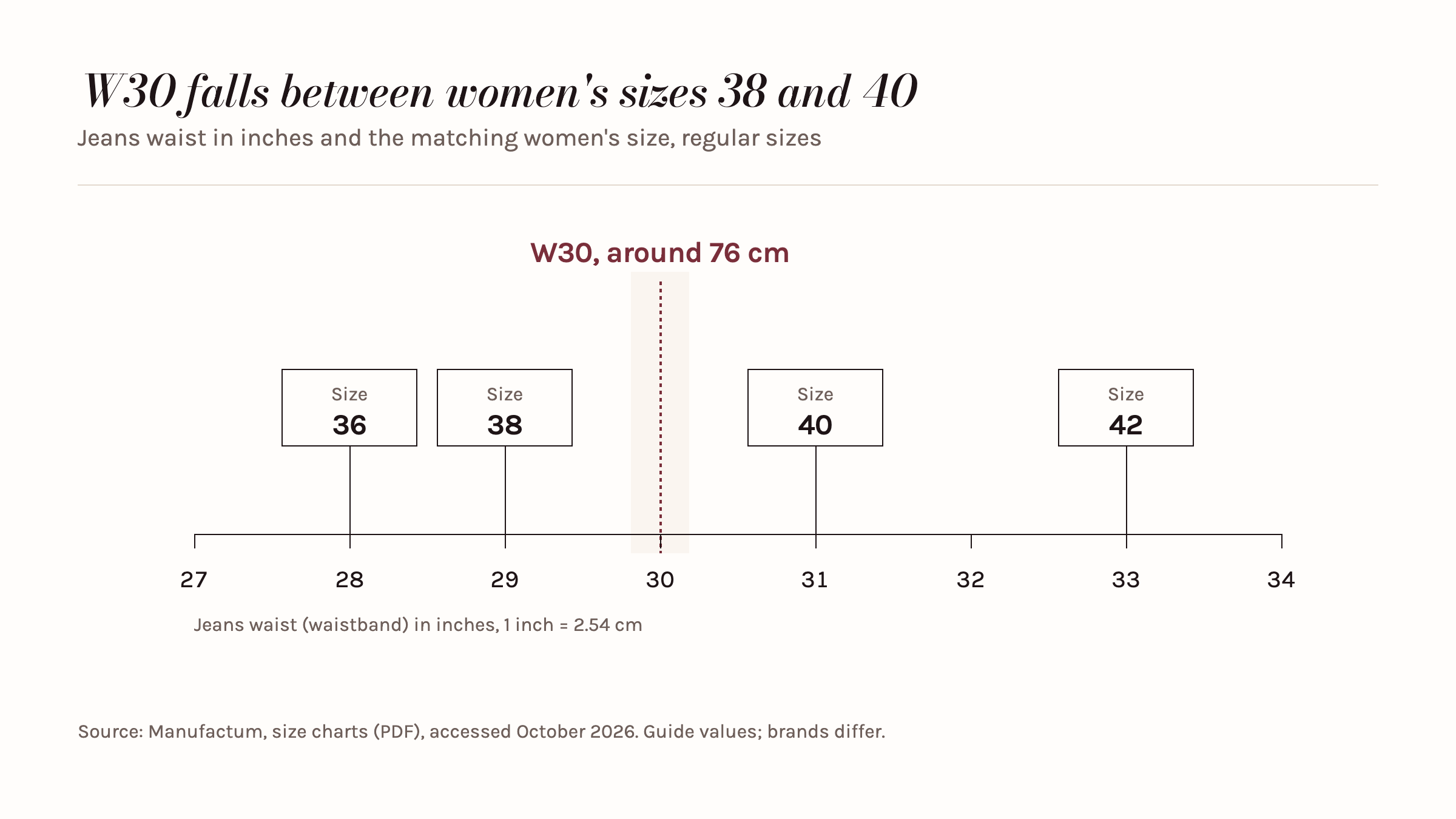
For women too, W30 L32 denotes a waist width of 30 inches, roughly 76 cm, and an inseam length of 32 inches, roughly 81 cm. In German women's sizes, that falls roughly between 38 and 40.
The measurement chart from Manufactum assigns jeans width 29 to women's size 38 and width 31 to size 40.[1] The chart from Bergzeit lists width 30/31 for size 38.[3] W30 therefore fits size 38 best, and size 40 for more generously cut models.
| Jeans width (inches) | Women's size EU (Manufactum) |
|---|---|
| 28 | 36 |
| 29 | 38 |
| 31 | 40 |
| 33 | 42 |
The conversion rule from above works in both directions. Note that the waist width of a pair of jeans depends on where they sit: worn on the hips, they fit more snugly than at the waist measurement.
What is size 40 for women?
In the standard sizes table of German Wikipedia and in the measurement chart from Manufactum, women's size 40 corresponds to the following body measurements:[2][1]
| Body measurement | Standard size (cm) | Reference value Manufactum (cm) |
|---|---|---|
| Chest circumference | 90 to 93 | 92 |
| Waist circumference | 73 to 77 | 76 |
| Hip measurement | 98 to 101 | 100 |
Internationally, size 40 corresponds to a 12 in the UK, a 42 in France and a 46 in Italy. In the US, size.ly puts a 40 at a US 8, while the chart from Bergzeit places it at a US 10.[4][3] The letter size also varies: Wikipedia and Manufactum list the 40 as M, Bergzeit as L. So even widely used conversion charts do not agree.
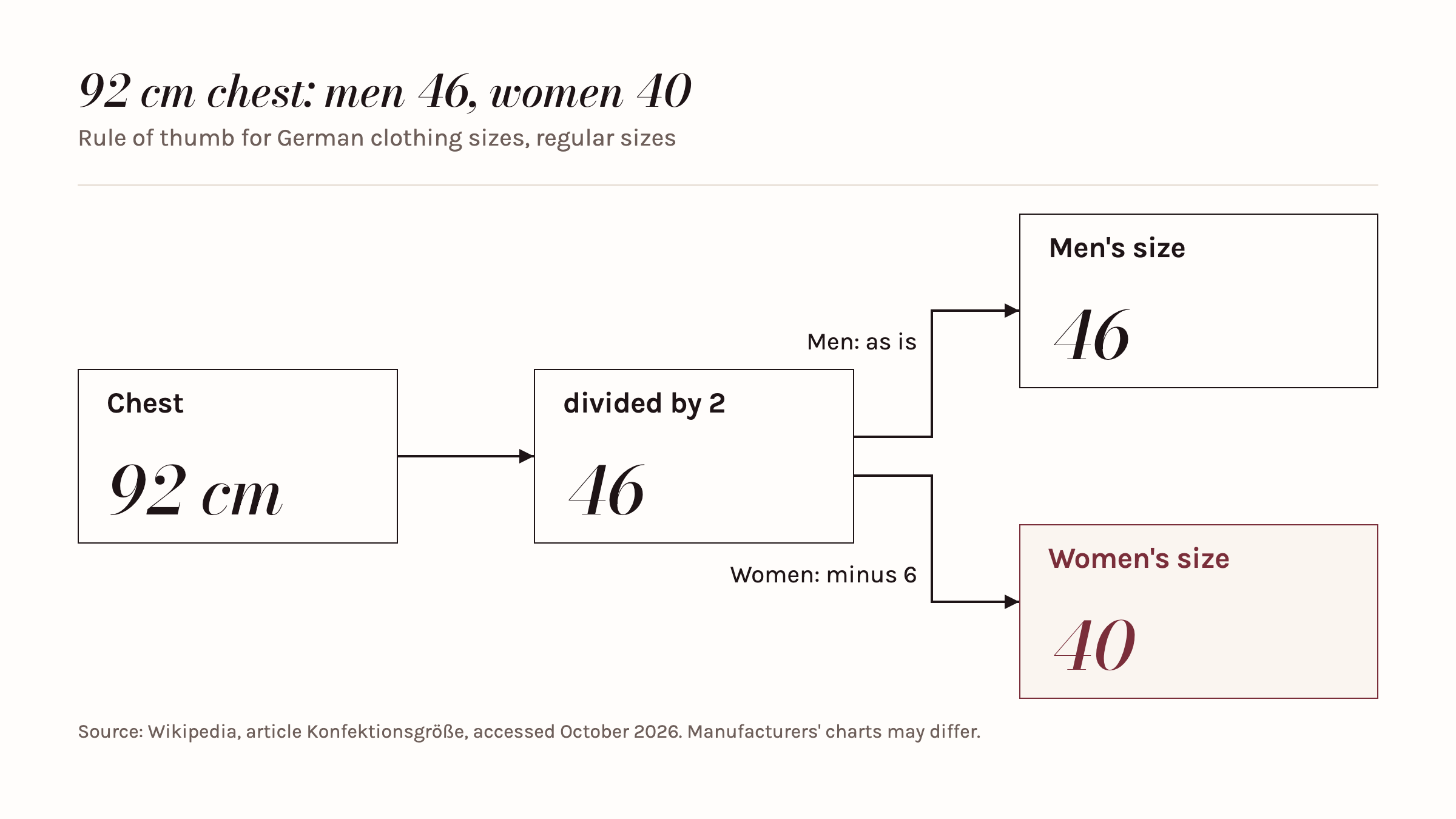
If you like doing the maths, here is the historical logic: the EU women's size was derived from half the chest circumference minus 6. With a chest circumference of 92 cm, that gives 92 divided by 2, minus 6 — in other words, size 40.[2]
What does 40 mean in other sizing systems?
In menswear, a German size 40 simply does not exist: standard sizes start at 44.[2]
Men still encounter the number 40 frequently, but in other systems. A British or American men's size 40 corresponds to German size 50 — the rule of thumb is German size minus 10.
| The label “40” | What it means |
|---|---|
| Women's EU 40 | Chest circumference 90 to 93 cm, internationally M or L |
| Men's UK/US 40 | corresponds to German men's size 50 |
| Men's shirt size 40 | collar circumference of 40 cm |
| Jeans W40 | waist width of around 101.6 cm |
For shirts, the number therefore refers to the collar circumference in centimetres, with shirt sizes running roughly from 39 to 46. For jeans, the number after the W stands for the waist width in inches. The same digit can thus mean a chest, collar or waist measurement, depending on the garment and the country in question.[1]
What size is 50 or 52 for men?
Men's sizes 50 and 52 sit at the centre of the standard sizes scale and, depending on the chart, correspond to the letter sizes M to XL. The body measurements are consistent across the charts; the letter assignments vary:[2]
| Size | Chest circumference (cm) | Waist width (cm) | Height (cm) | International |
|---|---|---|---|---|
| 50 | 98 to 101 | 86 to 89 | 174 to 179 | M or L |
| 52 | 102 to 105 | 90 to 94 | 177 to 182 | L or XL |
According to the conversion rule of German size minus 10, a 50 corresponds to a British and American size 40, and a 52 to a size 42.
Wikipedia classifies the 50 as M and the 52 as L, Manufactum lists both as L, and the chart from Bergzeit places the 50 at L and the 52 at XL.[2][1][3] All three readings exist because letter sizes are not standardised.
Clothing size chart: women's and men's sizes at a glance
The following tables summarise the common standard sizes with body measurements and international equivalents, as of October 2026. The body measurements follow the chart from German Wikipedia; the UK and US values for women come from the size.ly conversion.[2][4] All values are reference measurements, designed for women with a height of roughly 164 to 170 cm.
| EU women's | Chest (cm) | Waist (cm) | Hip (cm) | UK | US | FR | IT |
|---|---|---|---|---|---|---|---|
| 32 | 74 to 77 | 58 to 61 | 80 to 84 | 4 | 0 | 34 | 38 |
| 34 | 78 to 81 | 62 to 64 | 85 to 89 | 6 | 2 | 36 | 40 |
| 36 | 82 to 85 | 65 to 68 | 90 to 94 | 8 | 4 | 38 | 42 |
| 38 | 86 to 89 | 69 to 72 | 95 to 97 | 10 | 6 | 40 | 44 |
| 40 | 90 to 93 | 73 to 77 | 98 to 101 | 12 | 8 | 42 | 46 |
| 42 | 94 to 97 | 78 to 81 | 102 to 104 | 14 | 10 | 44 | 48 |
| 44 | 98 to 102 | 82 to 85 | 105 to 108 | 16 | 12 | 46 | 50 |
| 46 | 103 to 107 | 86 to 90 | 109 to 112 | 18 | 14 | 48 | 52 |
| 48 | 108 to 113 | 91 to 95 | 113 to 116 | 20 | 16 | 50 | 54 |
| EU men's | Chest circumference (cm) | Waist width (cm) | UK/US |
|---|---|---|---|
| 44 | 86 to 89 | 74 to 77 | 34 |
| 46 | 90 to 93 | 78 to 81 | 36 |
| 48 | 94 to 97 | 82 to 85 | 38 |
| 50 | 98 to 101 | 86 to 89 | 40 |
| 52 | 102 to 105 | 90 to 94 | 42 |
| 54 | 106 to 109 | 95 to 99 | 44 |
| 56 | 110 to 113 | 100 to 104 | 46 |
| 58 | 114 to 117 | 105 to 109 | 48 |
The most reliable approach remains the same as at the start: measure your chest circumference, waist circumference and hip measurement, plus waist width and inseam length for trousers, and compare these values against the clothing size chart of the respective manufacturer. This is especially worthwhile for your travel wardrobe, because a wrong size is hard to correct on the road.
Frequently asked questions
Which clothing size am I with a chest circumference of 90 to 93 cm?
For women, a chest circumference of 90 to 93 cm corresponds to clothing size 40 (UK 12, usually US 8, internationally M or L). For men, the same chest circumference corresponds to clothing size 46, because the men's system halves the chest circumference without subtracting 6.
What do W and L mean in jeans sizes?
W stands for Waist, the waist width, and L for Length, the inseam length. Both figures are measured in inches, with 1 inch equal to 2.54 cm. So W30 L32 means roughly 76 cm waist width and roughly 81 cm inseam length.
Which US size corresponds to German women's size 40?
The German women's size 40 usually corresponds to US size 8 and UK size 12; some retailer charts, such as Bergzeit's, list US 10. In France it corresponds to size 42, in Italy to 46.
Is men's size 50 M or L?
It depends on the chart: Wikipedia lists men's size 50 (chest circumference 98 to 101 cm) as M, while Manufactum and Bergzeit list it as L. Size 52 (102 to 105 cm) is L according to Wikipedia and Manufactum, but XL according to Bergzeit.
What size is W40 for men?
W40 denotes a waist width of 40 inches, i.e. roughly 102 cm. That corresponds approximately to German men's clothing size 56. The matching L figure (inseam length) should be chosen in addition to your height.
Do clothing sizes run the same for every manufacturer?
No. There is no internationally binding standard for clothing sizes, and manufacturers cut their garments based on different measurement data. General charts serve as orientation; the reliable reference is the clothing size chart of the respective manufacturer.
How do I convert German men's sizes to UK and US sizes?
For men, the rule of thumb is: German size minus 10 gives the UK and US size. So German size 50 corresponds to UK/US 40, and size 52 corresponds to UK/US 42. For women the conversion is not linear — the chart helps here.